Admin July 1, 2026
Smart Factories in Textile Manufacturing
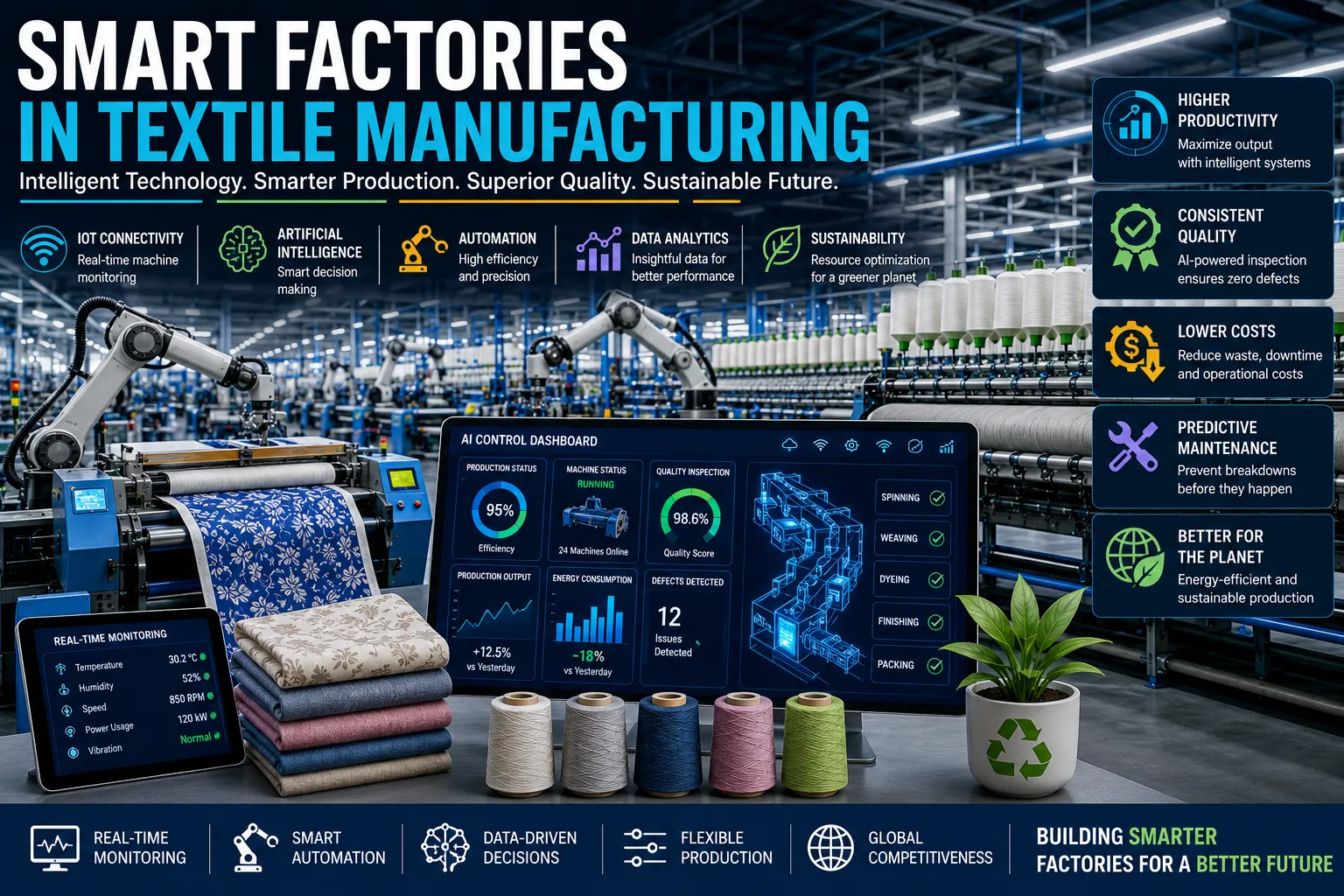
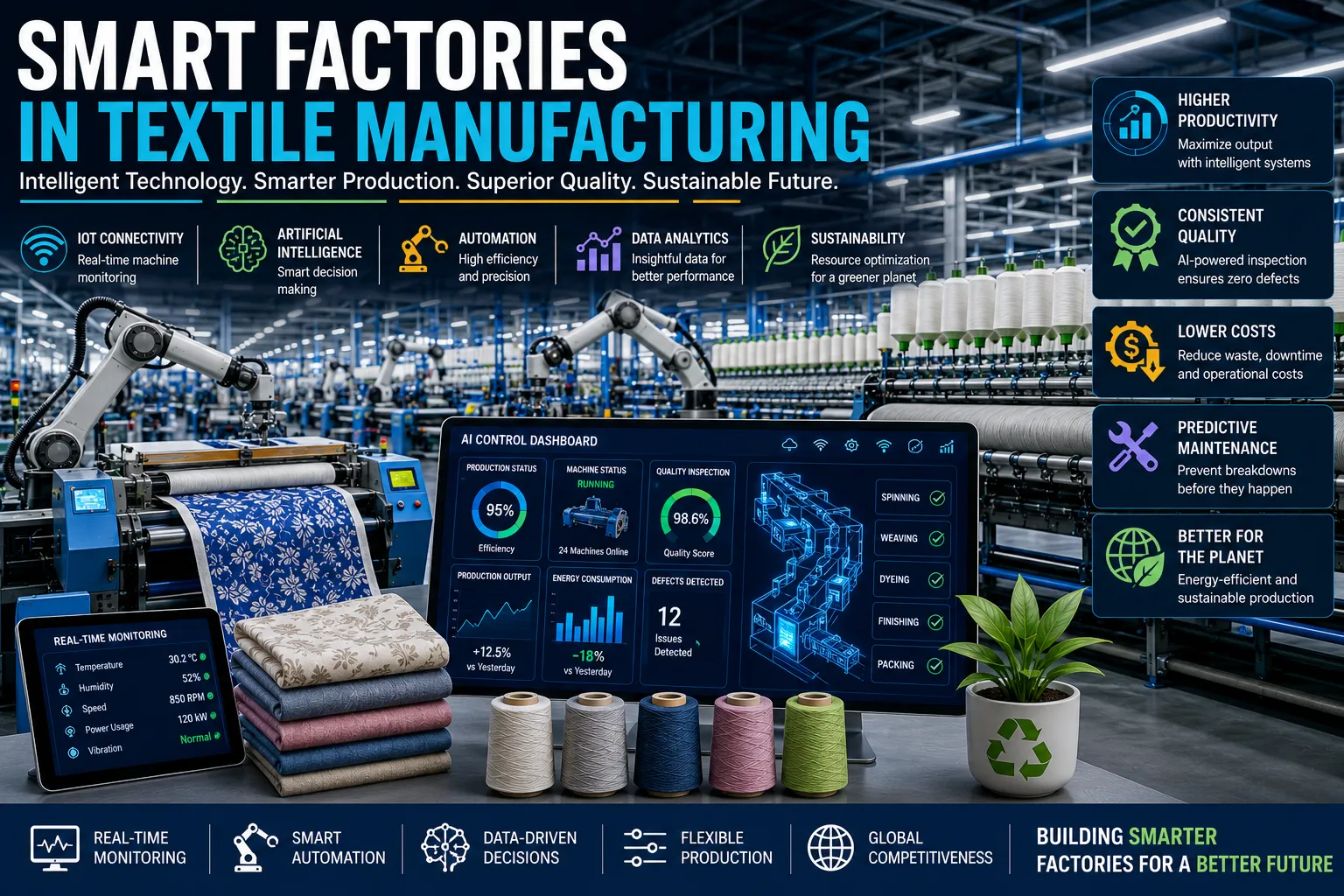
Smart factories are changing the future of textile manufacturing by combining advanced technologies with intelligent decision making. Traditional textile factories often depend on manual monitoring, paper based reporting, and reactive maintenance, which can slow production and increase operational costs. As customer expectations continue to grow and global competition becomes stronger, textile manufacturers need faster, smarter, and more efficient production systems. Smart factories solve these challenges by connecting machines, sensors, software, Artificial Intelligence, and automation into one intelligent manufacturing environment. Every stage of production generates valuable data that is analyzed instantly, allowing manufacturers to improve productivity, reduce waste, maintain consistent quality, and respond quickly to changing market demands. Instead of making decisions based only on experience, factory managers can use real time information to optimize operations and improve overall performance. Smart factories are becoming an important part of the digital transformation of the textile industry and are helping manufacturers build a more competitive and sustainable future.
What Is a Smart Factory
A smart factory is a modern manufacturing facility where machines, production equipment, sensors, software platforms, and Artificial Intelligence work together to improve every stage of textile production. These technologies communicate continuously, collect operational data, and automatically recommend or perform actions that improve efficiency and product quality.
Unlike traditional factories where production decisions often rely on manual observation, smart factories use connected systems to monitor production every second. This allows managers to identify problems immediately, improve machine performance, and make informed decisions based on accurate information instead of assumptions.
The result is a factory that becomes more efficient, more reliable, and more responsive over time.
Why Smart Factories Matter in Textile Manufacturing
The textile industry operates in a highly competitive environment where manufacturers must produce high quality products while controlling costs and meeting strict delivery schedules. Even small production delays or quality problems can affect customer satisfaction and profitability.
Smart factories provide manufacturers with complete visibility across the production process. Managers can monitor spinning, weaving, knitting, dyeing, finishing, stitching, packaging, and shipping from a single digital platform.
This connected approach improves coordination between departments, reduces production delays, increases machine utilization, and allows businesses to respond quickly to customer requirements.
Artificial Intelligence Improves Manufacturing Decisions
Artificial Intelligence is one of the most valuable technologies inside a smart textile factory. AI continuously analyzes production data, machine performance, quality inspection results, customer demand, and maintenance records to identify opportunities for improvement.
Instead of waiting until problems become serious, AI detects unusual production patterns and recommends corrective actions immediately. This allows manufacturers to improve efficiency while reducing waste and production interruptions.
AI also helps managers forecast demand, optimize production schedules, improve inventory management, and maintain consistent product quality across multiple production lines.
Internet of Things Connects Every Machine
The Internet of Things allows production equipment to communicate with one another through connected sensors and digital networks.
Sensors installed on textile machinery collect information such as temperature, vibration, operating speed, humidity, energy consumption, and machine performance. This information is transmitted continuously to intelligent monitoring systems where Artificial Intelligence analyzes production conditions in real time.
By understanding exactly how machines are performing, manufacturers can improve efficiency while preventing unexpected equipment failures.
Predictive Maintenance Reduces Downtime
Unexpected machine breakdowns are one of the largest causes of production delays in textile manufacturing.
Smart factories use predictive maintenance powered by Artificial Intelligence to monitor machine health continuously. Instead of repairing equipment only after failure occurs, AI predicts maintenance requirements before serious problems develop.
Maintenance teams receive early alerts that allow repairs to be completed during scheduled maintenance periods. This reduces downtime, extends equipment life, lowers repair costs, and keeps production running smoothly.
Real Time Quality Control
Maintaining consistent quality is essential for every textile manufacturer.
Smart factories combine Artificial Intelligence with computer vision to inspect fabrics throughout production. High resolution cameras examine every meter of fabric and identify defects such as broken yarns, weaving faults, stains, color inconsistencies, printing errors, and stitching defects.
When defects are detected, production teams receive immediate notifications so problems can be corrected before defective products continue through additional manufacturing stages.
This real time inspection process improves customer satisfaction while reducing material waste.
Better Production Planning
Production planning becomes significantly more efficient inside a smart factory.
Artificial Intelligence analyzes customer orders, raw material availability, machine capacity, employee schedules, and production priorities before creating optimized manufacturing plans.
This allows manufacturers to maximize equipment utilization while reducing production delays and unnecessary overtime.
Accurate planning also improves delivery performance and strengthens customer relationships.
Energy Efficient Manufacturing
Energy efficiency is becoming increasingly important for textile manufacturers because rising energy costs directly affect profitability.
Smart factories monitor electricity usage across every production department. Artificial Intelligence identifies inefficient equipment, recommends process improvements, and optimizes machine operation to reduce unnecessary energy consumption.
Lower energy usage not only reduces production costs but also supports environmental sustainability by reducing carbon emissions.
Supporting Home Textile Manufacturing
Smart factory technology benefits manufacturers producing a wide range of home textile products.
These include:
-
Bed Sheets
-
Pillowcases
-
Duvet Covers
-
Comforters
-
Towels
-
Curtains
-
Cushion Covers
-
Table Linen
Intelligent production systems help ensure these products meet consistent quality standards while improving manufacturing efficiency.
Sustainable Textile Manufacturing
Smart factories support sustainable manufacturing by reducing waste, improving resource utilization, optimizing water consumption, lowering chemical usage, and reducing unnecessary production.
Artificial Intelligence also helps manufacturers minimize rejected products by detecting quality issues earlier in the manufacturing process.
Organizations such as Textile Exchange encourage manufacturers to adopt digital technologies that improve operational efficiency while supporting environmental responsibility.
Supply Chain Optimization
A smart factory extends beyond the production floor.
Artificial Intelligence analyzes supplier performance, raw material availability, customer demand, transportation schedules, and inventory levels to improve supply chain efficiency.
Better coordination reduces delays, lowers inventory costs, improves purchasing decisions, and ensures products reach customers more quickly.
This integrated approach strengthens the entire textile business.
Challenges of Building a Smart Factory
Although smart factories offer many advantages, implementation requires careful planning.
Manufacturers may need to invest in connected equipment, software systems, employee training, cybersecurity, and digital infrastructure.
Smaller manufacturers often begin with one production area before expanding smart technologies throughout the factory.
As technology becomes more affordable, adoption is expected to increase rapidly across the textile industry.
The Future of Smart Textile Factories
The future of textile manufacturing will become even more intelligent as Artificial Intelligence, robotics, cloud computing, digital twins, and advanced analytics continue to evolve.
Future smart factories may automatically adjust production schedules, optimize machine performance, predict customer demand, reduce environmental impact, and coordinate global supply chains with minimal human intervention.
Manufacturers adopting these technologies early will improve competitiveness while delivering higher quality products more efficiently.
Conclusion
Smart factories are transforming textile manufacturing by combining Artificial Intelligence, connected machines, automation, and real time data into one intelligent production system. These advanced manufacturing facilities improve quality, reduce waste, increase productivity, optimize energy usage, and strengthen supply chain performance.
Rather than replacing skilled textile professionals, smart factories provide powerful digital tools that help manufacturers make better decisions and operate more efficiently. As the textile industry continues its digital transformation, smart factories will become essential for businesses seeking sustainable growth and long term success.
Frequently Asked Questions
1. What is a smart factory in textile manufacturing?
A smart factory uses Artificial Intelligence, connected machines, sensors, and automation to improve production efficiency and product quality.
2. How does Artificial Intelligence improve smart factories?
AI analyzes production data, predicts machine failures, improves quality control, and optimizes manufacturing decisions.
3. What technologies are used in smart textile factories?
Artificial Intelligence, Internet of Things, computer vision, robotics, cloud computing, and predictive analytics.
4. Can smart factories reduce production costs?
Yes. They improve efficiency, reduce downtime, minimize waste, and optimize energy consumption.
5. How do smart factories improve quality?
Real time inspection systems detect defects immediately, allowing manufacturers to correct problems before production continues.
6. Are smart factories environmentally friendly?
Yes. They reduce waste, save energy, optimize water usage, and improve sustainable manufacturing practices.
7. Which textile products benefit from smart factories?
Bed sheets, towels, curtains, duvet covers, pillowcases, comforters, upholstery fabrics, and table linen.
8. Do smart factories replace workers?
No. They support workers by automating repetitive tasks while people focus on supervision, maintenance, and decision making.
9. What challenges do manufacturers face when building smart factories?
Investment costs, employee training, cybersecurity, and system integration are the most common challenges.
10. What is the future of smart factories?
Future smart factories will become more autonomous, more connected, and more efficient through advanced Artificial Intelligence and digital technologies.
Recent Posts
Categories
- Home Textiles (11)
- AI & Textile Innovation (10)
- AI + Textile Manufacturing (10)
- AI + Sustainability (5)
- AI + Home Textiles (4)
- AI + Supply Chain (5)
- AI + Future Technology (7)