Admin July 24, 2026
Artificial Intelligence and Industry 4.0 in Textiles
The textile industry is experiencing a major transformation as Artificial Intelligence and Industry 4.0 technologies reshape traditional manufacturing processes. For many years, textile production depended on manual labor, conventional machinery, historical data, and human decision making. Although these methods helped build the global textile industry, modern market conditions require manufacturers to produce better quality products faster, reduce costs, minimize waste, and respond quickly to changing customer demands. Industry 4.0 introduces a new approach to manufacturing by connecting machines, people, software, sensors, and data into intelligent production systems. Artificial Intelligence plays a central role in this transformation by analyzing large amounts of information, identifying patterns, predicting future events, and supporting automated decision making. Together, Artificial Intelligence and Industry 4.0 are helping textile manufacturers create smarter factories that can monitor production in real time, predict machine problems, improve quality, optimize inventory, reduce energy consumption, and respond more efficiently to customer requirements. This technological transformation is not only improving productivity but is also creating new opportunities for sustainable and innovative textile manufacturing.
What Is Industry 4.0 in Textile Manufacturing
Industry 4.0 represents the fourth major stage of industrial development and focuses on intelligent, connected, and highly automated manufacturing systems.
In the textile industry, Industry 4.0 connects machines, production lines, warehouse systems, employees, suppliers, and customers through digital technologies.
Sensors installed on machines collect information about production speed, temperature, energy consumption, machine performance, and product quality.
This information is then transferred to digital platforms where Artificial Intelligence and advanced analytics can analyze it.
The result is a connected manufacturing environment where businesses can understand what is happening inside their factories and make faster and more informed decisions.
The Role of Artificial Intelligence in Industry 4.0
Artificial Intelligence is one of the most important technologies supporting Industry 4.0.
AI systems can process enormous amounts of production data and identify patterns that may not be visible to human employees.
In textile manufacturing, AI can analyze information from machines, production systems, warehouses, customer orders, suppliers, and quality control operations.
These insights help manufacturers predict future demand, identify possible equipment failures, detect quality problems, optimize production schedules, and improve resource utilization.
Artificial Intelligence therefore acts as the intelligent decision making layer within the Industry 4.0 manufacturing environment.
Smart Textile Factories
One of the most important outcomes of Industry 4.0 is the development of smart textile factories.
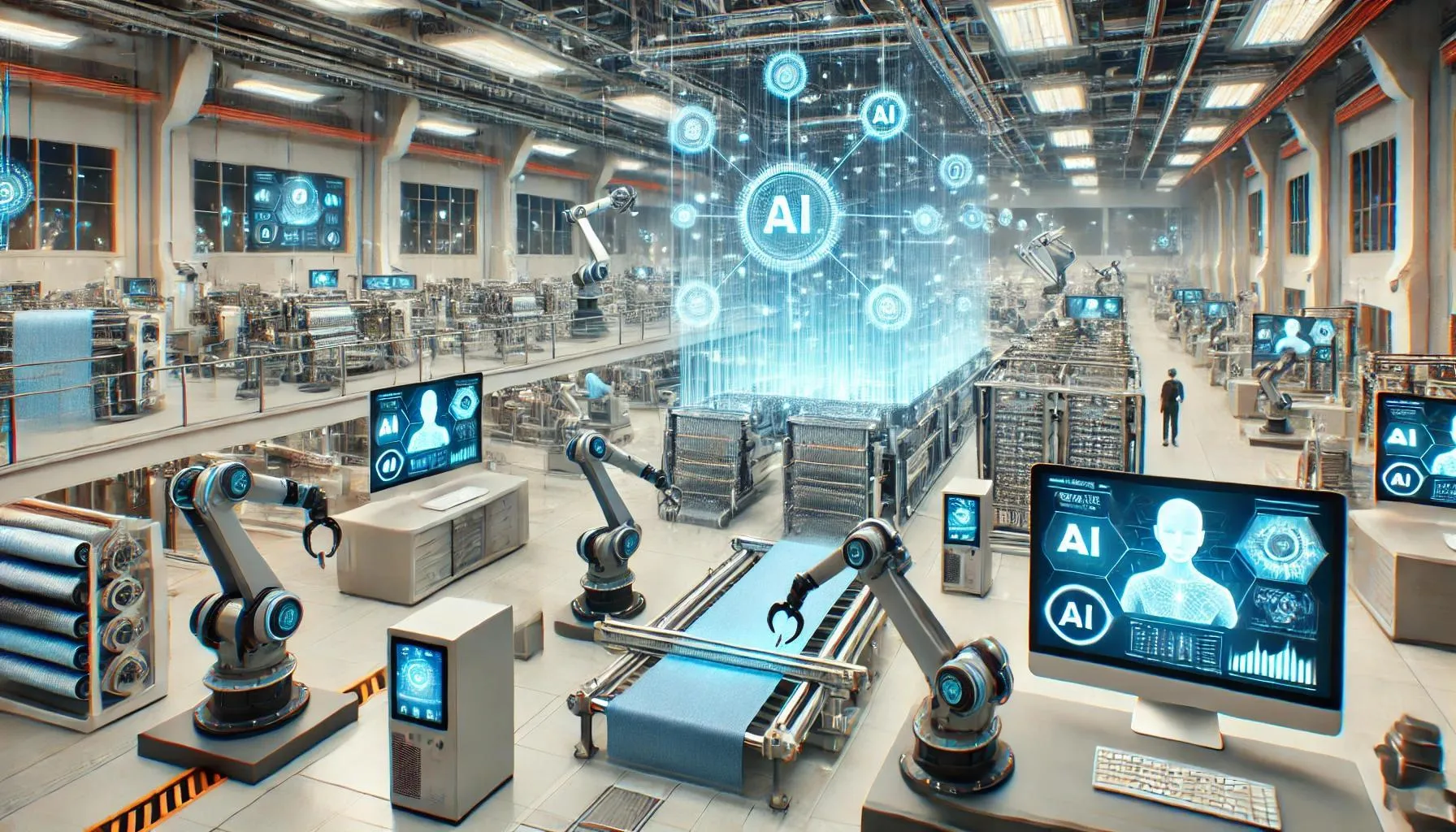
A smart factory uses connected machines, sensors, Artificial Intelligence, robotics, automation, and digital software to improve production operations.
Machines can communicate with each other and share information about their performance.
Factory managers can monitor production through digital dashboards and receive real time information about production output, machine health, energy consumption, and quality performance.
AI systems can analyze this information and recommend improvements.
This creates a more efficient and transparent manufacturing environment.
Predictive Maintenance
Machine breakdowns can create major challenges for textile manufacturers.
Unexpected equipment failures can stop production, delay customer orders, increase repair costs, and reduce factory productivity.
Industry 4.0 technologies allow manufacturers to install sensors that continuously monitor machine performance.
Artificial Intelligence analyzes this information to identify unusual patterns that may indicate future equipment problems.
Maintenance teams can receive early warnings and repair machines before major failures occur.
Predictive maintenance reduces downtime and improves the overall reliability of textile production.
Intelligent Quality Control
Quality control is another area where Artificial Intelligence and Industry 4.0 provide significant advantages.
Traditional quality inspection often depends on manual inspection, which can be affected by human fatigue and differences in judgment.
Modern textile factories use Artificial Intelligence, computer vision, and automated inspection systems to examine fabrics and finished products.
These systems can identify holes, stains, broken threads, color variations, pattern problems, and other defects.
Early detection helps manufacturers prevent large quantities of defective products from being produced.
This improves product quality while reducing material waste.
AI and Textile Production Planning
Production planning becomes more accurate when manufacturers use Artificial Intelligence and Industry 4.0 technologies.
AI systems analyze customer orders, historical sales, raw material availability, machine capacity, workforce requirements, and delivery schedules.
Based on this information, manufacturers can create more efficient production plans.
AI can also identify potential production bottlenecks before they affect operations.
Better planning allows textile companies to complete orders on time while improving machine utilization and reducing unnecessary production costs.
AI Powered Inventory Management
Inventory management is an important part of successful textile manufacturing.
Factories need to maintain sufficient quantities of fabrics, yarns, dyes, accessories, packaging materials, and finished products.
Too much inventory increases storage costs, while too little inventory can create production delays.
Artificial Intelligence analyzes historical demand, customer orders, seasonal trends, supplier performance, and production requirements to predict future inventory needs.
Industry 4.0 systems can also monitor inventory levels in real time.
This allows manufacturers to maintain balanced inventory and avoid unnecessary shortages or excess stock.
Digital Supply Chain Management
Industry 4.0 is transforming textile supply chains by connecting manufacturers with suppliers, warehouses, logistics companies, and customers.
Artificial Intelligence analyzes information across the supply chain and helps identify potential risks.
For example, AI may identify that a supplier is experiencing delivery delays or that a transportation route could create a shipment problem.
Manufacturers can respond before these issues affect production.
This creates a more flexible and resilient supply chain.
Robotics and Automation
Robotics is another important part of Industry 4.0 in textile manufacturing.
Automated machines and robotic systems can perform repetitive tasks with high levels of speed and accuracy.
Robots may assist with material handling, fabric cutting, packaging, warehouse operations, and other manufacturing activities.
Artificial Intelligence allows robotic systems to become more intelligent by helping them recognize objects, respond to changing conditions, and make decisions.
The combination of robotics and AI is helping factories improve productivity while reducing repetitive manual work.
Supporting Home Textile Manufacturing
Artificial Intelligence and Industry 4.0 technologies can improve the manufacturing of many home textile products.
These include:
-
Bed Sheets
-
Pillowcases
-
Duvet Covers
-
Comforters
-
Blankets
-
Towels
-
Curtains
-
Cushion Covers
-
Mattress Protectors
-
Table Linen
Smart production systems can improve quality control, inventory management, demand forecasting, machine maintenance, and production planning for these products.
Improving Energy Efficiency
Energy consumption is an important concern for textile manufacturers.
Industry 4.0 systems can monitor energy consumption across machines and production lines.
Artificial Intelligence analyzes this information to identify inefficient equipment and unnecessary energy usage.
Manufacturers can adjust machine schedules and production processes to reduce energy consumption.
This helps lower operating costs while supporting environmentally responsible manufacturing.
Reducing Textile Waste
Textile waste can occur because of production defects, excess inventory, inaccurate forecasting, and inefficient use of raw materials.
Artificial Intelligence helps manufacturers predict demand more accurately and reduce unnecessary production.
Computer vision detects fabric defects at an early stage, while smart inventory systems prevent excessive stock.
Industry 4.0 technologies therefore help manufacturers use resources more efficiently and reduce waste.
Supporting Sustainable Textile Manufacturing
Sustainability is becoming increasingly important across the global textile industry.
Artificial Intelligence and Industry 4.0 can support sustainable manufacturing by improving resource utilization, reducing waste, optimizing energy consumption, and improving production efficiency.
Manufacturers can use digital systems to monitor water usage, energy consumption, material waste, and production performance.
This information helps companies identify areas where resources can be conserved.
Organizations such as Textile Exchange promote responsible textile production and encourage the industry to improve environmental performance and resource efficiency.
Challenges of Industry 4.0 Adoption
Although Industry 4.0 offers significant benefits, textile manufacturers may face several challenges when adopting these technologies.
The initial investment in smart machinery, sensors, software, Artificial Intelligence systems, and digital infrastructure can be significant.
Companies may also need to train employees to work with new technologies.
Data security and cybersecurity are important concerns because connected factories generate and share large amounts of information.
Manufacturers must also integrate new digital systems with existing equipment.
Despite these challenges, the long term benefits of Industry 4.0 can make digital transformation a valuable investment.
The Future of Artificial Intelligence and Industry 4.0 in Textiles
The future of textile manufacturing will become increasingly connected, intelligent, and automated.
Artificial Intelligence will work together with robotics, smart sensors, computer vision, digital twins, cloud computing, and advanced analytics.
Factories will be able to monitor their operations continuously and predict problems before they occur.
Production systems may automatically adjust according to customer demand, material availability, machine performance, and environmental conditions.
Future textile factories will be more flexible and capable of producing personalized products with greater efficiency.
Why Textile Manufacturers Should Invest in Industry 4.0
The adoption of Artificial Intelligence and Industry 4.0 provides textile manufacturers with significant competitive advantages.
Companies can improve productivity, reduce costs, increase product quality, minimize waste, improve inventory management, strengthen supply chains, and support sustainability.
Digital transformation also allows manufacturers to respond more quickly to changing customer expectations and market conditions.
Businesses that invest in intelligent manufacturing technologies today will be better prepared for future competition.
Conclusion
Artificial Intelligence and Industry 4.0 are transforming the textile industry by creating smarter, more connected, and more efficient manufacturing environments. From predictive maintenance and automated quality control to intelligent inventory management and digital supply chain operations, these technologies are improving almost every stage of textile production.
The combination of Artificial Intelligence, smart machines, sensors, robotics, computer vision, and advanced data analytics is helping textile manufacturers reduce costs, improve quality, minimize waste, and support sustainable production. As technology continues to develop, Industry 4.0 will become an increasingly important part of the global textile industry. Manufacturers that embrace this transformation will be better positioned to meet future customer expectations, improve operational performance, and compete successfully in the rapidly changing global market.
Frequently Asked Questions
1. What is Industry 4.0 in textile manufacturing?
Industry 4.0 is a modern manufacturing approach that connects machines, software, sensors, people, and data to create intelligent and automated production systems.
2. What role does Artificial Intelligence play in Industry 4.0?
Artificial Intelligence analyzes manufacturing data, predicts future events, identifies problems, and supports intelligent decision making.
3. How does Industry 4.0 improve textile quality?
It uses AI, computer vision, sensors, and automated inspection systems to identify defects and maintain consistent product quality.
4. Can AI reduce textile manufacturing costs?
Yes. AI can reduce costs by improving production planning, preventing machine failures, reducing waste, optimizing inventory, and improving energy efficiency.
5. How does Industry 4.0 support sustainability?
It helps manufacturers reduce waste, monitor energy consumption, improve resource utilization, and optimize production processes.
6. Which textile products benefit from Industry 4.0?
Bed sheets, pillowcases, duvet covers, comforters, blankets, towels, curtains, cushion covers, mattress protectors, and table linen.
7. What technologies are used in Industry 4.0?
Artificial Intelligence, machine learning, robotics, sensors, computer vision, Internet of Things devices, digital twins, cloud computing, and advanced data analytics.
8. What are the challenges of adopting Industry 4.0?
High initial investment, employee training, system integration, data security, cybersecurity, and the need for reliable digital infrastructure are common challenges.
9. Can Industry 4.0 improve textile supply chains?
Yes. Connected systems and Artificial Intelligence help manufacturers monitor suppliers, predict risks, optimize inventory, and improve transportation planning.
10. What is the future of AI and Industry 4.0 in textiles?
The future will involve highly connected factories where Artificial Intelligence, robotics, smart machines, and digital systems work together to create efficient, flexible, and sustainable textile manufacturing.
Recent Posts
Categories
- Home Textiles (11)
- AI & Textile Innovation (10)
- AI + Textile Manufacturing (10)
- AI + Sustainability (5)
- AI + Home Textiles (4)
- AI + Supply Chain (5)
- AI + Future Technology (7)