Admin July 1, 2026
Machine Learning in the Textile Industry: Applications, Benefits, and Future Opportunities
Discover how machine learning is transforming the textile industry through intelligent manufacturing, quality control, demand forecasting, predictive maintenance, and AI driven innovation.
Machine Learning (ML), a branch of Artificial Intelligence (AI), is becoming one of the most important technologies shaping the future of the textile industry. As global competition increases and customer expectations continue to evolve, textile manufacturers are under constant pressure to improve quality, reduce production costs, accelerate product development, and operate more sustainably. Traditional manufacturing methods often rely on manual decision-making and historical experience, but today's factories generate enormous amounts of production data that can be used to make smarter decisions. Machine learning enables businesses to analyze this data automatically, recognize hidden patterns, predict future outcomes, and continuously improve manufacturing processes. Rather than replacing experienced textile professionals, machine learning supports them by providing accurate insights that help increase productivity, reduce waste, and deliver better products. From spinning and weaving to dyeing, printing, quality inspection, inventory management, and customer demand forecasting, machine learning is becoming an essential technology throughout the modern textile supply chain.
What Is Machine Learning?
Machine learning is a type of Artificial Intelligence that allows computer systems to learn from data without being explicitly programmed for every task. Instead of following fixed instructions, machine learning algorithms analyze historical information, identify relationships, and improve their performance as they receive more data.
In textile manufacturing, machine learning processes thousands of production records, machine readings, inspection reports, customer orders, and market trends. By learning from this information, it helps manufacturers make faster and more accurate decisions while continuously improving production efficiency.
Unlike traditional software, machine learning becomes smarter over time because every production cycle provides new data that improves future predictions.
Why Machine Learning Matters in Textile Manufacturing
Modern textile factories operate with hundreds of machines producing thousands of meters of fabric every day. Managing such complex operations manually is increasingly difficult because every stage of production generates valuable information.
Machine learning helps manufacturers transform raw production data into meaningful business intelligence. It identifies production bottlenecks, predicts equipment failures, detects quality issues, forecasts customer demand, and recommends improvements before problems become expensive.
By making decisions based on real time data instead of assumptions, manufacturers improve operational efficiency while reducing manufacturing risks.
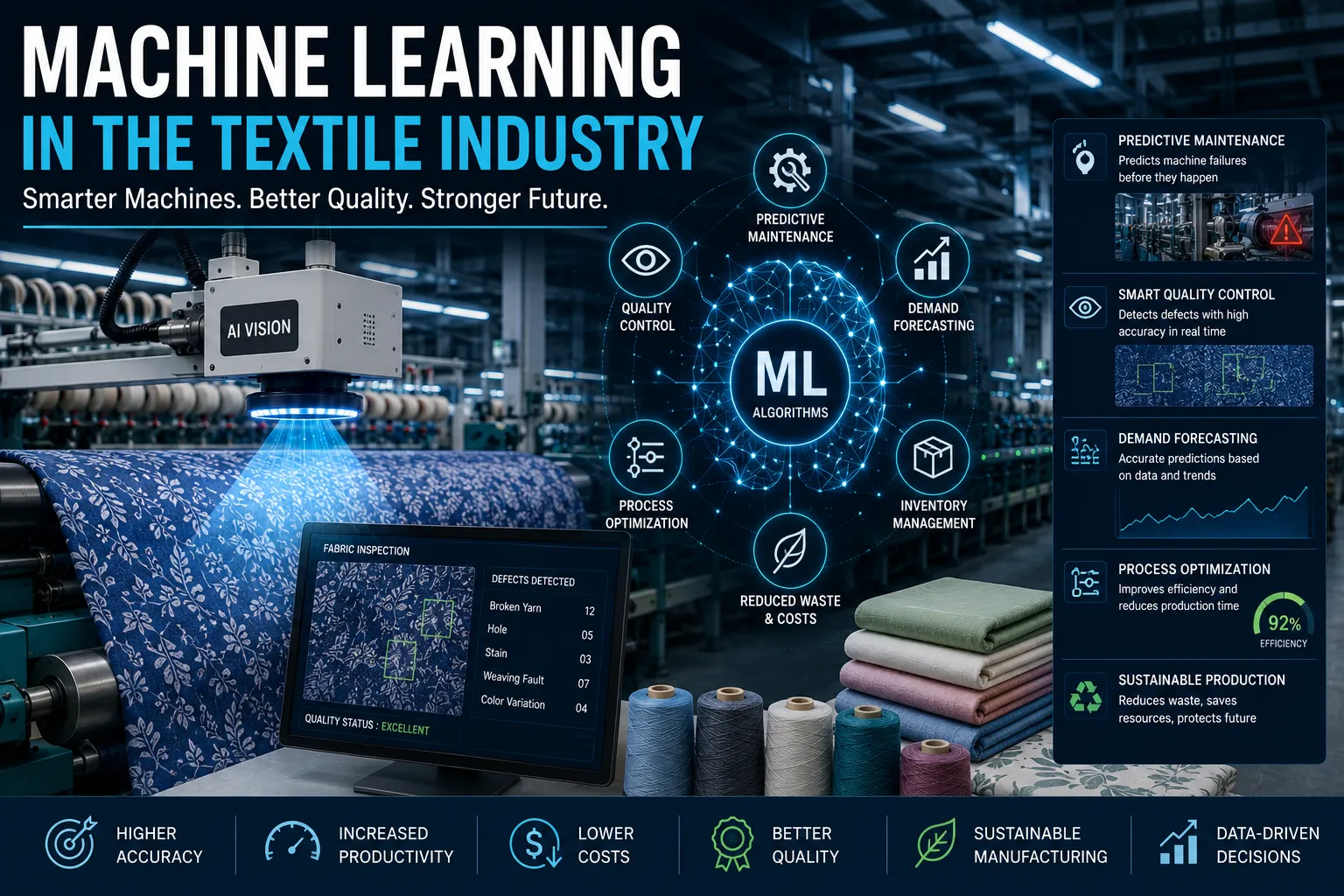
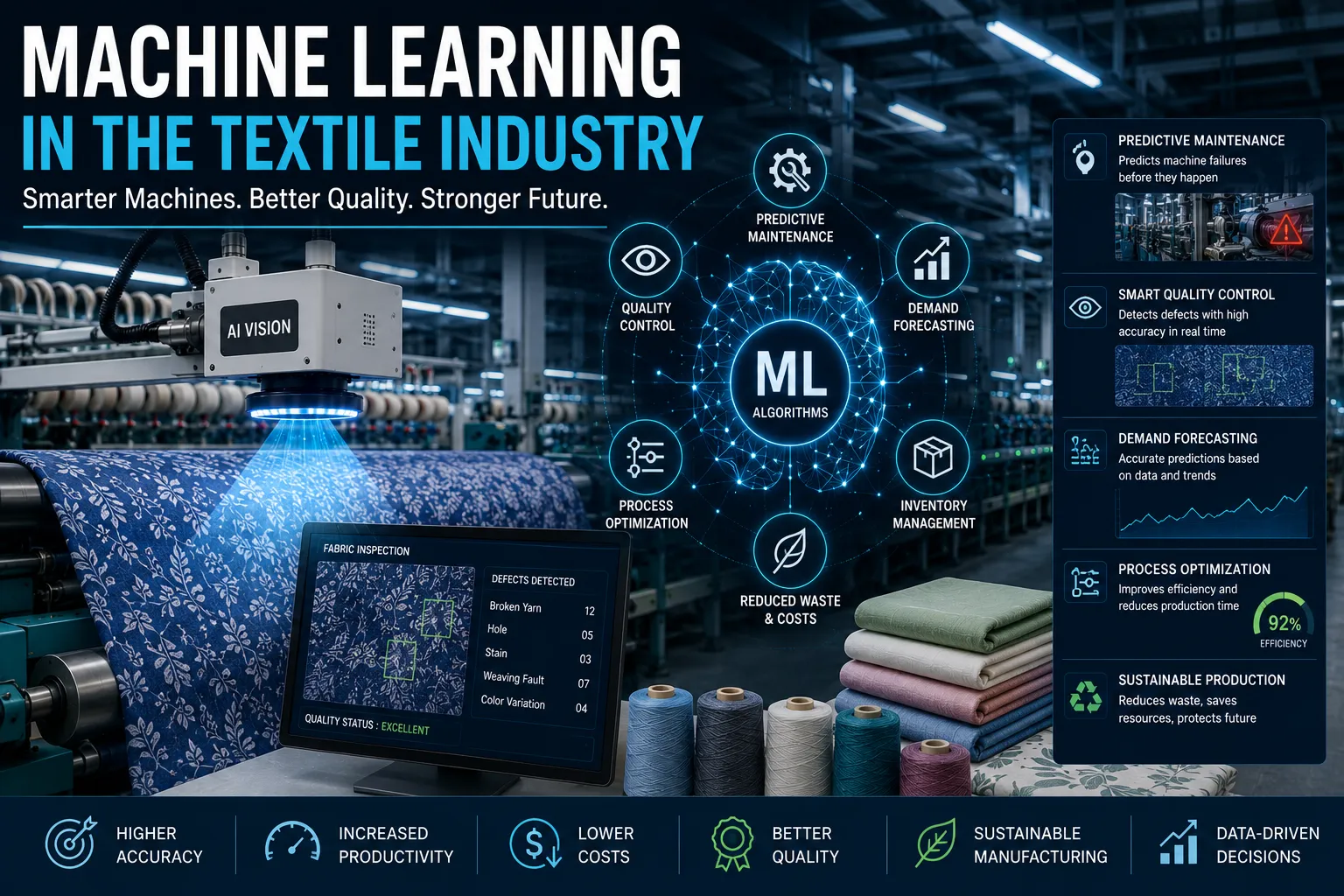
Machine Learning Improves Fabric Quality Inspection
Quality control is one of the most valuable applications of machine learning in the textile industry.
Modern inspection systems use industrial cameras combined with computer vision and deep learning algorithms to inspect fabrics automatically during production. These systems recognize defects such as broken yarns, weaving faults, holes, stains, color inconsistencies, printing errors, and stitching defects with remarkable accuracy.
As the system analyzes more production data, it continuously improves its ability to recognize both common and uncommon defects. This results in more consistent quality inspection than traditional manual methods while significantly reducing rejected products.
Manufacturers producing bed sheets, towels, duvet covers, curtains, and other home textile products benefit greatly from this intelligent inspection technology.
Predictive Maintenance Keeps Machines Running
Unexpected equipment failures can interrupt production, delay deliveries, and increase maintenance costs.
Machine learning continuously monitors machine temperature, vibration, operating speed, power consumption, and production performance. When unusual patterns appear, the system predicts potential failures before they occur.
Maintenance teams receive early warnings that allow them to repair equipment during scheduled maintenance instead of waiting for unexpected breakdowns.
This predictive maintenance approach reduces downtime, extends machine lifespan, lowers repair costs, and improves factory productivity.
Smarter Demand Forecasting
Consumer preferences change quickly within the home textile industry. Seasonal demand, interior design trends, and global economic conditions all influence purchasing decisions.
Machine learning analyzes historical sales, online searches, retailer orders, seasonal buying patterns, and customer behavior to forecast future demand with greater accuracy.
Instead of producing excessive inventory based on estimates, manufacturers can align production with expected market demand.
This improves inventory management, reduces storage costs, and minimizes overproduction.
Machine Learning Supports Textile Design
Textile designers increasingly use machine learning to better understand customer preferences before creating new collections.
Machine learning analyzes color trends, purchasing behavior, social media engagement, design inspiration, and historical product performance to recommend popular themes and styles.
Rather than replacing creativity, these insights help designers create products that better reflect changing consumer preferences.
This technology supports the development of bed linen, towels, curtains, upholstery fabrics, hotel textiles, and decorative home textile collections.
Inventory Optimization
Managing inventory efficiently is essential for profitable textile manufacturing.
Machine learning monitors stock levels, raw material availability, customer demand, supplier performance, and production schedules simultaneously.
Using predictive analysis, the system recommends when materials should be ordered, identifies slow-moving inventory, and prevents unnecessary stock accumulation.
This reduces warehousing costs while improving customer order fulfillment.
Sustainable Manufacturing Through Machine Learning
Sustainability has become one of the industry's highest priorities.
Machine learning contributes to environmentally responsible manufacturing by optimizing production planning, reducing energy consumption, minimizing water usage, improving chemical utilization, and reducing fabric waste.
Because production becomes more efficient, manufacturers consume fewer resources while producing higher quality products.
Organizations such as Textile Exchange continue encouraging technology that supports responsible manufacturing and sustainable supply chains.
Better Supply Chain Management
Global textile supply chains involve raw material suppliers, manufacturers, logistics providers, retailers, and customers across multiple countries.
Machine learning analyzes shipping performance, supplier reliability, production capacity, customer demand, and transportation conditions to optimize supply chain operations.
Businesses gain greater visibility into potential disruptions while improving delivery reliability and customer satisfaction.
Challenges of Machine Learning Implementation
Although machine learning offers significant advantages, successful implementation requires planning and investment.
Manufacturers often face challenges including collecting high quality production data, integrating AI with existing machinery, training employees, protecting sensitive business information, and maintaining reliable digital infrastructure.
Small and medium sized businesses may begin by implementing machine learning in quality inspection or inventory management before expanding into additional applications.
The Future of Machine Learning in Textiles
Machine learning will continue playing an increasingly important role as textile manufacturing becomes more digital.
Future developments are expected to include autonomous production planning, self learning quality inspection systems, digital twin technology, AI-assisted robotic manufacturing, predictive sustainability monitoring, and fully connected smart factories.
Manufacturers that adopt these technologies early will be better prepared to compete in global markets while meeting growing customer expectations for quality, sustainability, and innovation.
Why Textile Manufacturers Should Invest in Machine Learning
Companies investing in machine learning gain more than automation they gain intelligent decision-making.
Machine learning helps manufacturers:
-
Improve product quality
-
Reduce operational costs
-
Predict customer demand
-
Optimize inventory
-
Increase manufacturing efficiency
-
Support sustainability
-
Strengthen global competitiveness
-
Launch products faster
-
Reduce production waste
-
Improve customer satisfaction
These long term advantages make machine learning one of the most valuable investments for modern textile businesses.
Conclusion
Machine learning is transforming the textile industry by turning production data into valuable business intelligence. Through intelligent quality inspection, predictive maintenance, demand forecasting, inventory optimization, and sustainable manufacturing, machine learning enables textile companies to produce higher-quality products while reducing costs and improving efficiency. Rather than replacing human expertise, machine learning empowers textile professionals with smarter tools that support better decision making. As the industry continues its digital transformation, manufacturers that combine skilled professionals with machine learning technology will be best positioned for long term success in the global textile market.
Frequently Asked Questions
1. What is machine learning in the textile industry?
Machine learning uses AI algorithms to analyze textile production data, improve decision-making, and optimize manufacturing processes.
2. How does machine learning improve textile quality?
It detects fabric defects automatically, improves inspection accuracy, and helps maintain consistent product quality.
3. Can machine learning predict customer demand?
Yes. It analyzes historical sales, market trends, and customer behavior to forecast future demand.
4. Is machine learning useful for home textile manufacturers?
Yes. It supports the production of bed sheets, towels, curtains, duvet covers, and other home textile products.
5. How does machine learning reduce production costs?
It minimizes waste, improves machine efficiency, reduces downtime, and optimizes inventory.
6. Does machine learning support sustainability?
Yes. It helps reduce energy consumption, water usage, and material waste while improving production efficiency.
7. What industries use machine learning in textiles?
Home textiles, fashion, automotive textiles, healthcare textiles, hospitality textiles, and industrial fabrics.
8. Is machine learning replacing textile workers?
No. It automates repetitive tasks while allowing employees to focus on supervision, innovation, and decision-making.
9. What technologies work with machine learning?
Computer vision, predictive analytics, IoT sensors, robotics, cloud computing, and artificial intelligence.
10. What is the future of machine learning in textile manufacturing?
Future applications include smart factories, autonomous production systems, digital twins, AI-driven quality control, and intelligent supply chain management.
Recent Posts
Categories
- Home Textiles (11)
- AI & Textile Innovation (10)
- AI + Textile Manufacturing (10)
- AI + Sustainability (5)
- AI + Home Textiles (4)
- AI + Supply Chain (5)
- AI + Future Technology (7)