Admin June 30, 2026
How Artificial Intelligence Improves Textile Quality Control
Learn how Artificial Intelligence improves textile quality control through automated fabric inspection, defect detection, computer vision, predictive analytics, and smart manufacturing.
Quality is one of the most important factors in the textile industry. Whether manufacturers produce bed sheets, towels, curtains, duvet covers, or other home textile products, maintaining consistent quality is essential for customer satisfaction and business success. Traditionally, textile quality control relied heavily on manual inspections performed by experienced workers. While human expertise remains valuable, manual inspection can be time consuming, inconsistent, and prone to error, especially in large-scale production.
Artificial Intelligence (AI) is transforming this process by introducing intelligent quality control systems that can inspect fabrics faster, detect defects more accurately, and provide real time production insights. Today, AI powered inspection technology helps manufacturers improve efficiency, reduce waste, and deliver higher quality textile products while lowering production costs.
What Is AI Based Textile Quality Control?
AI based textile quality control uses technologies such as machine learning, computer vision, deep learning, and high resolution imaging to inspect fabrics during production. Instead of relying solely on manual visual checks, AI systems continuously monitor textiles using cameras and intelligent software capable of identifying defects within milliseconds.
These systems analyze every centimeter of fabric as it moves through the production line. When a defect is detected, the system immediately alerts operators, allowing corrective action before defective products continue through manufacturing. This real time monitoring significantly improves production accuracy and reduces material waste.
Why Traditional Quality Inspection Has Limitations
Manual textile inspection has served the industry for decades, but modern manufacturing requires greater speed and consistency. Human inspectors can become fatigued after long working hours, making it difficult to identify every defect accurately. Small weaving faults, color inconsistencies, broken yarns, or printing errors may go unnoticed, particularly when production volumes are high.
Additionally, different inspectors may evaluate quality differently, creating inconsistencies in production standards. AI helps eliminate these challenges by applying the same inspection criteria to every product regardless of production volume or operating hours.
How AI Detects Fabric Defects
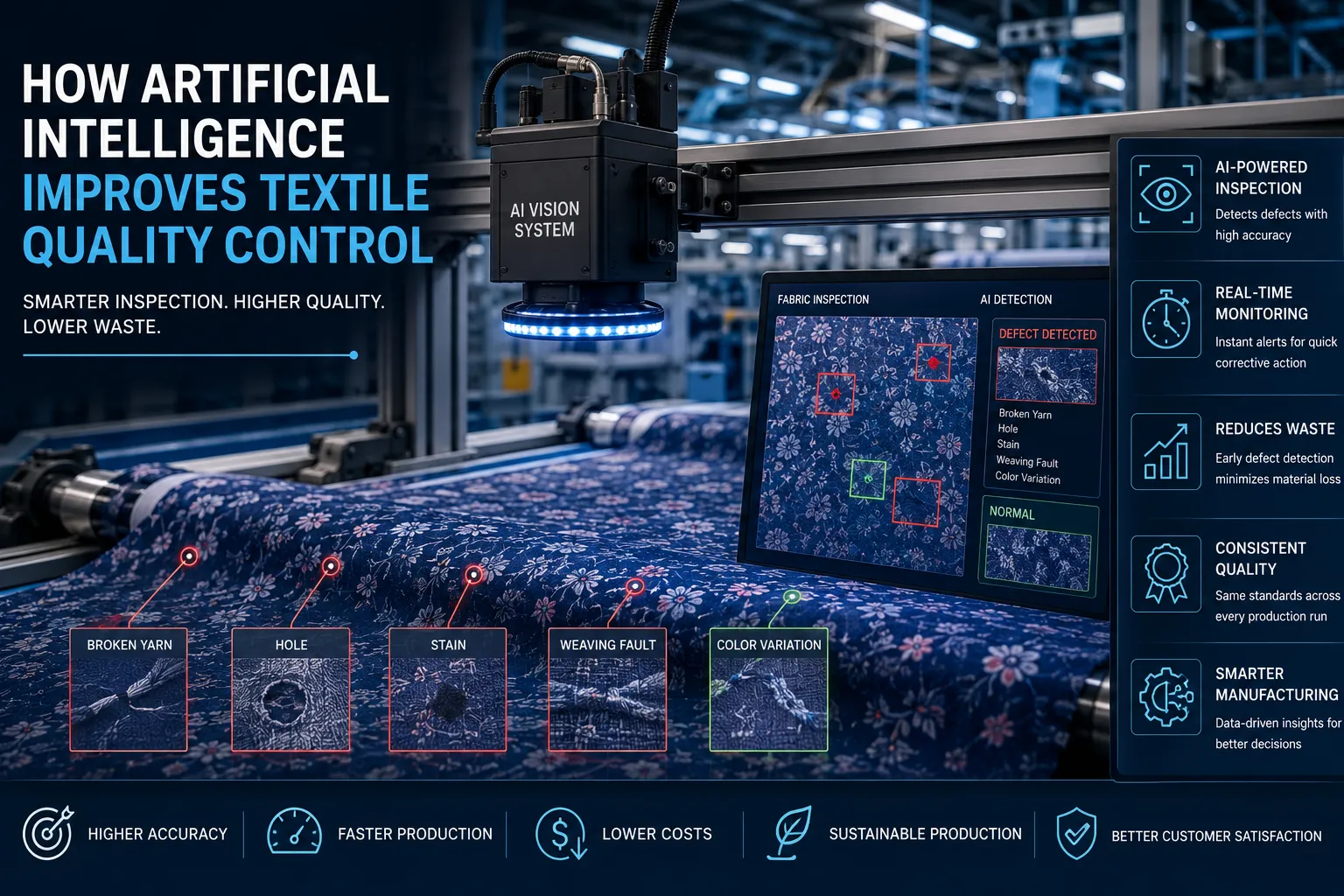
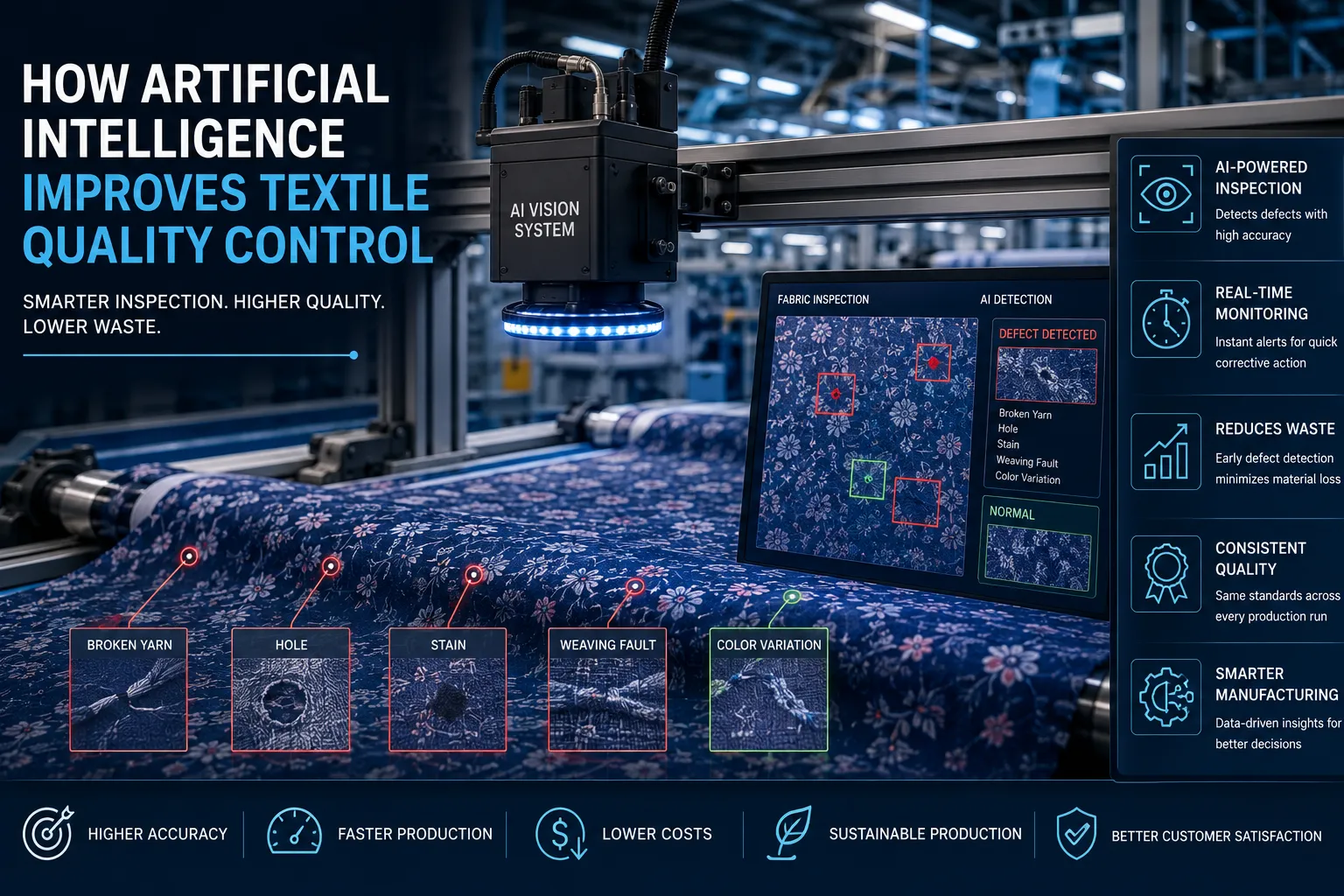
AI powered computer vision systems use industrial cameras positioned along production lines to capture thousands of high-resolution images every minute. These images are analyzed using deep learning algorithms trained to recognize both common and complex textile defects.
The AI system can identify issues such as broken yarns, weaving defects, holes, stains, printing misalignment, color variation, stitching errors, fabric distortion, and surface imperfections. Because the system continuously learns from production data, its accuracy improves over time, making inspections even more reliable.
Unlike manual inspection, AI performs this analysis without fatigue, ensuring every roll of fabric receives the same level of attention.
Real Time Quality Monitoring
One of AI's greatest strengths is its ability to provide real-time monitoring throughout the manufacturing process. Instead of discovering problems after production has finished, manufacturers receive instant alerts when defects occur.
Real-time monitoring allows production teams to identify machine problems, adjust production settings, replace damaged components, or correct weaving errors before they affect large quantities of fabric. This proactive approach saves both time and raw materials while improving production efficiency.
AI Reduces Manufacturing Waste
Textile waste remains one of the industry's biggest challenges. Defective fabrics often require reprocessing or disposal, increasing production costs and environmental impact.
AI helps minimize waste by detecting defects at their earliest stage. Early detection prevents defective materials from progressing through additional manufacturing processes such as dyeing, printing, cutting, or stitching.
By reducing unnecessary waste, manufacturers also improve sustainability while lowering operating expenses.
Better Color Consistency
Maintaining consistent colors across large production batches is essential for customer satisfaction, particularly in home textile products where matching colors are important.
AI systems compare each fabric against digital color standards and identify even slight variations that may be difficult for the human eye to detect.
This ensures greater color consistency across products such as:
-
Bed Sheets
-
Pillowcases
-
Towels
-
Curtains
-
Duvet Covers
-
Cushion Covers
Customers receive products that match expected quality standards, reducing complaints and product returns.
Predictive Quality Analysis
Modern AI systems not only detect defects but also predict potential quality issues before they occur.
By analyzing production data, machine performance, humidity, temperature, and historical defect patterns, AI can identify conditions likely to produce defects in future production runs.
Manufacturers can therefore perform preventive maintenance or adjust machine settings before quality problems arise.
AI Improves Production Efficiency
AI contributes to overall manufacturing efficiency by reducing production interruptions and minimizing manual inspection requirements.
Benefits include:
-
Faster inspections
-
Higher production speed
-
Reduced labor-intensive tasks
-
More consistent quality
-
Lower operational costs
-
Better production planning
Employees can focus on process improvement and quality management while AI handles repetitive inspection tasks.
AI Supports Sustainable Manufacturing
Sustainability has become a major priority within the global textile industry.
AI supports sustainable production by reducing:
-
Material waste
-
Water consumption
-
Energy usage
-
Rejected products
-
Unnecessary reprocessing
Organizations such as Textile Exchange encourage manufacturers to adopt technologies that improve efficiency while supporting environmentally responsible production.
AI in Home Textile Manufacturing
Home textile manufacturers increasingly use AI inspection systems during the production of bed linen, towels, curtains, comforters, and filled bedding.
These intelligent systems ensure consistent quality throughout every stage of manufacturing while helping companies meet international customer expectations.
Challenges of AI Quality Control
Although AI offers numerous advantages, implementation requires careful planning and investment.
Common challenges include:
-
High initial investment
-
Integration with existing machinery
-
Employee training
-
Data management
-
Cybersecurity considerations
Despite these challenges, many manufacturers achieve long term savings through improved efficiency and reduced product defects.
The Future of AI in Textile Quality Control
The future of quality control is becoming increasingly automated.
Emerging technologies are expected to include:
-
Self learning inspection systems
-
AI powered robotic inspection
-
Digital twins
-
Predictive quality analytics
-
Cloud-based production monitoring
-
Smart factory integration
As these innovations become more affordable, AI based quality control will likely become the standard across the global textile industry.
Conclusion
Artificial Intelligence is transforming textile quality control by making inspections faster, more accurate, and more consistent than traditional methods. Through computer vision, machine learning, and predictive analytics, AI helps manufacturers reduce defects, improve efficiency, minimize waste, and deliver higher quality textile products.
Rather than replacing experienced quality professionals, AI provides intelligent support that enables manufacturers to achieve better results while remaining competitive in today's rapidly evolving textile industry.
Frequently Asked Questions
1. What is AI textile quality control?
AI textile quality control uses computer vision and machine learning to automatically inspect fabrics for defects.
2. How does AI detect textile defects?
Industrial cameras capture fabric images while AI algorithms identify weaving faults, color variations, holes, stains, and stitching defects.
3. Is AI more accurate than manual inspection?
AI provides consistent and highly accurate inspections without fatigue, making it more reliable for large-scale production.
4. Can AI reduce textile waste?
Yes. AI detects defects early, reducing rejected products and unnecessary material waste.
5. What technologies are used in AI quality control?
Computer vision, deep learning, machine learning, image recognition, and predictive analytics.
6. Is AI suitable for home textile manufacturing?
Yes. AI is widely used to inspect bed sheets, towels, curtains, pillowcases, and other home textile products.
7. Does AI replace quality inspectors?
No. AI supports inspectors by automating repetitive inspection tasks while humans supervise quality management.
8. What are the benefits of AI inspection?
Higher accuracy, faster production, lower costs, improved quality, and better customer satisfaction.
9. What challenges do manufacturers face when implementing AI?
High investment costs, employee training, and system integration are common challenges.
10. What is the future of AI in textile quality control?
Future systems will include self-learning inspection, predictive analytics, cloud monitoring, and fully integrated smart factories.
Recent Posts
Categories
- Home Textiles (11)
- AI & Textile Innovation (10)
- AI + Textile Manufacturing (10)
- AI + Sustainability (5)
- AI + Home Textiles (4)
- AI + Supply Chain (5)
- AI + Future Technology (7)