Admin July 1, 2026
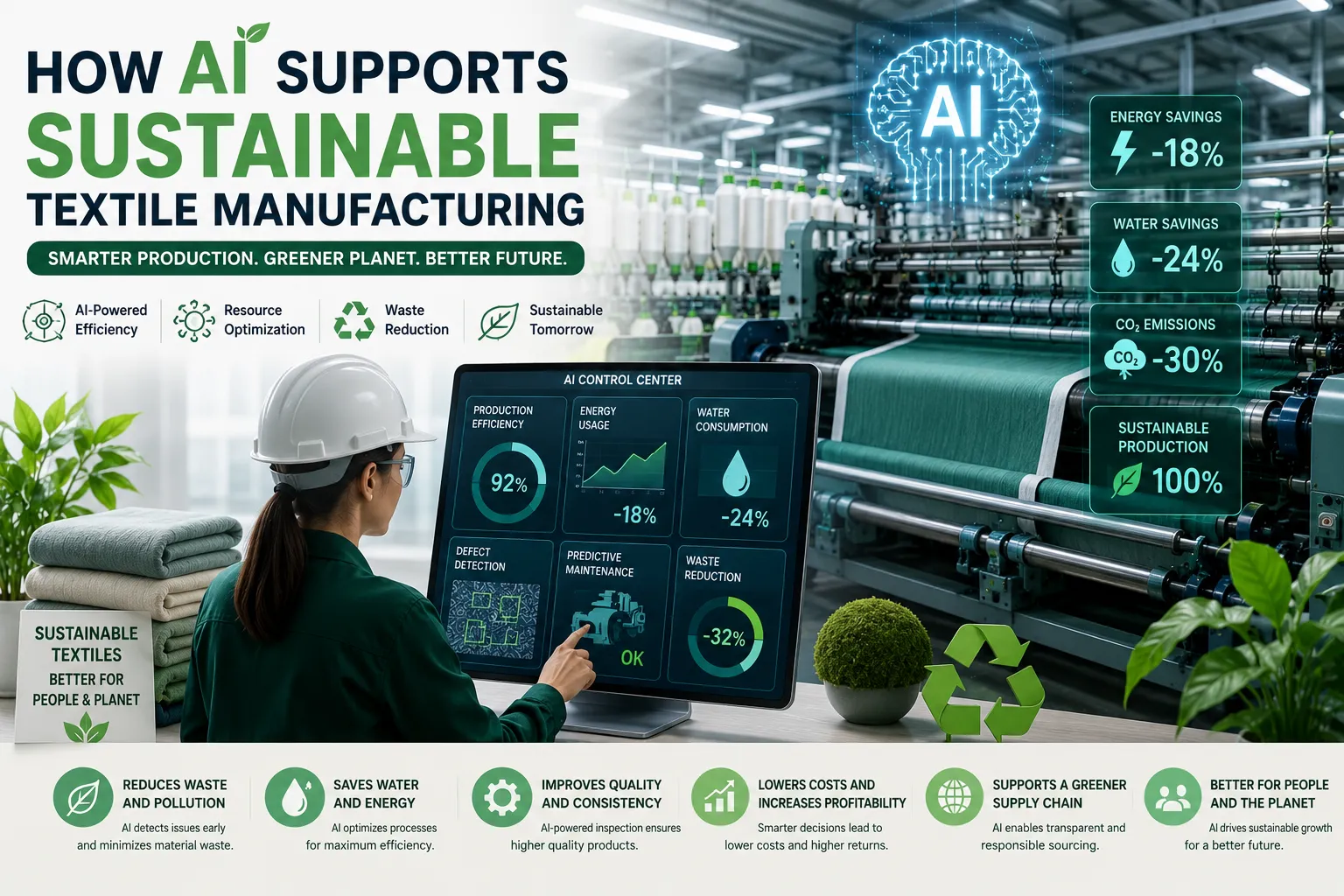
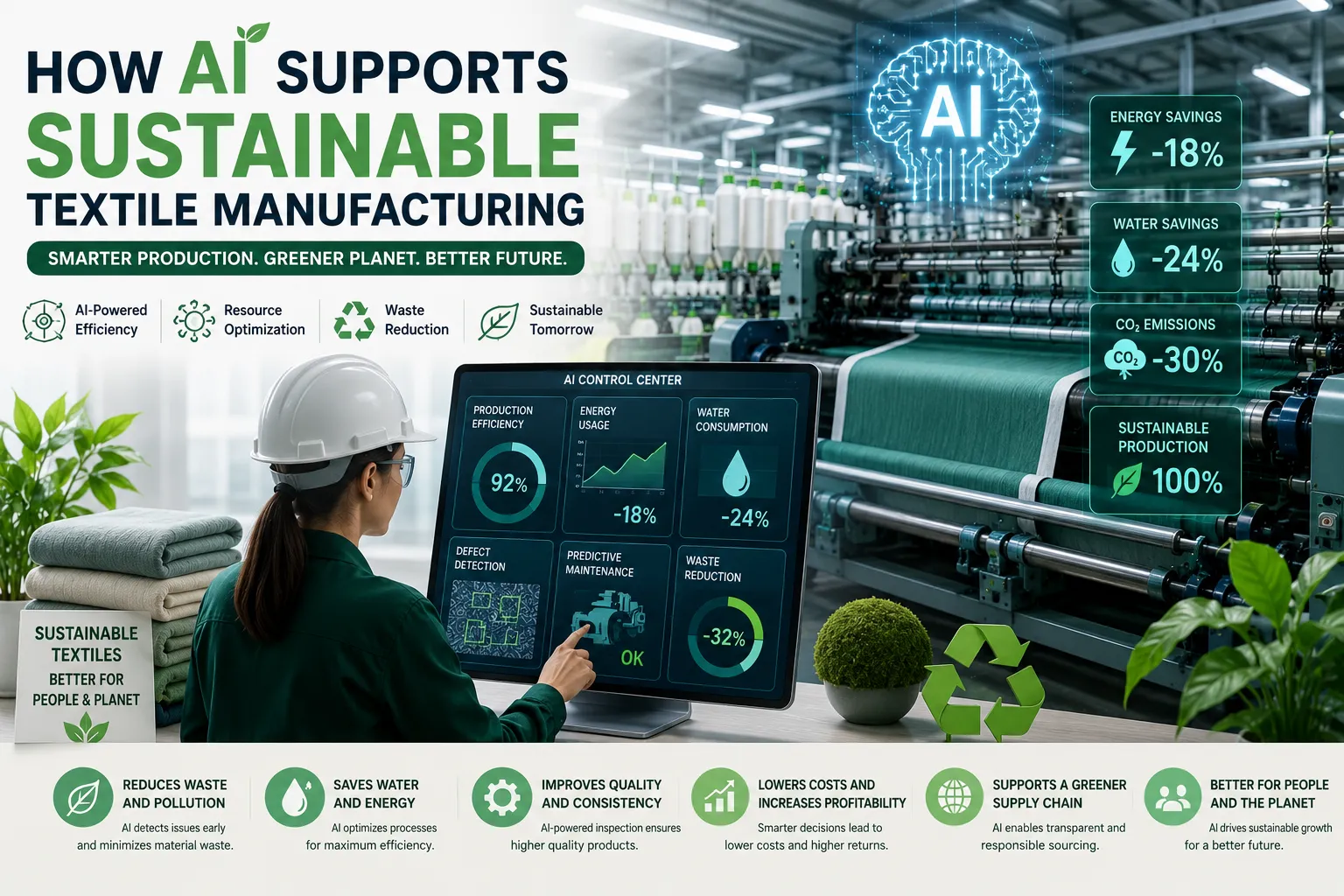
How AI Supports Sustainable Textile Manufacturing
Learn how AI supports sustainable textile manufacturing by reducing waste, saving energy, optimizing water use, improving production efficiency, and enabling eco-friendly textile innovation.
Sustainability has become one of the most important priorities in the global textile industry. Rising environmental concerns, increasing customer awareness, and stricter international regulations are encouraging manufacturers to adopt cleaner and more responsible production methods. Traditional textile manufacturing often consumes large amounts of water, electricity, chemicals, and raw materials, while generating significant production waste. These challenges not only increase manufacturing costs but also place pressure on natural resources and the environment. Artificial Intelligence (AI) is helping solve many of these problems by enabling manufacturers to make smarter, data-driven decisions throughout the production process. Instead of relying only on manual planning and reactive problem solving, AI analyzes production data in real time, predicts future demand, optimizes resource utilization, and identifies opportunities to reduce waste. As a result, textile companies can improve productivity while significantly lowering their environmental impact, making AI one of the most valuable technologies for building a more sustainable textile industry.
What Is Sustainable Textile Manufacturing?
Sustainable textile manufacturing is the process of producing fabrics and home textile products while minimizing environmental impact and using resources responsibly. The goal is to reduce waste, lower carbon emissions, conserve water and energy, use eco-friendly raw materials, and create products that are both durable and environmentally responsible.
Artificial Intelligence strengthens sustainability by providing manufacturers with accurate data and intelligent automation. AI systems continuously monitor production, identify inefficiencies, and recommend improvements that help factories operate more efficiently without compromising product quality.
This combination of sustainability and intelligent technology is becoming the foundation of modern textile manufacturing.
AI Reduces Textile Waste
Textile waste remains one of the industry's biggest environmental challenges. Fabric defects, incorrect production planning, overproduction, and inefficient cutting processes often result in large quantities of unused material.
AI helps reduce waste by monitoring every stage of production. Intelligent inspection systems identify weaving defects, dyeing problems, and stitching errors immediately, allowing operators to correct issues before defective fabrics continue through additional manufacturing stages.
Machine learning also analyzes production history to identify recurring quality problems and recommends process improvements that prevent defects from occurring in the future. As a result, manufacturers produce more usable fabric while reducing unnecessary waste and lowering production costs.
Smarter Demand Forecasting Prevents Overproduction
One of the most common causes of waste is producing more products than customers actually need.
AI-powered demand forecasting analyzes historical sales, seasonal buying patterns, online searches, retailer orders, and consumer behavior to estimate future demand more accurately.
Manufacturers can use these predictions to adjust production volumes before manufacturing begins. Instead of filling warehouses with unsold inventory, companies produce quantities that closely match market demand.
This approach reduces excess inventory, minimizes storage costs, and prevents valuable raw materials from being wasted.
AI Optimizes Water Usage
Textile dyeing and finishing processes require large amounts of water, making water conservation an important sustainability goal.
AI systems monitor water consumption throughout production and identify opportunities to improve efficiency. By analyzing machine performance, production schedules, and process conditions, AI recommends adjustments that reduce unnecessary water usage while maintaining product quality.
Some advanced manufacturing systems even optimize dyeing cycles automatically, helping factories conserve water without affecting color consistency or fabric performance.
Reducing water consumption benefits both manufacturers and the environment while supporting long term resource conservation.
Energy Efficiency Through Artificial Intelligence
Energy consumption is another major operational cost in textile manufacturing.
AI continuously analyzes energy usage across spinning, weaving, knitting, dyeing, finishing, and packaging operations. Intelligent monitoring systems identify equipment operating inefficiently and recommend adjustments that reduce electricity consumption.
Predictive maintenance also contributes to energy efficiency by ensuring machines operate under optimal conditions. Properly maintained equipment consumes less energy, produces higher-quality products, and experiences fewer unexpected breakdowns.
Lower energy usage reduces manufacturing costs while helping companies achieve their sustainability targets.
AI Improves Fabric Utilization
Every centimeter of fabric has value. Poor cutting layouts and inaccurate production planning can result in unnecessary fabric waste.
AI powered optimization software calculates the most efficient fabric layouts before cutting begins. These intelligent systems maximize material utilization while minimizing leftover fabric.
Manufacturers benefit from reduced raw material costs, improved production efficiency, and lower environmental impact.
This optimization becomes especially valuable for home textile products such as bed sheets, duvet covers, pillowcases, towels, curtains, and table linen.
Better Quality Means Less Waste
High-quality production and sustainability are closely connected.
AI-powered quality control systems inspect fabrics using computer vision and machine learning. They identify defects such as broken yarns, weaving faults, color inconsistencies, stains, and printing errors before products move further along the production line.
Because defects are detected earlier, manufacturers avoid unnecessary dyeing, finishing, packaging, and shipping of products that would ultimately be rejected.
This saves raw materials, energy, labor, and transportation resources while improving customer satisfaction.
AI Supports Responsible Supply Chains
Sustainability extends beyond factory production.
AI helps companies improve supply chain efficiency by analyzing supplier performance, transportation routes, inventory levels, production schedules, and customer demand.
These insights reduce unnecessary transportation, improve delivery planning, and optimize inventory management.
A more efficient supply chain consumes fewer resources and produces lower carbon emissions throughout the product lifecycle.
AI Encourages Circular Textile Manufacturing
The future of sustainable textiles increasingly focuses on circular manufacturing, where materials are reused, recycled, or repurposed instead of discarded.
AI supports circular manufacturing by tracking raw materials, identifying recyclable fabrics, optimizing collection systems, and improving recycling processes.
Manufacturers can make better decisions about material recovery while reducing dependence on newly produced raw materials.
This approach supports long-term environmental sustainability and resource conservation.
Predictive Maintenance Reduces Environmental Impact
Unexpected machine failures often lead to production interruptions, defective products, and unnecessary resource consumption.
AI continuously monitors machine health using sensors that analyze temperature, vibration, operating speed, and energy consumption.
When abnormal conditions are detected, AI predicts maintenance requirements before equipment fails.
Keeping machines operating efficiently reduces waste, extends equipment lifespan, and improves overall sustainability.
Challenges of Implementing AI for Sustainability
Although AI offers significant environmental benefits, implementation requires careful planning and investment.
Manufacturers may face challenges such as purchasing advanced technology, integrating AI with existing equipment, training employees, maintaining cybersecurity, and collecting accurate production data.
However, as AI technologies become more affordable and accessible, these barriers continue to decrease, making sustainable manufacturing achievable for businesses of all sizes.
The Future of Sustainable Textile Manufacturing
Artificial Intelligence is expected to play an even greater role in the future of sustainable textiles.
Next-generation manufacturing systems may combine AI, robotics, digital twins, Internet of Things (IoT) sensors, renewable energy monitoring, and predictive analytics into fully connected smart factories.
These intelligent factories will continuously optimize resource usage, reduce emissions, improve recycling efficiency, and support environmentally responsible production without sacrificing product quality or business profitability.
Organizations such as Textile Exchange continue encouraging innovation that combines sustainability with advanced manufacturing technologies.
Why Sustainable Manufacturing Is Good for Business
Sustainability is no longer just an environmental responsibility it has become a competitive business advantage.
Manufacturers adopting AI-powered sustainable practices benefit from:
-
Lower production costs
-
Reduced material waste
-
Improved energy efficiency
-
Better product quality
-
Stronger international competitiveness
-
Compliance with environmental regulations
-
Increased customer trust
-
Greater operational efficiency
-
Reduced carbon emissions
-
Long term business growth
Customers increasingly prefer brands that demonstrate genuine commitment to environmental responsibility, making sustainable manufacturing an important investment for the future.
Conclusion
Artificial Intelligence is helping reshape the textile industry by making sustainable manufacturing more practical, efficient, and profitable. Through intelligent demand forecasting, quality inspection, predictive maintenance, energy optimization, water conservation, and waste reduction, AI enables manufacturers to produce high-quality textile products while minimizing environmental impact.
Rather than replacing human expertise, AI provides manufacturers with powerful decision making tools that support responsible production and continuous improvement. As the global textile industry moves toward greener manufacturing, companies that combine sustainability with intelligent technology will be better positioned for long-term success.
Frequently Asked Questions
1. How does AI support sustainable textile manufacturing?
AI reduces waste, optimizes energy and water usage, improves production efficiency, and supports responsible resource management.
2. Can AI reduce textile waste?
Yes. AI detects defects early, optimizes production planning, and minimizes material waste.
3. How does AI save water in textile manufacturing?
AI monitors dyeing and finishing processes to reduce unnecessary water consumption while maintaining quality.
4. Does AI improve energy efficiency?
Yes. AI identifies inefficient equipment, optimizes machine performance, and reduces electricity consumption.
5. Can AI reduce carbon emissions?
Yes. Better production planning, efficient supply chains, and lower energy usage help reduce emissions.
6. What role does AI play in textile recycling?
AI helps identify recyclable materials, improve sorting, and support circular manufacturing systems.
7. Is AI suitable for home textile manufacturers?
Yes. AI supports the sustainable production of bed sheets, towels, curtains, duvet covers, pillowcases, and other home textile products.
8. What are the biggest sustainability benefits of AI?
Reduced waste, lower resource consumption, improved efficiency, better quality, and more environmentally responsible production.
9. Are there challenges to implementing AI?
Common challenges include investment costs, staff training, system integration, and data management.
10. What is the future of AI in sustainable textiles?
The future includes AI powered smart factories, predictive sustainability monitoring, digital twins, and advanced circular manufacturing systems.
Recent Posts
Categories
- Home Textiles (11)
- AI & Textile Innovation (10)
- AI + Textile Manufacturing (10)
- AI + Sustainability (5)
- AI + Home Textiles (4)
- AI + Supply Chain (5)
- AI + Future Technology (7)