Admin July 2, 2026
How AI Reduces Textile Production Costs
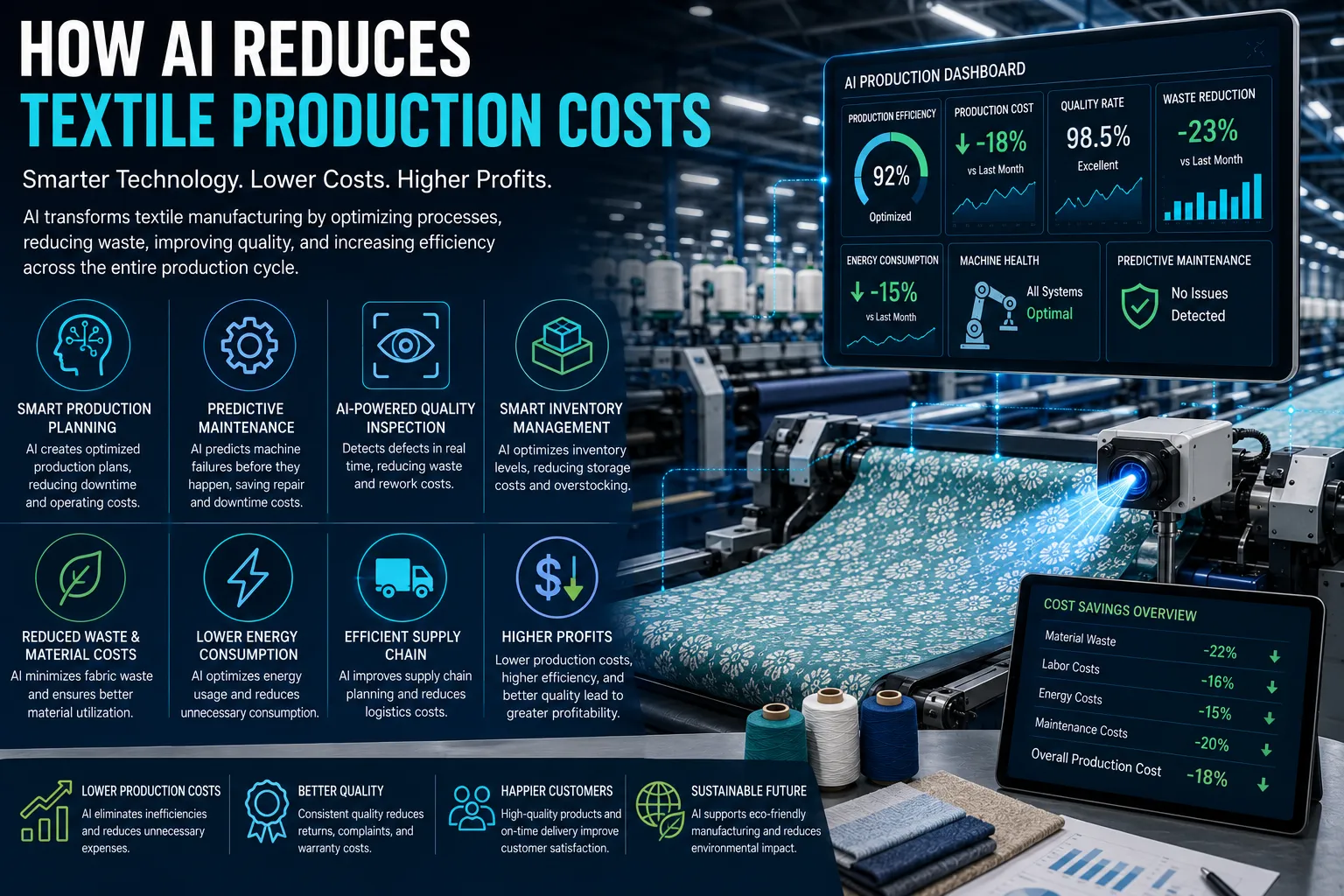
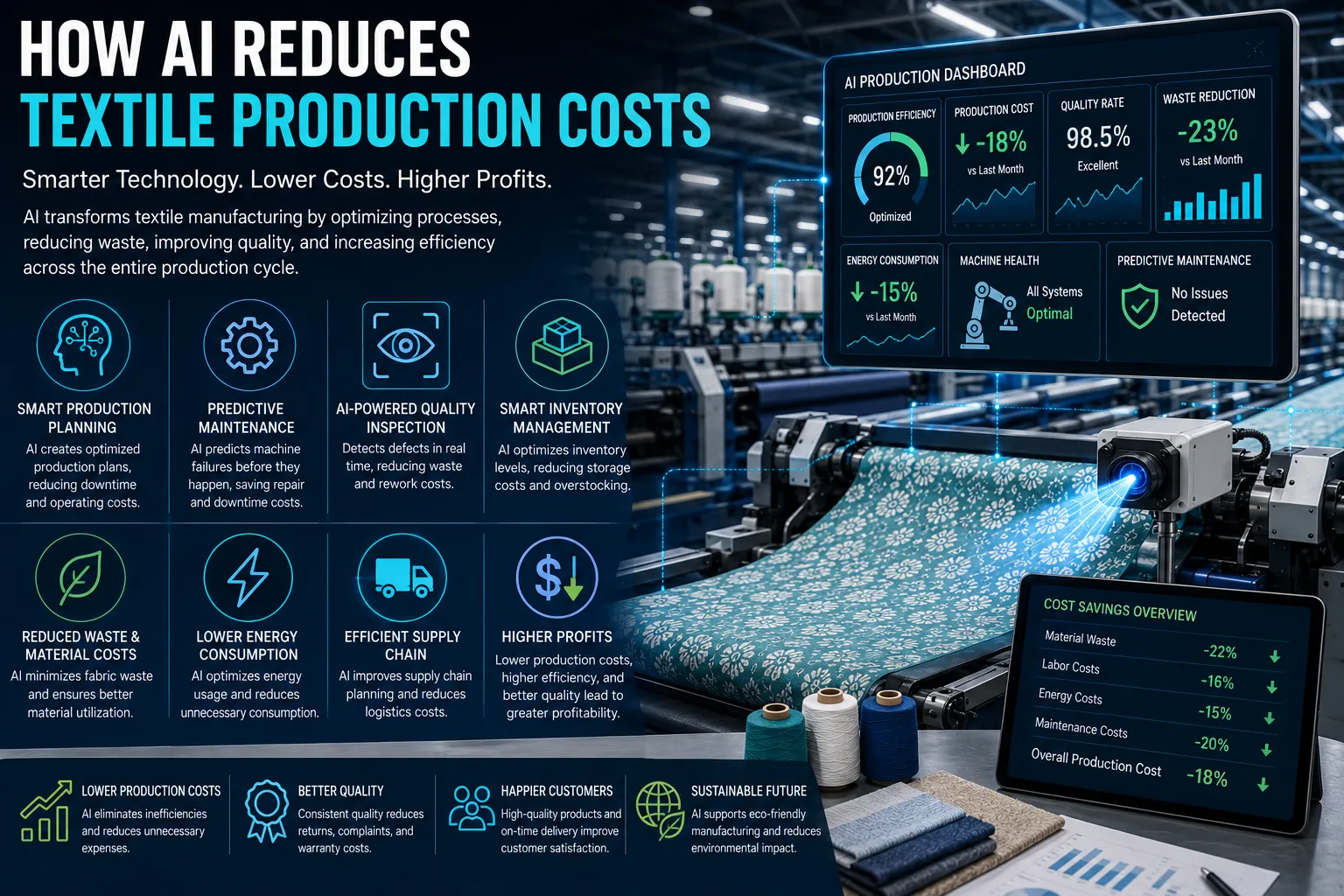
Artificial Intelligence is helping textile manufacturers reduce production costs while improving product quality and operational efficiency. The textile industry faces constant challenges such as rising labor expenses, increasing energy prices, raw material shortages, production waste, and strong global competition. Manufacturers must find ways to produce high quality products at competitive prices without sacrificing customer satisfaction or sustainability. Artificial Intelligence provides a practical solution by analyzing production data, automating routine processes, predicting future demand, improving quality inspection, and optimizing manufacturing operations. Instead of relying only on manual planning and traditional production methods, AI helps companies make faster and more accurate business decisions based on real time information. From spinning and weaving to dyeing, finishing, packaging, and inventory management, AI improves every stage of textile manufacturing while reducing unnecessary expenses. As digital transformation continues across the industry, manufacturers that adopt AI technology are achieving higher productivity, lower operating costs, and stronger competitiveness in global markets.
What Is Artificial Intelligence in Textile Manufacturing
Artificial Intelligence refers to computer systems that can analyze information, recognize patterns, learn from production data, and make intelligent recommendations without constant human supervision. In textile manufacturing, AI works with machine learning, computer vision, sensors, smart software, and connected production systems to improve operational performance.
AI continuously collects information from machines, production lines, warehouses, quality inspection systems, and customer demand. This information allows manufacturers to identify inefficiencies, reduce waste, optimize production schedules, and improve decision making throughout the factory.
Instead of reacting to problems after they occur, manufacturers can prevent many issues before they affect production.
Reducing Material Waste
Raw materials represent one of the largest expenses in textile manufacturing. Fabric, yarn, dyes, chemicals, packaging materials, and accessories all contribute significantly to production costs.
Artificial Intelligence reduces material waste by monitoring production continuously and identifying opportunities to improve efficiency. AI recommends optimized cutting layouts, detects production defects early, predicts material requirements, and minimizes unnecessary overproduction.
By using only the required amount of material, manufacturers lower production costs while supporting environmentally responsible manufacturing practices.
Reducing waste also improves profitability without compromising product quality.
Improving Production Planning
Efficient production planning is essential for controlling manufacturing expenses.
AI analyzes customer orders, machine availability, workforce schedules, raw material inventory, and production capacity before creating optimized manufacturing plans.
Instead of depending on manual scheduling, manufacturers receive intelligent production recommendations that maximize machine utilization and reduce unnecessary downtime.
Better planning improves delivery performance while lowering overtime expenses and production delays.
Predictive Maintenance Saves Money
Unexpected machine failures can stop production and create expensive repairs.
Artificial Intelligence continuously monitors machine temperature, vibration, operating speed, energy usage, and overall performance. Machine learning algorithms recognize unusual operating patterns and predict maintenance requirements before breakdowns occur.
Maintenance teams receive early alerts, allowing repairs to be completed during scheduled maintenance periods.
This predictive maintenance approach reduces emergency repair costs, extends equipment life, increases productivity, and minimizes production interruptions.
Faster and More Accurate Quality Control
Poor product quality increases manufacturing costs through rejected materials, customer complaints, product returns, and additional production.
AI powered computer vision systems inspect fabrics during manufacturing using advanced cameras and intelligent image analysis.
These systems detect weaving faults, stains, color inconsistencies, printing defects, broken yarns, holes, and stitching problems immediately.
Early defect detection prevents large quantities of defective products from being produced, reducing waste and improving customer satisfaction.
Better quality control also protects the manufacturer's reputation in competitive markets.
Smarter Inventory Management
Maintaining excessive inventory increases storage costs and ties up valuable business capital.
Artificial Intelligence analyzes customer demand, production schedules, supplier performance, seasonal trends, and warehouse inventory before recommending optimal stock levels.
Manufacturers purchase raw materials only when needed while maintaining enough inventory to support uninterrupted production.
This intelligent inventory planning improves cash flow and reduces unnecessary warehouse expenses.
Lower Energy Consumption
Energy costs continue to rise across the manufacturing industry.
Artificial Intelligence helps reduce electricity consumption by monitoring machine performance, identifying inefficient equipment, and optimizing production schedules.
Smart systems recommend the most energy efficient operating conditions while reducing idle machine time and unnecessary production activities.
Lower energy usage reduces manufacturing expenses while supporting sustainable production.
Supporting Home Textile Manufacturing
Home textile manufacturers produce a wide variety of products that require efficient cost management.
Artificial Intelligence supports the production of:
-
Bed Sheets
-
Pillowcases
-
Duvet Covers
-
Comforters
-
Towels
-
Curtains
-
Cushion Covers
-
Table Linen
By improving manufacturing efficiency and reducing waste, AI helps manufacturers produce these products at lower costs without sacrificing quality.
Stronger Supply Chain Management
Artificial Intelligence improves supply chain efficiency by analyzing supplier performance, transportation schedules, inventory levels, customer demand, and production capacity.
Manufacturers receive accurate recommendations for purchasing decisions, logistics planning, and inventory replenishment.
Better supply chain coordination reduces transportation costs, prevents raw material shortages, and improves customer delivery performance.
Efficient supply chain management contributes directly to lower production expenses.
Supporting Sustainable Manufacturing
Reducing production costs does not mean sacrificing environmental responsibility.
Artificial Intelligence helps manufacturers reduce waste, optimize resource utilization, minimize water consumption, improve chemical usage, and lower carbon emissions through more efficient production planning.
Organizations such as Textile Exchange encourage manufacturers to adopt digital technologies that improve operational efficiency while supporting sustainable textile manufacturing.
Challenges of Implementing AI
Although AI provides significant cost savings, successful implementation requires careful planning.
Manufacturers may need to invest in modern software, connected production equipment, employee training, cybersecurity, and reliable business data.
However, these initial investments often generate long term savings through improved efficiency, reduced waste, and better production performance.
Many companies recover their investment within a relatively short period after implementation.
The Future of Cost Efficient Textile Manufacturing
Artificial Intelligence will continue becoming more advanced as technology evolves.
Future AI systems will automatically optimize production schedules, predict market demand, monitor energy usage, improve machine performance, manage inventory, and coordinate supply chains with minimal human intervention.
These intelligent manufacturing systems will allow textile companies to produce higher quality products at lower costs while remaining competitive in global markets.
Businesses that invest in AI today will be better prepared for future industry challenges and opportunities.
Why Textile Manufacturers Should Invest in AI
Companies adopting Artificial Intelligence gain many competitive advantages beyond simple cost reduction.
Major benefits include improved productivity, lower operating expenses, higher product quality, better inventory management, reduced material waste, improved customer satisfaction, stronger sustainability, faster production, more accurate planning, and greater profitability.
These benefits make Artificial Intelligence one of the most valuable investments available for modern textile manufacturers.
Conclusion
Artificial Intelligence is transforming textile manufacturing by helping companies reduce production costs while improving efficiency, quality, and sustainability. Through intelligent production planning, predictive maintenance, quality inspection, inventory optimization, and energy management, AI enables manufacturers to make smarter business decisions based on real time information.
As competition continues to grow within the global textile industry, manufacturers that adopt Artificial Intelligence will be better positioned to increase profitability, strengthen customer satisfaction, and achieve long term business success.
Frequently Asked Questions
1. How does AI reduce textile production costs?
AI improves efficiency, reduces waste, optimizes production planning, and minimizes unnecessary operating expenses.
2. Can AI reduce fabric waste?
Yes. AI detects defects early and optimizes material usage throughout production.
3. How does AI improve production planning?
AI analyzes demand, machine capacity, inventory, and workforce schedules to create efficient production plans.
4. What is predictive maintenance?
Predictive maintenance uses Artificial Intelligence to identify equipment problems before machine failures occur.
5. Does AI improve textile quality?
Yes. AI powered inspection systems detect defects in real time and help maintain consistent product quality.
6. Can AI reduce energy consumption?
Yes. AI monitors machine performance and recommends energy efficient production methods.
7. Which textile products benefit from AI?
Bed sheets, pillowcases, duvet covers, comforters, towels, curtains, cushion covers, and table linen all benefit from AI powered manufacturing.
8. Is AI suitable for small textile manufacturers?
Yes. Many cloud based AI solutions are designed for both small and large manufacturing businesses.
9. What challenges exist when adopting AI?
Initial investment, employee training, system integration, and cybersecurity are the most common challenges.
10. Why should textile companies invest in AI now?
AI helps manufacturers lower costs, improve quality, increase productivity, strengthen sustainability, and remain competitive in the future textile industry.
Recent Posts
Categories
- Home Textiles (11)
- AI & Textile Innovation (10)
- AI + Textile Manufacturing (10)
- AI + Sustainability (5)
- AI + Home Textiles (4)
- AI + Supply Chain (5)
- AI + Future Technology (7)