Admin June 30, 2026
How AI Predicts Home Textile Trends: The Future of Data-Driven Design
Discover how AI predicts home textile trends by analyzing consumer behavior, market data, social media, and global design patterns. Learn how artificial intelligence is transforming trend forecasting in the home textile industry.
The home textile industry has always been influenced by changing consumer preferences, seasonal demand, interior design styles, and global fashion movements. In the past, predicting future trends relied heavily on experienced designers, market research, trade exhibitions, and historical sales data. While these methods remain valuable, today's rapidly changing market requires much faster and more accurate forecasting. This is where Artificial Intelligence (AI) is transforming the industry.
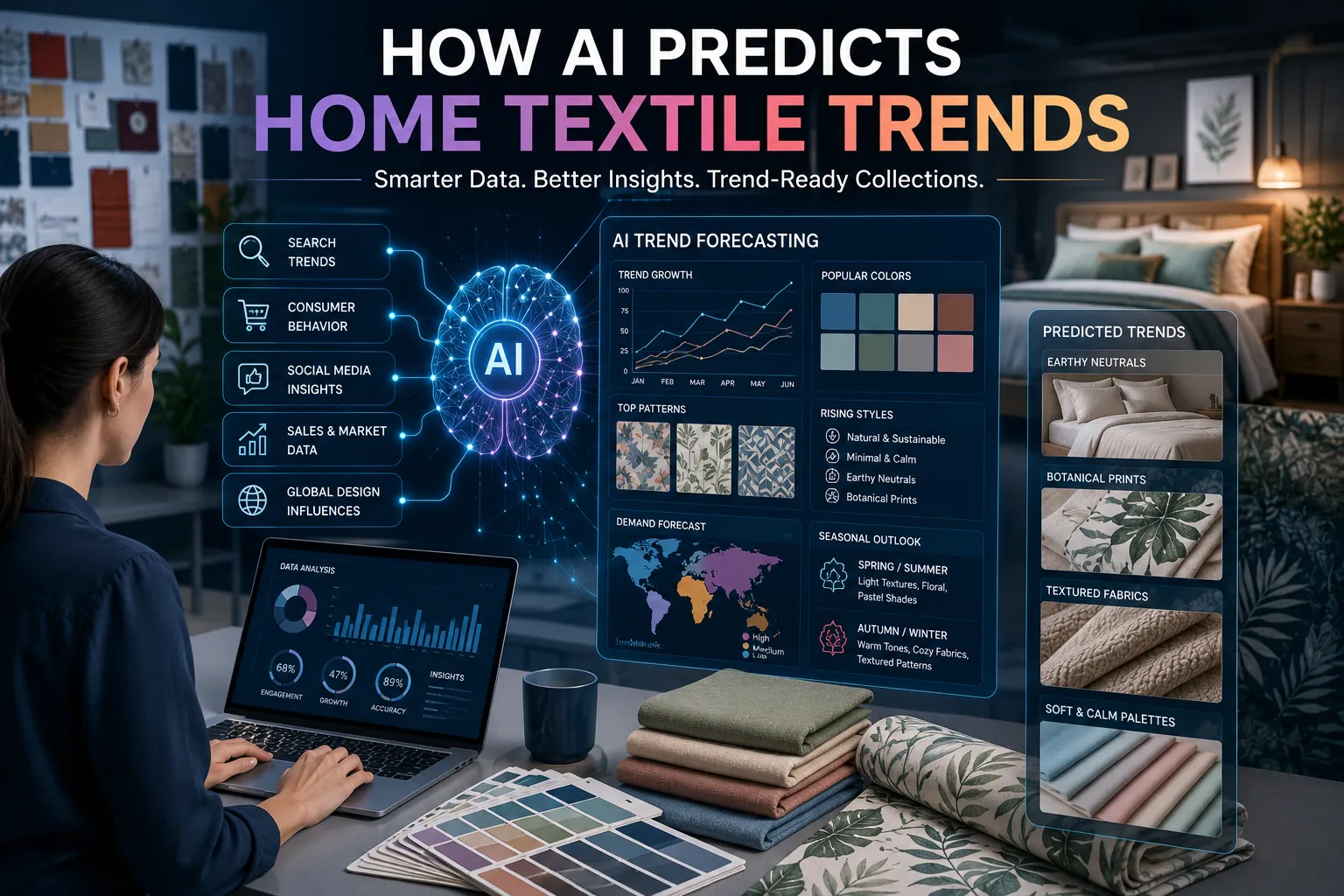
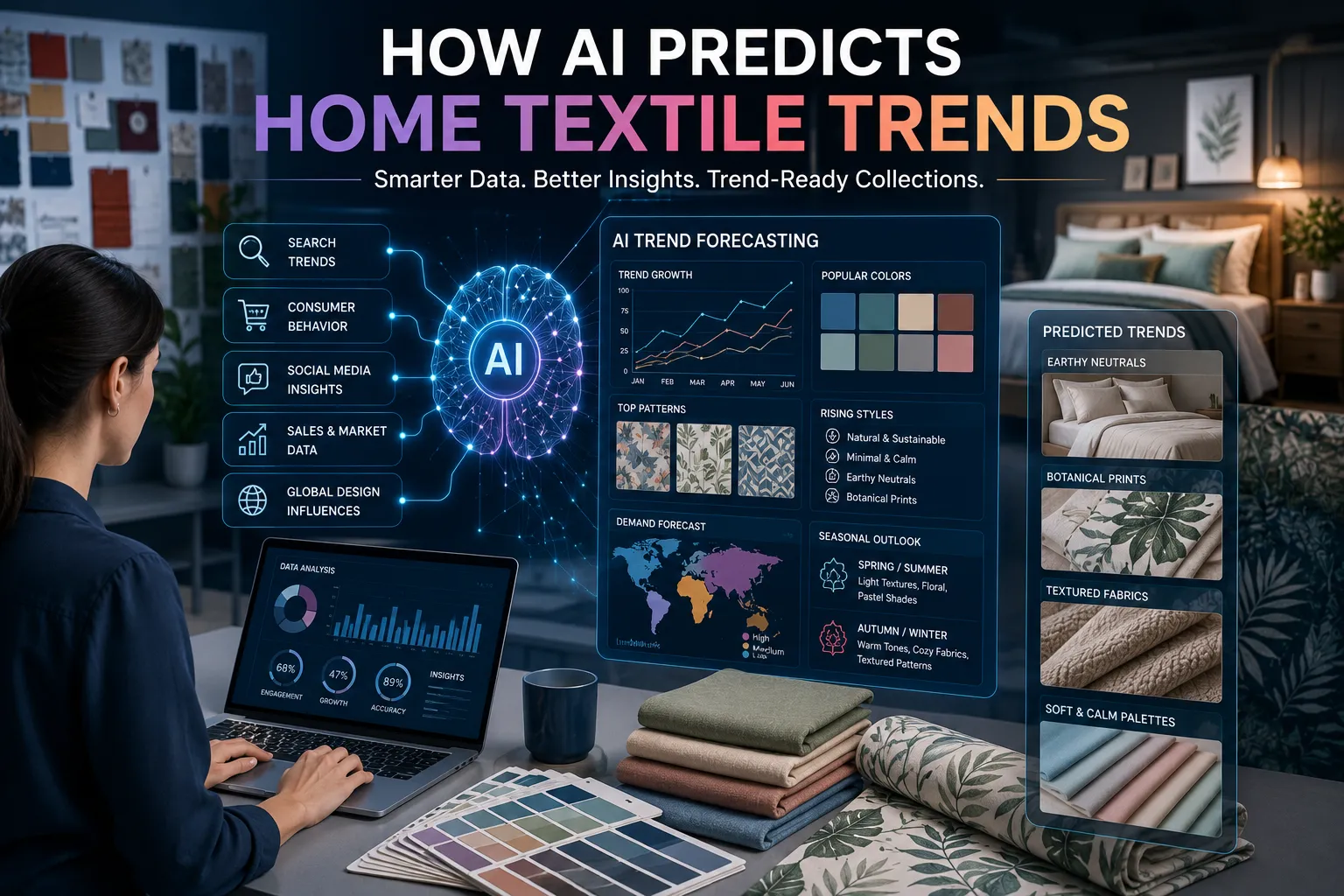
AI enables manufacturers, retailers, and designers to analyze millions of pieces of information within seconds. By studying online searches, social media activity, customer purchasing behavior, interior design trends, economic indicators, and historical sales data, AI identifies emerging patterns long before they become mainstream. Instead of reacting to market changes after they happen, businesses can anticipate customer demand and develop products that align with future trends. This proactive approach allows companies to reduce risk, improve product planning, and stay competitive in the global home textile market.
What Is AI Trend Forecasting?
AI trend forecasting is the process of using machine learning, predictive analytics, computer vision, and big data to identify future consumer preferences. Unlike traditional forecasting, which often depends on manual analysis and personal experience, AI continuously learns from new information and updates its predictions in real time.
Modern AI systems examine data from multiple sources simultaneously. They compare historical market performance with current buying behavior, online engagement, design movements, seasonal patterns, and regional preferences. As more information becomes available, AI refines its predictions, giving manufacturers a clearer understanding of what customers are likely to purchase in the coming months.
For home textile companies, this means making smarter decisions before investing in large-scale production.
Why Trend Prediction Matters in Home Textiles
Home textile manufacturing requires significant investment in raw materials, production planning, inventory management, and global distribution. Producing products that customers no longer want can lead to excess inventory, financial losses, and unnecessary waste.
Accurate trend forecasting helps businesses manufacture products with greater confidence. When companies understand upcoming consumer preferences, they can introduce collections that match current lifestyles, interior design movements, and seasonal demand.
Whether manufacturing bed sheets, duvet covers, towels, curtains, table linen, or decorative cushions, predicting future demand allows businesses to improve customer satisfaction while reducing production risks.
How AI Collects Market Intelligence
Artificial Intelligence gathers information from numerous digital and commercial sources before transforming it into meaningful insights.
These sources include:
-
Online shopping behavior
-
Search engine trends
-
Social media discussions
-
Interior design websites
-
Customer reviews
-
Global fashion reports
-
Retail sales data
-
Hospitality industry trends
-
Economic indicators
Rather than relying on a single source of information, AI combines multiple datasets to produce highly accurate forecasts.
This broader perspective allows manufacturers to identify market opportunities much earlier than traditional forecasting methods.
AI Understands Consumer Behavior
Modern consumers leave valuable digital signals whenever they search for products, browse online stores, save inspiration images, or interact with social media platforms.
AI analyzes these behavioral patterns to understand what customers are interested in before purchasing decisions are made.
For example, if searches for organic cotton bedding, neutral bedroom colors, or sustainable home textiles begin increasing across different regions, AI recognizes these signals as emerging trends. Manufacturers can then adjust product development accordingly.
Understanding customer behavior at this level helps businesses remain closely aligned with changing market expectations.
Predicting Color and Pattern Trends
Color selection plays a major role in the success of home textile collections.
AI analyzes millions of interior design images, product catalogs, social media posts, and consumer interactions to identify colors that are gaining popularity.
Instead of depending entirely on seasonal predictions, AI continuously monitors changing preferences and recommends combinations likely to perform well in future collections.
Similarly, AI studies pattern styles such as floral prints, geometric designs, minimalist textures, traditional motifs, and contemporary aesthetics. These insights help designers create collections that appeal to evolving customer tastes while reducing uncertainty during product development.
AI Helps Designers Create Better Collections
Artificial Intelligence is not replacing textile designers it is providing them with better information.
By analyzing market data before the design process begins, AI enables creative teams to make informed decisions about colors, fabrics, textures, themes, and product combinations.
Designers remain responsible for originality, storytelling, cultural inspiration, and emotional appeal, while AI supplies valuable insights based on measurable consumer behavior.
This collaboration between creativity and technology allows manufacturers to launch collections with greater confidence and market relevance.
AI Improves Inventory Planning
Trend forecasting directly affects inventory management.
Without accurate predictions, manufacturers may overproduce slow-moving products or underestimate demand for popular collections.
AI forecasts future demand by analyzing sales history, seasonal buying patterns, regional differences, and economic conditions. These forecasts help businesses purchase raw materials more efficiently, optimize warehouse capacity, and maintain healthier inventory levels.
As a result, manufacturers reduce unnecessary storage costs while improving product availability for customers.
AI Supports Sustainable Manufacturing
One of the greatest advantages of AI forecasting is its contribution to sustainability.
When manufacturers understand future demand more accurately, they produce only what customers are likely to purchase. This reduces excess inventory, unnecessary fabric consumption, water usage, energy consumption, and production waste.
AI also helps optimize fabric utilization, production scheduling, and supply chain planning, making the entire manufacturing process more environmentally responsible.
Organizations such as Textile Exchange encourage technology driven innovation that supports sustainable textile production and responsible sourcing practices.
AI in Home Textile Manufacturing
Many home textile manufacturers now integrate AI forecasting into product development and production planning.
AI assists with products including:
-
Bed Sheets
-
Pillowcases
-
Duvet Covers
-
Comforters
-
Towels
-
Curtains
-
Table Linen
-
Decorative Cushions
By understanding future customer preferences, manufacturers can introduce collections that better match market demand while minimizing production risks.
Challenges of AI Trend Forecasting
Although AI significantly improves forecasting accuracy, it is not without limitations.
The quality of AI predictions depends on the quality of available data. Inaccurate, incomplete, or outdated information can reduce forecasting performance. Manufacturers also need skilled professionals who understand both textile production and AI technologies.
Furthermore, consumer preferences can occasionally change unexpectedly due to global events, economic shifts, or cultural influences that are difficult for any forecasting system to predict perfectly.
For this reason, AI works best when combined with human expertise and industry knowledge.
The Future of AI in Home Textile Trends
Artificial Intelligence is expected to become even more sophisticated as technology continues to evolve.
Future forecasting systems may combine real time shopping behavior, smart home usage data, climate information, regional demographics, and AI-generated consumer simulations to predict demand with remarkable accuracy.
Manufacturers may eventually create highly personalized textile collections for individual markets, reducing waste while improving customer satisfaction.
As AI continues learning from increasingly diverse datasets, trend forecasting will become one of the most valuable strategic tools in the home textile industry.
Conclusion
Artificial Intelligence is transforming how home textile trends are predicted by replacing guesswork with data driven insights. Through advanced analytics, machine learning, and predictive modeling, AI helps manufacturers understand consumer behavior, identify emerging trends, optimize inventory, and improve sustainability.
Rather than replacing designers or business leaders, AI provides powerful decision-support tools that enable smarter planning and more successful product development. Companies that combine human creativity with AI powered forecasting will be better prepared to meet the changing needs of modern consumers and remain competitive in the evolving global home textile market.
Frequently Asked Questions
1. How does AI predict home textile trends?
AI analyzes consumer behavior, online searches, social media, historical sales, and market data to identify future demand.
2. Why is trend forecasting important in home textiles?
It helps manufacturers reduce risk, improve inventory planning, and create products customers are more likely to purchase.
3. Can AI predict color trends?
Yes. AI analyzes millions of design images and customer preferences to forecast emerging color palettes.
4. Does AI replace textile designers?
No. AI provides data driven insights, while designers contribute creativity, originality, and artistic vision.
5. How does AI improve sustainability?
By forecasting demand more accurately, AI reduces overproduction, material waste, and unnecessary resource consumption.
6. Which home textile products benefit from AI forecasting?
Bed sheets, duvet covers, towels, curtains, cushions, table linen, and many other textile products.
7. Is AI forecasting always accurate?
AI is highly accurate when supported by quality data, but human expertise remains important for interpreting results.
8. What technologies are used in AI forecasting?
Machine learning, predictive analytics, big data, computer vision, and natural language processing.
9. Can small textile businesses use AI?
Yes. Many AI powered forecasting tools are becoming increasingly accessible for businesses of all sizes.
10. What is the future of AI trend forecasting?
Future systems will provide real time predictions, personalized recommendations, and even smarter decision making for textile manufacturers.
Recent Posts
Categories
- Home Textiles (11)
- AI & Textile Innovation (10)
- AI + Textile Manufacturing (10)
- AI + Sustainability (5)
- AI + Home Textiles (4)
- AI + Supply Chain (5)
- AI + Future Technology (7)