Admin July 2, 2026
How AI Optimizes Water Usage in Textile Production
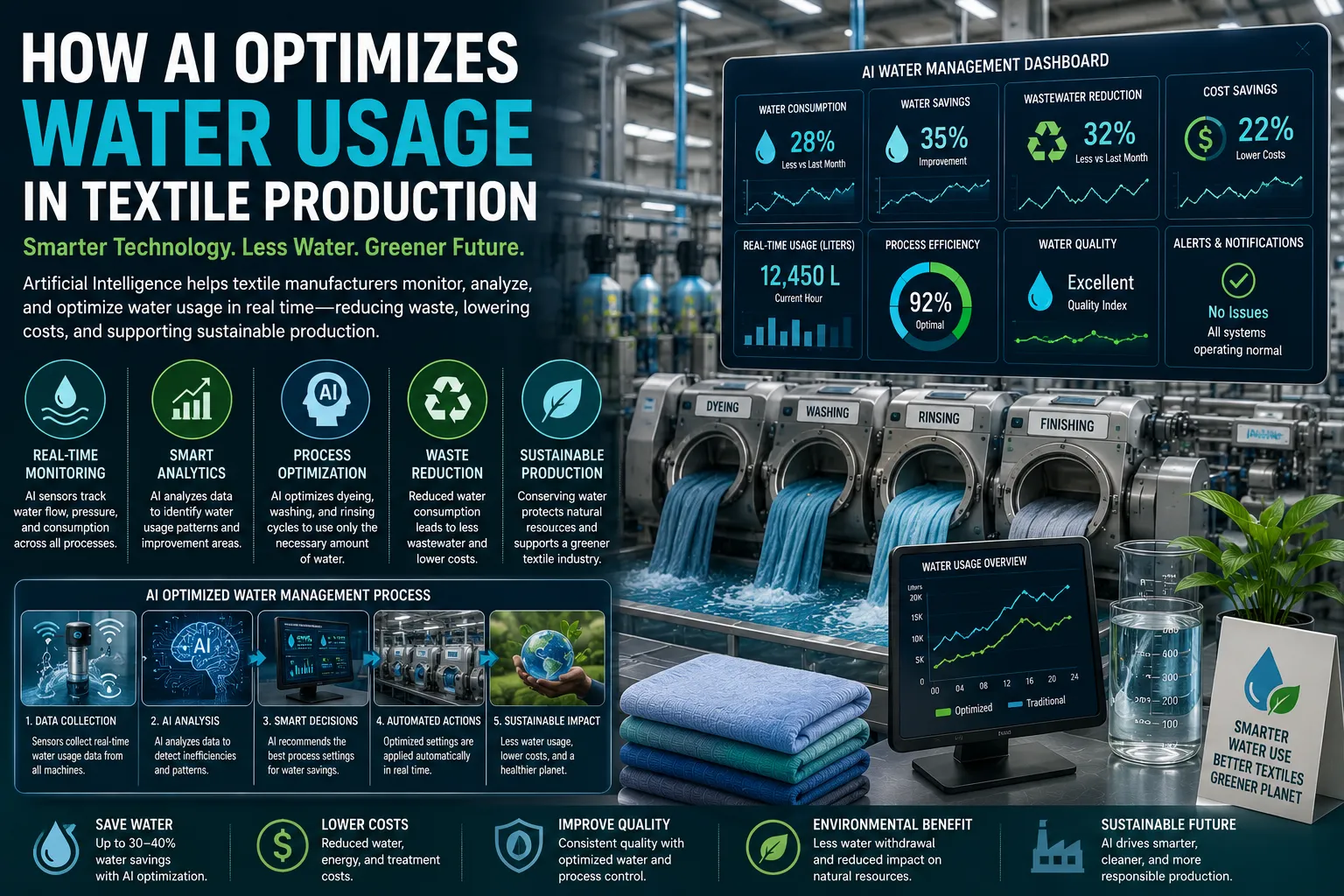
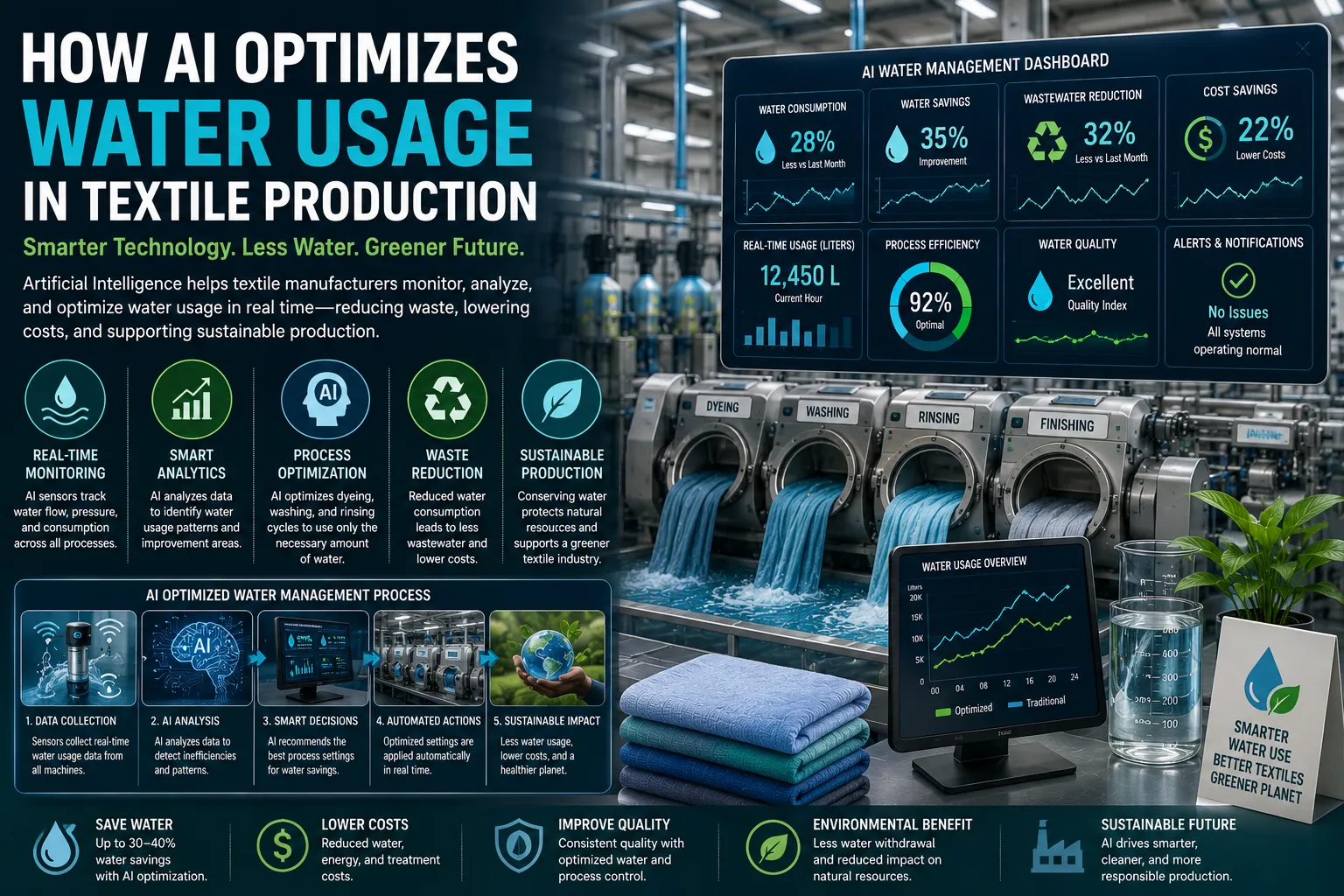
Artificial Intelligence is transforming textile production by helping manufacturers use water more efficiently while maintaining high product quality and reducing environmental impact. Water is one of the most valuable resources used in textile manufacturing, especially during dyeing, washing, bleaching, printing, and finishing processes. Traditional textile production often consumes thousands of liters of water every day, making water conservation a major challenge for manufacturers around the world. Rising environmental concerns, stricter regulations, and increasing production costs have encouraged textile companies to adopt smarter technologies that reduce water consumption without affecting productivity. Artificial Intelligence provides an intelligent solution by analyzing production data, monitoring water usage in real time, optimizing manufacturing processes, and recommending improvements that reduce unnecessary consumption. Instead of depending only on manual monitoring, manufacturers can rely on AI to make accurate decisions that improve efficiency while supporting sustainable textile production. As digital transformation continues across the textile industry, AI is becoming an essential tool for responsible water management and environmentally friendly manufacturing.
Why Water Management Is Important in Textile Manufacturing
Water plays an essential role in almost every stage of textile production. It is used for dyeing fabrics, washing fibers, bleaching materials, printing designs, finishing textiles, cleaning equipment, and cooling manufacturing systems.
Excessive water consumption increases production costs while placing pressure on natural water resources and wastewater treatment systems. In many regions, water shortages have become a serious concern, making efficient water management an important business and environmental priority.
Artificial Intelligence helps manufacturers understand exactly where water is being used and identifies opportunities to reduce unnecessary consumption throughout production.
How Artificial Intelligence Optimizes Water Usage
Artificial Intelligence collects information from production equipment, water flow sensors, quality inspection systems, and manufacturing software.
Machine learning algorithms analyze this information continuously to identify patterns, predict water requirements, detect unusual consumption, and recommend process improvements.
Instead of applying the same amount of water to every production cycle, AI adjusts water usage according to fabric type, production conditions, machine performance, and quality requirements.
This intelligent approach improves efficiency while reducing waste.
Smarter Dyeing Processes
Dyeing is one of the most water intensive operations in textile manufacturing.
Artificial Intelligence optimizes dyeing by analyzing fabric characteristics, dye formulations, temperature, processing time, and water requirements before production begins.
AI recommends the most efficient dyeing parameters to achieve consistent color quality while using the minimum amount of water necessary.
Better process control reduces repeated dyeing operations, lowers wastewater generation, and improves production efficiency.
Manufacturers achieve both cost savings and environmental benefits.
Improving Washing Operations
Washing removes excess dyes, chemicals, and impurities from textile products after various manufacturing processes.
Artificial Intelligence monitors washing cycles and determines the precise amount of water required for each batch of fabric.
Instead of using fixed washing programs, AI adjusts cycle duration, water volume, and machine settings according to production needs.
These improvements reduce unnecessary water consumption while maintaining excellent product quality.
Real Time Water Monitoring
One of the greatest advantages of Artificial Intelligence is continuous monitoring.
AI connected sensors measure water flow, pressure, temperature, and consumption throughout the factory in real time.
When unusual water usage is detected, the system immediately alerts production managers so corrective action can be taken.
Real time monitoring prevents water loss caused by leaks, equipment problems, or inefficient production practices.
Continuous monitoring also provides valuable data for future process improvements.
Detecting Equipment Problems Early
Faulty equipment can waste significant amounts of water without being immediately noticed.
Artificial Intelligence analyzes machine performance, valve operation, pump efficiency, and production conditions to identify abnormal operating patterns.
Predictive maintenance systems notify maintenance teams before equipment failures occur.
Repairing problems early reduces water loss while improving machine reliability and lowering maintenance costs.
Supporting Sustainable Home Textile Manufacturing
Artificial Intelligence helps manufacturers produce home textile products more responsibly by reducing water usage throughout production.
These products include:
-
Bed Sheets
-
Pillowcases
-
Duvet Covers
-
Comforters
-
Towels
-
Curtains
-
Cushion Covers
-
Table Linen
AI improves production efficiency while helping manufacturers meet growing consumer demand for environmentally responsible home textile products.
Better Production Planning
Efficient production planning also contributes to water conservation.
Artificial Intelligence analyzes customer demand, production schedules, machine availability, inventory levels, and raw material requirements before creating optimized manufacturing plans.
Efficient scheduling reduces unnecessary machine cleaning, repeated production runs, and excessive water consumption between manufacturing batches.
Better planning saves both water and production costs.
Supporting Environmental Sustainability
Reducing water consumption is one of the most important goals of sustainable textile manufacturing.
Artificial Intelligence helps manufacturers lower wastewater generation, improve chemical efficiency, reduce energy consumption, minimize production waste, and support responsible resource management.
Organizations such as Textile Exchange encourage textile companies to adopt advanced technologies that improve environmental performance and conserve natural resources.
Challenges of Implementing AI Water Management
Although Artificial Intelligence provides significant advantages, successful implementation requires investment in digital infrastructure, smart sensors, production software, employee training, and reliable manufacturing data.
Manufacturers must also integrate AI systems with existing production equipment while maintaining accurate monitoring throughout the factory.
Despite these initial investments, many companies achieve long term savings through lower water consumption, reduced operating costs, and improved production efficiency.
The Future of AI in Water Conservation
Artificial Intelligence will continue becoming more advanced as sustainable manufacturing technologies evolve.
Future AI systems will automatically optimize water usage across every stage of textile production while integrating with smart factories, Internet of Things sensors, cloud computing, and digital manufacturing platforms.
Manufacturers will gain even greater control over water management while reducing environmental impact and improving operational performance.
Companies adopting these technologies today will be better prepared for the future of sustainable textile manufacturing.
Why Textile Manufacturers Should Invest in AI
Artificial Intelligence offers benefits that extend far beyond water conservation.
Manufacturers improve production efficiency, reduce operating costs, strengthen quality control, optimize inventory management, lower energy consumption, reduce waste, improve customer satisfaction, and increase long term profitability.
Sustainable manufacturing has become a competitive advantage, making AI one of the most valuable investments available to modern textile businesses.
Conclusion
Artificial Intelligence is helping transform water management in textile production by optimizing dyeing, washing, monitoring, maintenance, and production planning. Through intelligent analysis and real time decision making, AI enables manufacturers to reduce water consumption while maintaining high product quality and improving operational efficiency.
As sustainability becomes increasingly important across the global textile industry, Artificial Intelligence will continue supporting responsible manufacturing practices that protect natural resources while helping companies remain competitive. Businesses that invest in AI powered water management today will lead the future of sustainable textile production.
Frequently Asked Questions
1. How does AI reduce water usage in textile production?
AI analyzes production data and optimizes dyeing, washing, and manufacturing processes to minimize unnecessary water consumption.
2. Which textile processes use the most water?
Dyeing, washing, bleaching, printing, and finishing are the most water intensive textile manufacturing processes.
3. Can AI improve dyeing efficiency?
Yes. AI recommends optimized dyeing parameters that reduce water usage while maintaining color consistency.
4. How does AI monitor water consumption?
AI uses smart sensors and machine learning to track water flow, pressure, and usage in real time.
5. Can AI detect water leaks?
Yes. AI identifies unusual water consumption patterns and alerts maintenance teams before major losses occur.
6. Which home textile products benefit from AI water management?
Bed sheets, towels, pillowcases, duvet covers, comforters, curtains, cushion covers, and table linen.
7. Does AI support sustainable manufacturing?
Yes. AI reduces water consumption, lowers waste, improves efficiency, and supports environmentally responsible production.
8. What technologies work with AI in water management?
Machine learning, Internet of Things sensors, cloud computing, smart monitoring systems, and predictive analytics.
9. Is AI suitable for small textile manufacturers?
Yes. Many AI based monitoring solutions are scalable and suitable for manufacturers of different sizes.
10. Why is AI important for the future of textile manufacturing?
AI helps manufacturers conserve resources, improve efficiency, reduce production costs, strengthen sustainability, and remain competitive in the global textile industry.
Recent Posts
Categories
- Home Textiles (11)
- AI & Textile Innovation (10)
- AI + Textile Manufacturing (10)
- AI + Sustainability (5)
- AI + Home Textiles (4)
- AI + Supply Chain (5)
- AI + Future Technology (7)