Admin June 29, 2026
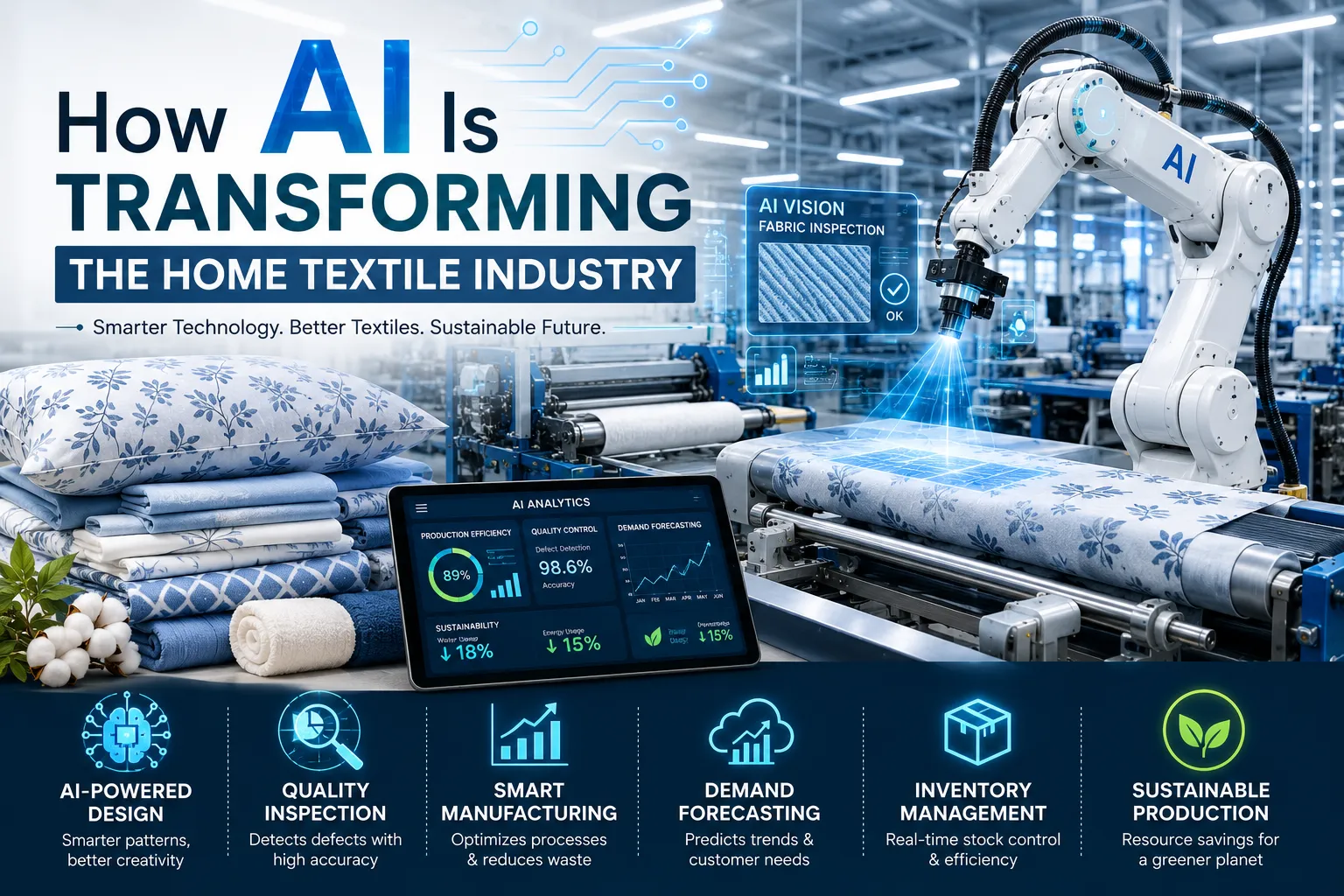
How AI Is Transforming the Home Textile Industry
Discover how AI is transforming the home textile industry through smart manufacturing, quality inspection, demand forecasting, inventory management, and sustainable production. Learn why artificial intelligence is shaping the future of home textiles.
Artificial Intelligence (AI) is rapidly changing industries across the world, and the home textile sector is no exception. From automated quality inspection to demand forecasting and smart manufacturing, AI is helping textile companies improve efficiency, reduce waste, and deliver better products.
As consumer expectations continue to grow, manufacturers are adopting AI-powered technologies to remain competitive. Today, AI is no longer a future concept—it has become an important part of modern textile production.
What Is AI in the Home Textile Industry?
Artificial Intelligence refers to computer systems that can analyze data, recognize patterns, make predictions, and automate tasks that traditionally required human involvement.
In the home textile industry, AI is used throughout the manufacturing process, including:
- Fabric inspection
- Production planning
- Inventory management
- Demand forecasting
- Quality control
- Textile design
- Supply chain optimization
These technologies help manufacturers produce high quality home textile products more efficiently.
AI Improves Textile Quality Inspection
Quality control has traditionally relied on manual inspection, which can be time-consuming and prone to human error.
Modern AI powered vision systems use cameras and machine learning algorithms to detect:
- Fabric defects
- Color variations
- Weaving faults
- Printing errors
- Stitching defects
Automated inspection improves consistency while reducing production waste.
Smarter Demand Forecasting
Predicting customer demand has always been a challenge.
AI analyzes:
- Historical sales
- Seasonal trends
- Consumer behavior
- Market demand
- Economic indicators
This allows manufacturers to plan production more accurately and reduce excess inventory.
AI Helps Optimize Production
Manufacturing efficiency is one of AI's biggest advantages.
AI systems can recommend:
- Better machine scheduling
- Reduced production downtime
- Faster workflow planning
- Lower energy consumption
- Improved factory efficiency
This leads to lower operating costs and higher productivity.
AI in Textile Design
Artificial intelligence is also changing product development.
Design teams now use AI tools to:
- Generate pattern ideas
- Predict color trends
- Create fabric simulations
- Analyze customer preferences
AI supports designers by providing insights rather than replacing creativity.
Human designers still play an essential role in creating unique collections.
AI Powered Inventory Management
Inventory management becomes easier when AI continuously monitors stock levels.
Benefits include:
- Automatic stock tracking
- Reduced overproduction
- Better warehouse management
- Improved order fulfillment
Accurate inventory data helps businesses respond more quickly to customer demand.
AI Supports Sustainable Manufacturing
Sustainability has become a major priority in the textile industry.
AI helps manufacturers reduce environmental impact by optimizing:
- Water usage
- Energy consumption
- Fabric utilization
- Production waste
- Supply chain efficiency
Organizations such as Textile Exchange continue to encourage technologies that improve sustainability across the textile industry.
AI Enhances Customer Experience
Many textile companies now use AI powered tools to improve customer service.
Examples include:
- Product recommendations
- Virtual room visualization
- Personalized shopping
- AI chat assistants
- Order tracking
These technologies help customers make better purchasing decisions.
Challenges of AI Adoption
Although AI offers many advantages, implementation also presents challenges.
Businesses may need to invest in:
- Modern equipment
- Employee training
- Data security
- Software integration
- Skilled technical staff
Smaller manufacturers often adopt AI gradually as technology becomes more affordable.
The Future of AI in Home Textiles
Experts expect AI to become even more important over the next few years.
Future developments may include:
- Fully automated textile factories
- Predictive machine maintenance
- AI-assisted fabric innovation
- Smarter quality control
- More sustainable manufacturing
- Advanced robotics in production
Companies that embrace AI early are likely to remain more competitive in global markets.
Conclusion
Artificial Intelligence is transforming the home textile industry by improving manufacturing efficiency, product quality, sustainability, and customer experience. Rather than replacing people, AI helps manufacturers make smarter decisions and optimize production processes.
As technology continues to evolve, AI will play an even greater role in shaping the future of home textile manufacturing and innovation.
Frequently Asked Questions
1. What is AI in the home textile industry?
AI refers to technologies that automate processes such as quality inspection, production planning, and demand forecasting.
2. How does AI improve textile manufacturing?
It increases efficiency, reduces waste, and improves product quality.
3. Can AI detect fabric defects?
Yes. AI-powered vision systems can identify many types of fabric and stitching defects.
4. Does AI replace textile workers?
No. AI supports workers by automating repetitive tasks, while skilled professionals remain essential.
5. How does AI help sustainability?
AI optimizes energy use, water consumption, and material utilization, helping reduce waste.
6. Is AI used in textile design?
Yes. AI can analyze trends and generate design ideas to support designers.
7. How does AI improve inventory management?
It predicts demand and helps businesses maintain optimal stock levels.
8. Which textile companies use AI?
Many global textile manufacturers are adopting AI for production, quality control, and supply chain management.
9. Is AI expensive to implement?
Initial investment can be significant, but many businesses achieve long-term savings through improved efficiency.
10. What is the future of AI in home textiles?
AI is expected to drive smarter factories, sustainable production, and more personalized customer experiences.
Recent Posts
Categories
- Home Textiles (11)
- AI & Textile Innovation (10)
- AI + Textile Manufacturing (10)
- AI + Sustainability (5)
- AI + Home Textiles (4)
- AI + Supply Chain (5)
- AI + Future Technology (7)