Admin July 6, 2026
How AI Improves Textile Supply Chain Management
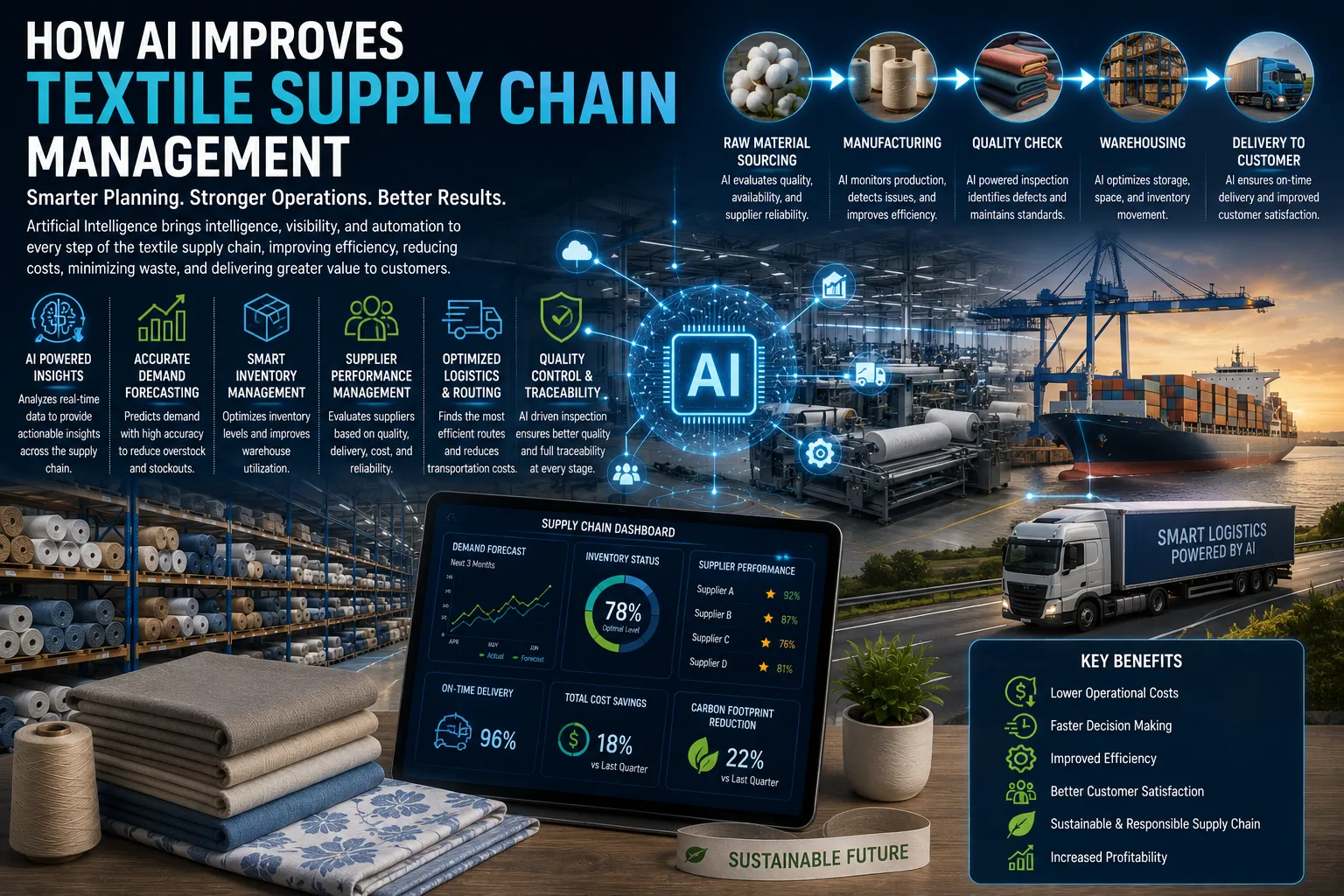
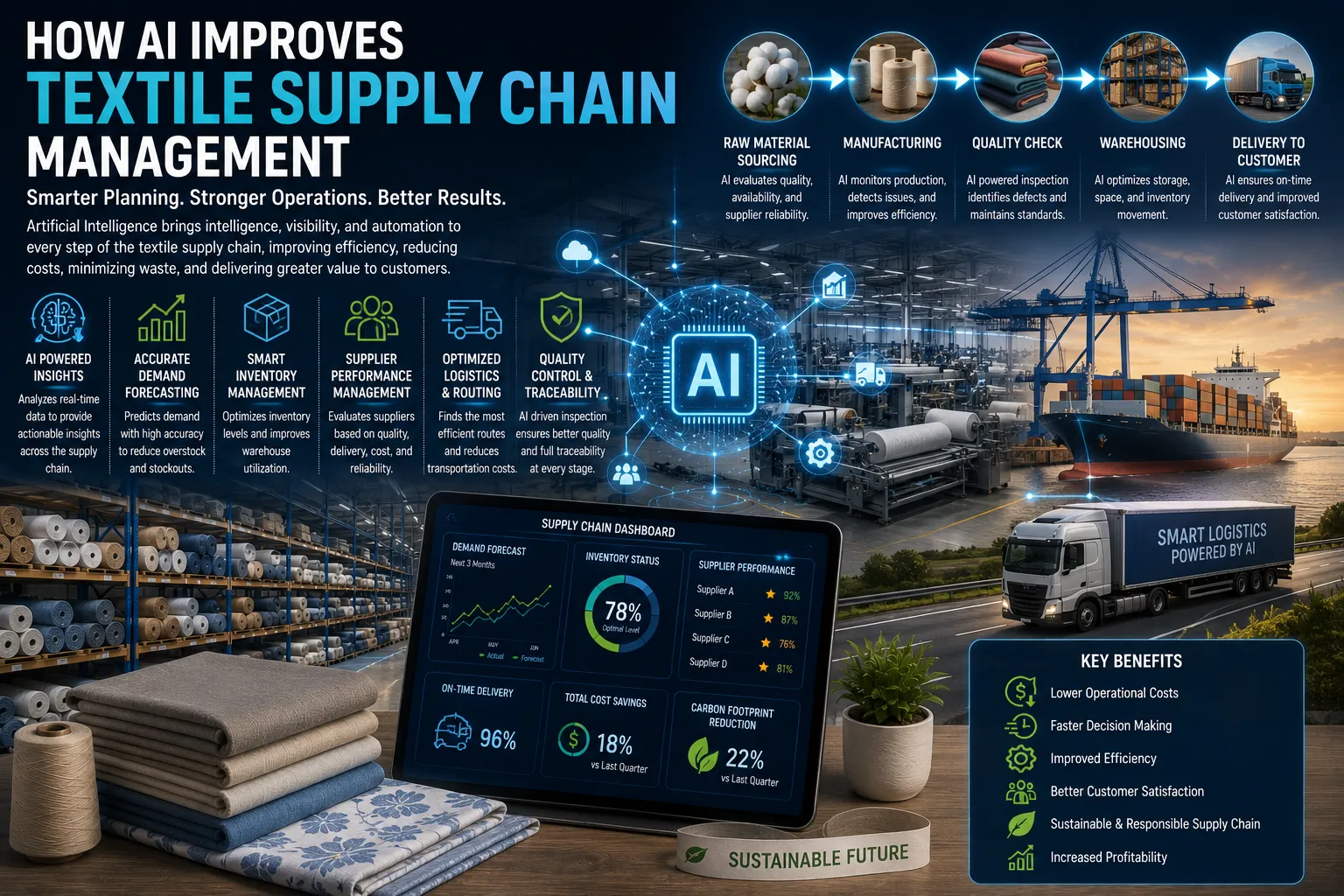
The textile industry depends on a well organized supply chain to deliver raw materials, manufacture quality products, manage inventory, and supply customers around the world. As global demand continues to grow, textile manufacturers face increasing challenges such as fluctuating customer demand, rising transportation costs, production delays, inventory shortages, and supply chain disruptions. Traditional supply chain management often relies on manual planning and historical data, making it difficult to respond quickly to changing market conditions. Artificial Intelligence is transforming textile supply chain management by providing intelligent solutions that improve visibility, automate decision making, and optimize every stage of the supply chain. By analyzing large volumes of information from suppliers, factories, warehouses, logistics providers, and customer orders, AI helps manufacturers make faster and more accurate decisions. The result is improved efficiency, lower operating costs, better customer satisfaction, reduced waste, and a more resilient textile supply chain capable of adapting to changing business conditions.
Understanding Textile Supply Chain Management
A textile supply chain includes every activity involved in producing and delivering textile products from raw materials to the final customer. It begins with sourcing fibers such as cotton, polyester, wool, or linen and continues through spinning, weaving, knitting, dyeing, finishing, manufacturing, packaging, warehousing, transportation, distribution, and retail.
Every stage depends on accurate planning and smooth coordination. Even a small delay in one area can affect the entire production process. Artificial Intelligence improves communication between these stages by providing real time information that supports faster and better decision making.
How Artificial Intelligence Supports Supply Chain Management
Artificial Intelligence gathers information from production systems, supplier databases, warehouse software, transportation networks, customer orders, and sales records.
Machine learning analyzes this information to identify patterns, predict future demand, detect risks, recommend improvements, and automate routine planning activities.
Instead of reacting after problems occur, manufacturers can identify potential disruptions early and take preventive action before they affect production or customer deliveries.
This proactive approach improves reliability while reducing business risk.
Accurate Demand Forecasting
Demand forecasting is one of the most valuable applications of Artificial Intelligence.
AI studies historical sales, seasonal buying patterns, market trends, weather conditions, promotional campaigns, and customer purchasing behavior to estimate future demand with high accuracy.
Manufacturers can produce the right quantities of products while avoiding both shortages and excess inventory.
Accurate forecasting improves production efficiency, reduces waste, lowers storage costs, and increases customer satisfaction.
Smarter Inventory Management
Maintaining balanced inventory levels is essential for efficient textile manufacturing.
Artificial Intelligence continuously monitors raw materials, work in progress inventory, and finished goods across warehouses.
When inventory reaches predefined levels, AI recommends purchasing additional materials or adjusting production schedules.
This reduces unnecessary stock while preventing production delays caused by material shortages.
Improved inventory management also lowers warehousing costs and improves cash flow.
Better Supplier Management
Reliable suppliers are critical for maintaining consistent production quality and delivery schedules.
Artificial Intelligence evaluates supplier performance by analyzing delivery times, product quality, pricing, production capacity, and historical reliability.
Manufacturers can identify the most dependable suppliers and reduce risks associated with delays or inconsistent raw materials.
Better supplier relationships contribute to stronger supply chain performance.
Optimizing Transportation and Logistics
Transportation is one of the largest operating expenses within textile supply chains.
Artificial Intelligence analyzes shipping routes, traffic conditions, transportation schedules, warehouse locations, fuel consumption, and customer delivery requirements.
AI recommends the most efficient logistics plans that reduce transportation time while lowering operating costs.
Improved route planning also reduces carbon emissions and supports sustainable business operations.
Improving Quality Throughout the Supply Chain
Quality control is not limited to factory production.
Artificial Intelligence monitors quality throughout the entire supply chain by analyzing supplier materials, manufacturing performance, storage conditions, transportation environments, and customer feedback.
Computer vision systems inspect fabrics for defects before production continues, while predictive analytics identifies potential quality risks before they become larger problems.
Consistent quality improves customer trust and reduces costly product returns.
Supporting Home Textile Manufacturing
Artificial Intelligence improves supply chain management across many home textile product categories.
These include:
-
Bed Sheets
-
Pillowcases
-
Duvet Covers
-
Comforters
-
Blankets
-
Towels
-
Curtains
-
Cushion Covers
-
Table Linen
-
Mattress Protectors
By improving planning, inventory control, logistics, and production efficiency, AI helps manufacturers deliver these products faster while maintaining high quality standards.
Reducing Waste and Supporting Sustainability
Efficient supply chains contribute directly to sustainable textile manufacturing.
Artificial Intelligence reduces unnecessary transportation, minimizes excess inventory, improves raw material utilization, lowers production waste, and reduces energy consumption throughout manufacturing operations.
These improvements help manufacturers conserve natural resources while lowering operating costs.
Organizations such as Textile Exchange encourage the adoption of advanced technologies that support responsible supply chain management and sustainable textile production.
Managing Supply Chain Risks
Unexpected events such as transportation delays, raw material shortages, natural disasters, or changing customer demand can disrupt textile production.
Artificial Intelligence continuously monitors supply chain performance and identifies potential risks before they become serious problems.
AI recommends alternative suppliers, revised production schedules, or different transportation options to maintain uninterrupted operations.
This flexibility improves business resilience and customer satisfaction.
Challenges of Implementing AI
Although Artificial Intelligence provides significant advantages, successful implementation requires investment in digital infrastructure, reliable production data, software integration, cybersecurity, and employee training.
Manufacturers must also ensure that AI systems remain updated and work effectively with existing enterprise management software.
Despite these initial investments, the long term financial and operational benefits make AI an excellent investment.
The Future of AI in Textile Supply Chains
Artificial Intelligence will continue transforming supply chain management as smart factories, cloud computing, Internet of Things technology, and advanced analytics become more common.
Future AI systems will coordinate suppliers, manufacturers, warehouses, logistics providers, and retailers automatically while providing complete visibility across the entire supply chain.
Real time decision making, predictive analytics, and intelligent automation will create faster, more efficient, and more sustainable textile supply networks.
Companies investing in AI today will gain significant competitive advantages in the future.
Why Textile Manufacturers Should Invest in AI
Artificial Intelligence provides long term benefits across every stage of supply chain management.
Manufacturers achieve lower operating costs, faster deliveries, stronger supplier relationships, improved quality control, reduced inventory waste, greater customer satisfaction, enhanced sustainability, and higher profitability.
As global competition continues increasing, AI enables textile businesses to remain flexible, efficient, and prepared for future market changes.
Conclusion
Artificial Intelligence is revolutionizing textile supply chain management by improving forecasting, inventory planning, supplier management, logistics, quality control, and sustainability. Through intelligent data analysis and automated decision making, AI enables manufacturers to build supply chains that are more efficient, reliable, and resilient.
As digital transformation continues across the textile industry, Artificial Intelligence will become an essential technology for companies seeking long term growth and operational excellence. Manufacturers adopting AI powered supply chain solutions today will be better positioned to meet customer expectations while achieving greater efficiency and sustainable business success.
Frequently Asked Questions
1. How does AI improve textile supply chain management?
AI improves demand forecasting, inventory management, logistics, supplier evaluation, quality control, and production planning.
2. Can AI predict customer demand?
Yes. AI analyzes sales history, market trends, seasonal demand, and customer behavior to forecast future demand accurately.
3. How does AI improve inventory management?
AI monitors inventory levels continuously and recommends optimal purchasing and production decisions.
4. Can AI improve supplier management?
Yes. AI evaluates supplier performance based on quality, reliability, pricing, and delivery history.
5. How does AI reduce transportation costs?
AI optimizes delivery routes, shipping schedules, warehouse operations, and logistics planning.
6. Which home textile products benefit from AI supply chain management?
Bed sheets, pillowcases, duvet covers, comforters, blankets, towels, curtains, cushion covers, table linen, and mattress protectors.
7. Does AI support sustainable manufacturing?
Yes. AI reduces waste, improves resource utilization, lowers energy consumption, and supports environmentally responsible production.
8. What technologies work with AI in supply chains?
Machine learning, Internet of Things devices, cloud computing, predictive analytics, and computer vision.
9. What challenges exist when implementing AI?
Technology investment, employee training, cybersecurity, system integration, and reliable data management are the main challenges.
10. Why is AI important for the future of textile supply chains?
AI enables manufacturers to build smarter, faster, more efficient, and sustainable supply chains that improve customer satisfaction and business performance.
Recent Posts
Categories
- Home Textiles (11)
- AI & Textile Innovation (10)
- AI + Textile Manufacturing (10)
- AI + Sustainability (5)
- AI + Home Textiles (4)
- AI + Supply Chain (5)
- AI + Future Technology (7)