Admin July 3, 2026
How AI Improves Home Textile Product Development
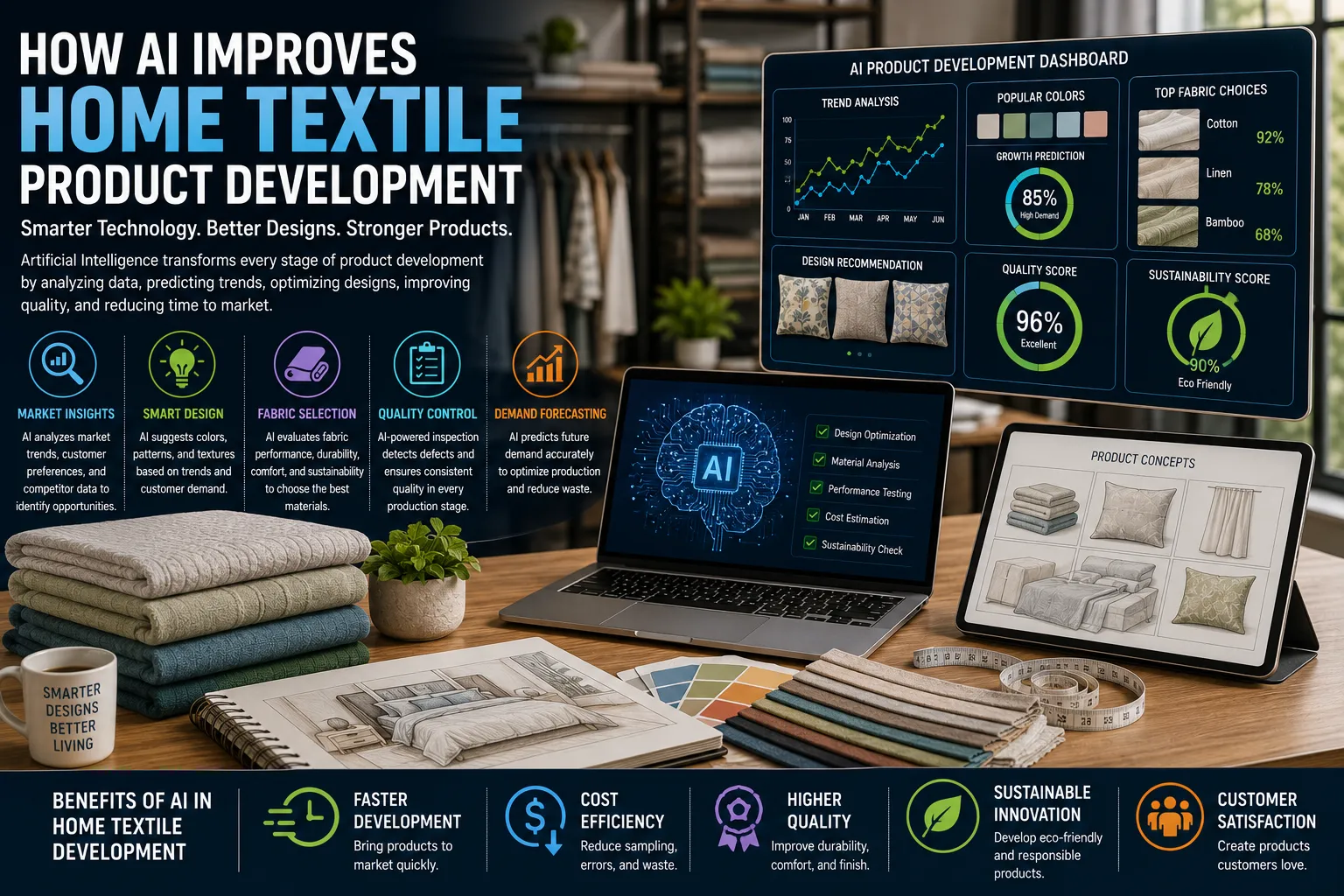
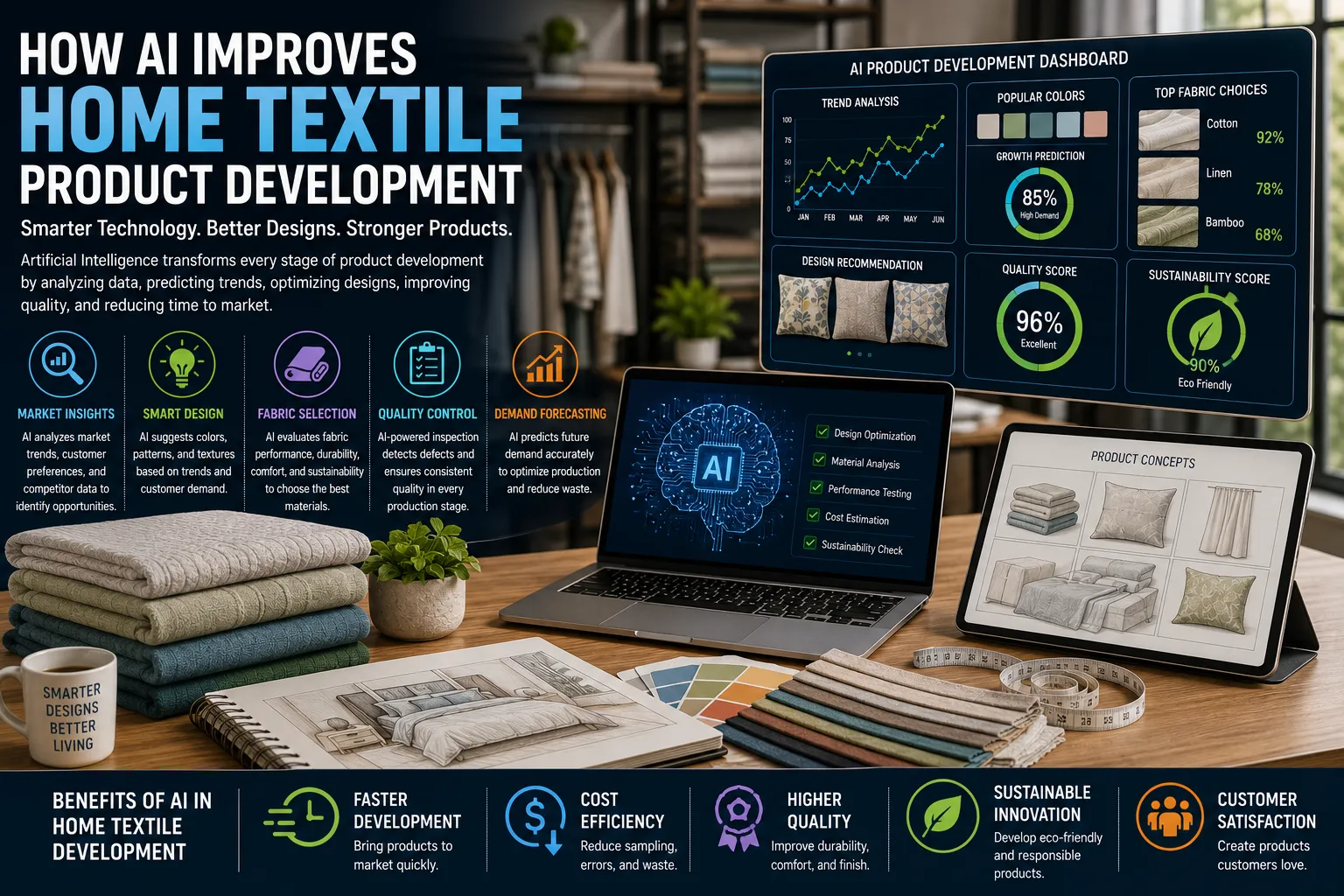
Artificial Intelligence is transforming home textile product development by helping manufacturers create better products in less time while reducing costs and improving quality. The home textile industry is constantly evolving as customers expect products that offer superior comfort, attractive designs, durability, sustainability, and excellent value. Traditional product development often requires months of market research, fabric testing, sample creation, customer feedback, and production planning before a new product reaches the market. Artificial Intelligence simplifies and accelerates this entire process by analyzing massive amounts of information, identifying customer preferences, predicting market trends, and supporting intelligent decision making. Instead of relying only on manual research and experience, manufacturers can use AI to develop innovative products based on real market data. From selecting fabrics and creating patterns to quality testing, inventory planning, and product improvement, Artificial Intelligence is helping home textile companies become faster, smarter, and more competitive in the global marketplace.
What Is AI Powered Product Development
AI powered product development refers to the use of Artificial Intelligence technologies to assist manufacturers during every stage of designing and producing new home textile products.
Artificial Intelligence collects information from customer reviews, online shopping behavior, market trends, production data, quality reports, and sales performance. Machine learning algorithms analyze this information to discover valuable insights that help companies create products customers actually want.
Instead of making decisions based only on assumptions, manufacturers can rely on accurate data to improve every step of product development.
Understanding Customer Preferences
One of the greatest strengths of Artificial Intelligence is its ability to understand changing customer preferences.
AI analyzes purchasing behavior, product reviews, social media discussions, search trends, seasonal demand, and customer feedback from multiple sources. This information helps manufacturers understand which colors, fabrics, textures, sizes, and styles are becoming more popular.
By understanding customer expectations before production begins, companies can develop products with a greater chance of market success.
This reduces business risk while increasing customer satisfaction.
Faster Design Creation
Creating new textile designs traditionally requires significant time and creative effort.
Artificial Intelligence assists designers by generating design ideas, suggesting color combinations, recommending fabric textures, and creating digital patterns based on market trends.
Designers remain responsible for creativity and final decisions, while AI serves as an intelligent assistant that speeds up the creative process.
This allows companies to launch new collections much faster than before.
Better Fabric Selection
Selecting the right fabric is essential for producing high quality home textile products.
Artificial Intelligence evaluates fiber properties, durability, softness, breathability, moisture management, shrinkage behavior, and customer preferences before recommending suitable fabric options.
Manufacturers can compare multiple materials quickly and choose fabrics that deliver the best balance between performance, quality, sustainability, and production cost.
Better material selection results in products that perform well throughout their lifetime.
Improving Product Quality
Quality remains one of the most important factors influencing customer satisfaction.
Artificial Intelligence improves quality by analyzing production data, inspecting fabrics through computer vision, identifying manufacturing defects, and monitoring production consistency.
AI powered quality control systems detect weaving faults, stitching problems, color variations, and surface imperfections before products reach customers.
Higher quality products reduce returns, strengthen brand reputation, and increase customer trust.
Supporting Sustainable Product Development
Sustainability has become a major priority in the home textile industry.
Artificial Intelligence helps manufacturers reduce waste by optimizing fabric utilization, improving production planning, reducing unnecessary sampling, and selecting environmentally responsible materials.
AI also supports efficient water usage, lower energy consumption, better inventory management, and reduced chemical waste during manufacturing.
These improvements benefit both the environment and business profitability.
Supporting Popular Home Textile Products
Artificial Intelligence supports innovation across many home textile categories.
These include:
-
Bed Sheets
-
Pillowcases
-
Duvet Covers
-
Comforters
-
Blankets
-
Towels
-
Curtains
-
Cushion Covers
-
Table Linen
-
Mattress Protectors
Manufacturers use AI to improve product quality, comfort, durability, and customer satisfaction across all of these product categories.Organizations such as Textile Exchange encourage textile companies to adopt advanced technologies.
Smarter Product Testing
Testing new textile products normally requires repeated laboratory evaluations and customer trials.
Artificial Intelligence analyzes previous testing data and predicts how fabrics are likely to perform under different conditions.
Manufacturers can identify potential issues earlier in the development process, reducing the number of physical prototypes required.
This shortens development time while lowering research costs.
Better Inventory Planning
Launching a successful product also requires accurate inventory planning.
Artificial Intelligence analyzes customer demand, seasonal buying patterns, historical sales, warehouse inventory, and production capacity before recommending manufacturing quantities.
Producing the right amount of inventory prevents excess stock while reducing production waste and storage expenses.
Accurate forecasting improves profitability throughout the product life cycle.
Accelerating Innovation
Artificial Intelligence encourages faster innovation by helping manufacturers discover opportunities that may otherwise remain unnoticed.
AI identifies emerging consumer trends, evaluates competitor products, analyzes global markets, and recommends opportunities for product improvement.
Instead of waiting for market changes, manufacturers can introduce innovative products ahead of competitors.
This creates stronger market positioning and long term business growth.
Challenges of Using AI in Product Development
Although Artificial Intelligence provides many advantages, successful implementation requires reliable production data, employee training, digital infrastructure, and integration with existing manufacturing systems.
Manufacturers must also maintain human creativity and product expertise while using AI as a decision support tool rather than replacing experienced designers.
Companies that combine technology with human knowledge achieve the best results.
The Future of AI in Home Textile Development
Artificial Intelligence will continue transforming home textile innovation over the coming years.
Future AI systems will create personalized textile products, recommend sustainable materials, simulate product performance before manufacturing, automate quality testing, predict customer preferences more accurately, and support intelligent product customization.
As smart manufacturing expands, AI will become an essential part of every stage of home textile product development.
Businesses investing in these technologies today will become leaders in tomorrow's textile industry.
Why Home Textile Manufacturers Should Invest in AI
Artificial Intelligence offers long term benefits that extend beyond faster product development.
Manufacturers gain improved product quality, lower development costs, reduced waste, better inventory management, stronger sustainability, higher customer satisfaction, faster innovation, increased profitability, and improved global competitiveness.
These advantages make Artificial Intelligence one of the most valuable technologies available for modern home textile businesses.
Conclusion
Artificial Intelligence is revolutionizing home textile product development by helping manufacturers design better products faster while reducing costs and improving sustainability. Through intelligent data analysis, market forecasting, quality improvement, material selection, and customer insight, AI enables companies to create innovative products that meet changing consumer expectations.
As technology continues advancing, Artificial Intelligence will become even more important for manufacturers seeking to remain competitive in the rapidly evolving home textile industry. Companies that adopt AI driven product development today will be well prepared for future market opportunities while delivering higher quality products that customers truly value.
Frequently Asked Questions
1. How does AI improve home textile product development?
AI analyzes customer preferences, market trends, production data, and quality information to support faster and smarter product development.
2. Can AI help create new textile designs?
Yes. AI assists designers by suggesting patterns, colors, textures, and design ideas based on current market trends.
3. Does AI improve textile quality?
Yes. AI detects manufacturing defects, monitors production consistency, and improves quality control.
4. Can AI reduce product development costs?
Yes. AI reduces sampling, improves planning, shortens development time, and minimizes production waste.
5. How does AI help select fabrics?
AI evaluates material properties, durability, comfort, sustainability, and customer preferences before recommending suitable fabrics.
6. Which home textile products benefit from AI?
Bed sheets, pillowcases, duvet covers, comforters, blankets, towels, curtains, cushion covers, table linen, and mattress protectors.
7. Does AI support sustainable manufacturing?
Yes. AI improves resource efficiency, reduces waste, conserves water, and supports environmentally responsible production.
8. Can AI predict customer demand?
Yes. AI analyzes purchasing behavior, seasonal trends, and historical sales to forecast future demand.
9. What challenges exist when using AI?
Technology investment, employee training, reliable production data, and system integration are the most common challenges.
10. Why is AI important for the future of home textiles?
AI enables manufacturers to develop innovative, sustainable, and high quality products faster while remaining competitive in the global market.
Recent Posts
Categories
- Home Textiles (11)
- AI & Textile Innovation (10)
- AI + Textile Manufacturing (10)
- AI + Sustainability (5)
- AI + Home Textiles (4)
- AI + Supply Chain (5)
- AI + Future Technology (7)