Admin June 30, 2026
AI vs Human Textile Designers: Can AI Replace Creativity?
Can AI replace human textile designers? Discover how Artificial Intelligence and human creativity work together in textile design, pattern creation, trend forecasting, and product innovation.
Artificial Intelligence (AI) is transforming the textile industry, from manufacturing and quality control to fabric design and trend forecasting. As AI powered design tools become more advanced, an important question arises: Can AI replace human textile designers?
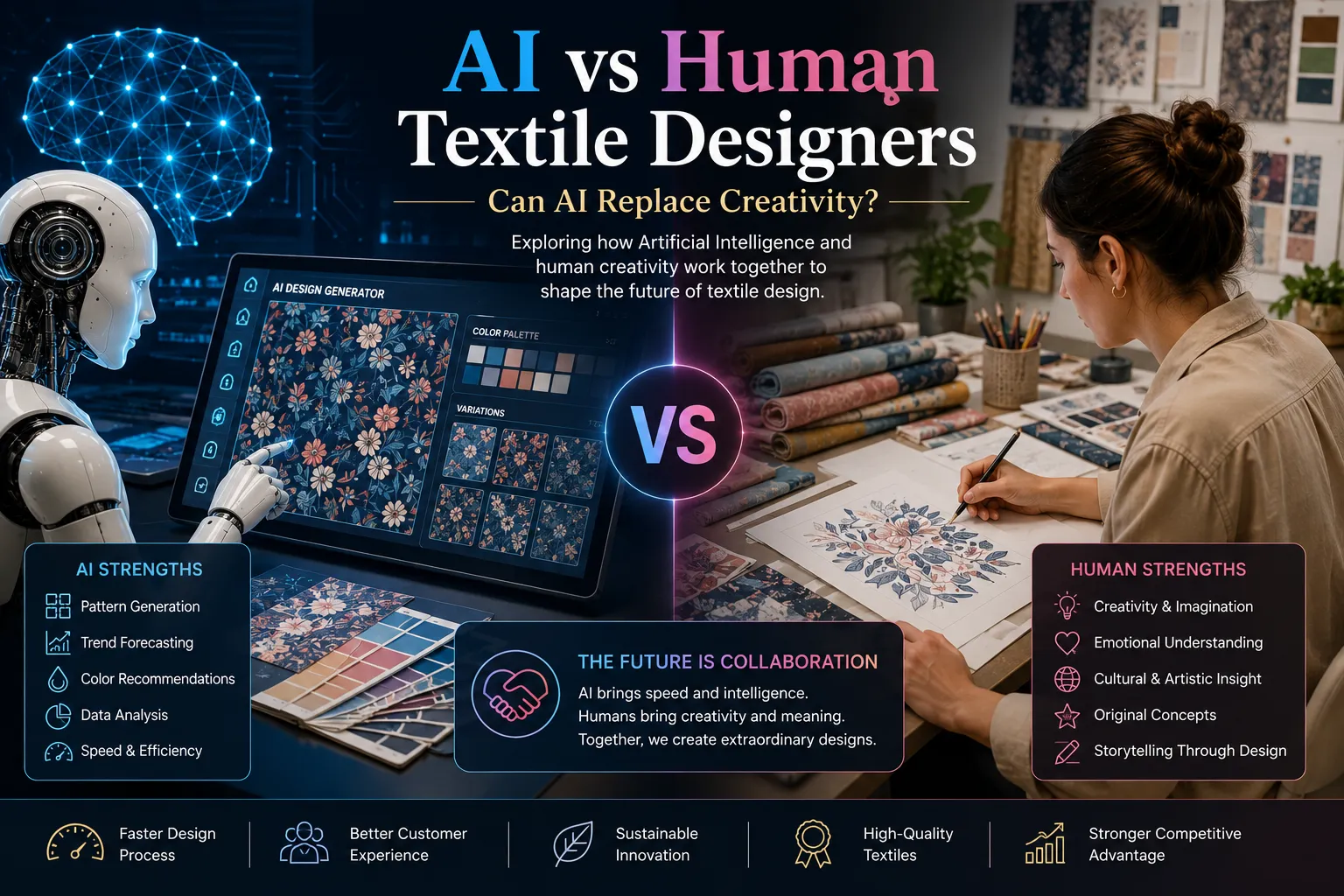
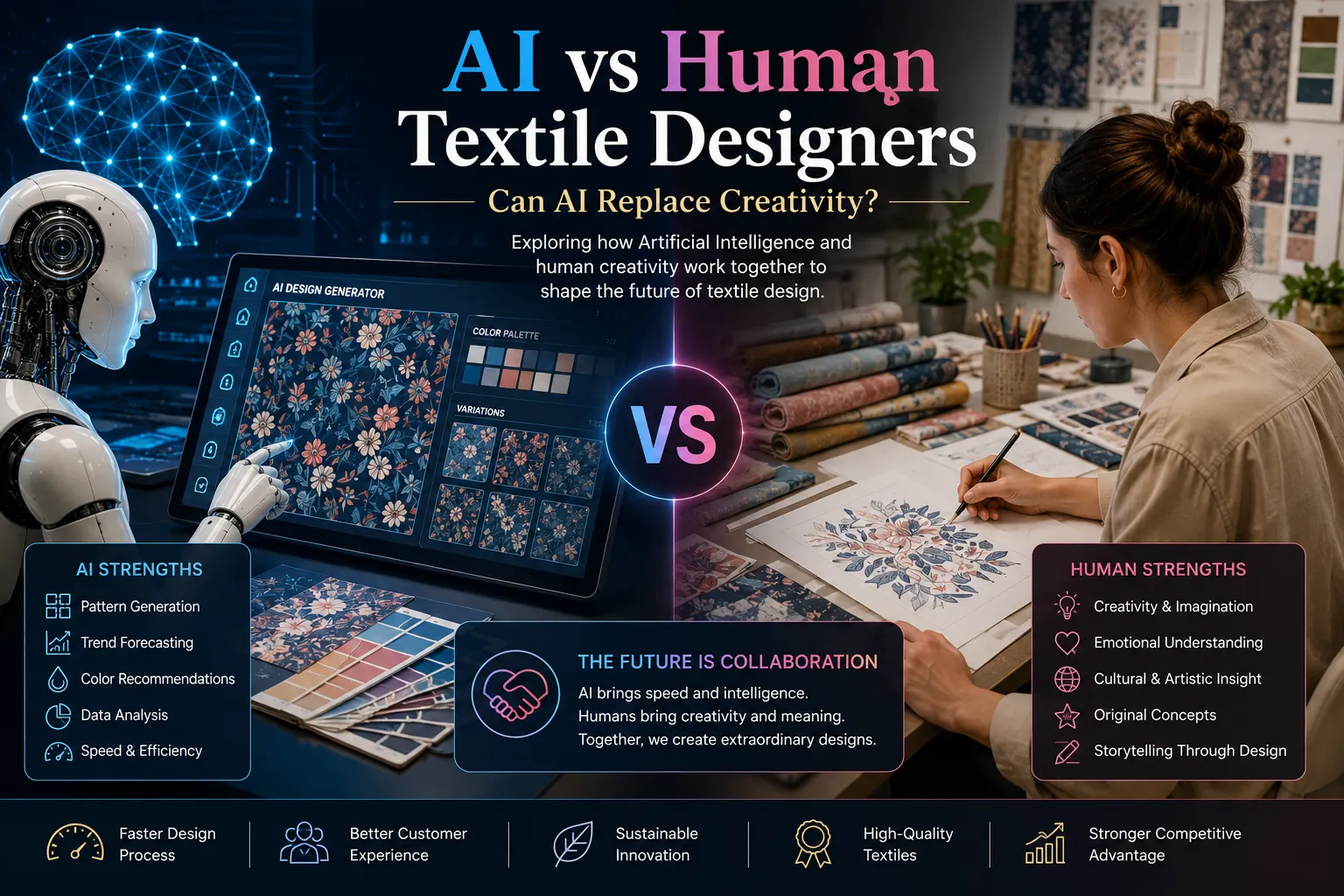
The simple answer is no. While AI can automate repetitive tasks, analyze large datasets, and generate design suggestions within seconds, it cannot fully replace human imagination, cultural understanding, and emotional creativity. Instead, AI is becoming a powerful creative partner that helps designers work faster and make better decisions.
In today's textile industry, the future belongs to collaboration between AI and human designers, not competition.
Understanding AI in Textile Design
AI in textile design uses machine learning, computer vision, and generative AI to assist designers throughout the product development process.
Modern AI systems can:
-
Generate textile patterns
-
Suggest color palettes
-
Analyze market trends
-
Predict consumer demand
-
Create digital fabric simulations
-
Speed up product development
These capabilities reduce manual work while giving designers more time to focus on innovation.
What Human Designers Bring That AI Cannot
Although AI is highly efficient, textile design is about more than producing patterns.
Human designers contribute qualities that technology cannot easily replicate, including:
-
Creative imagination
-
Emotional storytelling
-
Cultural inspiration
-
Artistic judgment
-
Understanding of customer emotions
-
Original design concepts
A designer can create a collection inspired by history, architecture, or personal experiences something AI can only imitate based on existing data.
Where AI Excels
AI performs exceptionally well when handling large amounts of information.
Its strengths include:
Trend Forecasting
AI analyzes global search behavior, social media, fashion shows, and customer preferences to identify emerging trends.
Pattern Generation
AI can quickly create hundreds of pattern variations based on specific themes or design requirements.
Color Recommendations
By studying seasonal preferences and consumer behavior, AI suggests color combinations likely to perform well in the market.
Virtual Sampling
Instead of producing physical fabric samples, AI-powered software creates realistic digital simulations that save time and reduce material waste.
Human Creativity Still Leads Innovation
Innovation often begins with curiosity, emotion, and imagination.
Textile designers understand:
-
Lifestyle changes
-
Interior design preferences
-
Cultural symbolism
-
Customer emotions
-
Luxury aesthetics
These elements require human interpretation rather than mathematical prediction.
For example, a designer creating a luxury bedding collection considers not only color but also comfort, atmosphere, and the emotional experience of a bedroom.
AI as a Creative Assistant
Rather than replacing designers, AI works best as a creative assistant.
Designers use AI to:
-
Generate initial concepts
-
Explore multiple layouts
-
Test color combinations
-
Visualize finished products
-
Speed up revisions
The final creative direction still depends on human expertise.
AI in Home Textile Design
Home textile manufacturers increasingly use AI to improve product development.
AI supports the design of:
-
Duvet Covers
-
Pillowcases
-
Towels
-
Curtains
-
Cushions
-
Table Linen
AI helps manufacturers respond faster to changing customer preferences while maintaining quality and consistency.
Why Collaboration Produces Better Results
The strongest textile collections often combine:
Human Strengths
-
Creativity
-
Innovation
-
Emotional intelligence
-
Brand identity
-
Design experience
AI Strengths
-
Speed
-
Data analysis
-
Automation
-
Pattern generation
-
Market prediction
Together, they create products that are both beautiful and commercially successful.
Challenges of Relying Only on AI
Using AI without human oversight can create several problems.
Potential limitations include:
-
Repetitive design ideas
-
Limited originality
-
Lack of cultural context
-
Generic product collections
-
Dependence on historical data
Human review remains essential to ensure authenticity and uniqueness.
The Future of Textile Design
The future is not about AI replacing designers it is about intelligent collaboration.
Over the coming years, textile professionals are expected to use AI for:
-
Faster product development
-
Personalized customer experiences
-
Sustainable design optimization
-
Digital prototyping
-
Predictive trend analysis
Meanwhile, designers will continue leading creativity, storytelling, and innovation.
Organizations such as Textile Exchange encourage innovation while promoting responsible and sustainable textile development.
What This Means for the Textile Industry
Manufacturers that combine AI technology with experienced design teams will be better positioned to compete in global markets.
Benefits include:
-
Faster product launches
-
Better customer satisfaction
-
Reduced development costs
-
Higher product quality
-
More sustainable production
-
Increased innovation
The most successful companies will use AI to enhance human creativity not replace it.
Conclusion
Artificial Intelligence is changing the way textile products are designed, but creativity remains a uniquely human strength. AI excels at automation, data analysis, and efficiency, while designers provide imagination, emotion, and artistic vision.
The future of textile design lies in the partnership between intelligent technology and human creativity. Companies that embrace both will create more innovative, sustainable, and customer-focused textile products.
Frequently Asked Questions
1. Can AI replace textile designers?
No. AI assists designers but cannot replace human creativity, imagination, and artistic judgment.
2. How does AI help textile designers?
AI generates patterns, predicts trends, recommends colors, and speeds up product development.
3. Is AI used in home textile manufacturing?
Yes. Many manufacturers use AI for design, quality control, and production planning.
4. What are the advantages of AI in textile design?
Faster workflows, better trend forecasting, digital sampling, and improved efficiency.
5. What can human designers do that AI cannot?
Human designers bring creativity, emotional storytelling, cultural understanding, and original ideas.
6. Does AI improve sustainability?
Yes. AI helps reduce waste by optimizing production and minimizing unnecessary sampling.
7. Will AI dominate the textile industry?
AI will become increasingly important, but human expertise will remain essential.
8. Is AI suitable for luxury textile design?
Yes. AI can support luxury design projects, but final creative decisions still require experienced designers.
9. How does AI predict design trends?
It analyzes consumer behavior, online searches, market data, and social media patterns.
10. What is the future of AI in textile design?
The future involves close collaboration between AI tools and human designers to create smarter, more innovative textile products.
Recent Posts
Categories
- Home Textiles (11)
- AI & Textile Innovation (10)
- AI + Textile Manufacturing (10)
- AI + Sustainability (5)
- AI + Home Textiles (4)
- AI + Supply Chain (5)
- AI + Future Technology (7)