Admin June 30, 2026
AI Powered Textile Manufacturing: Benefits and Challenges
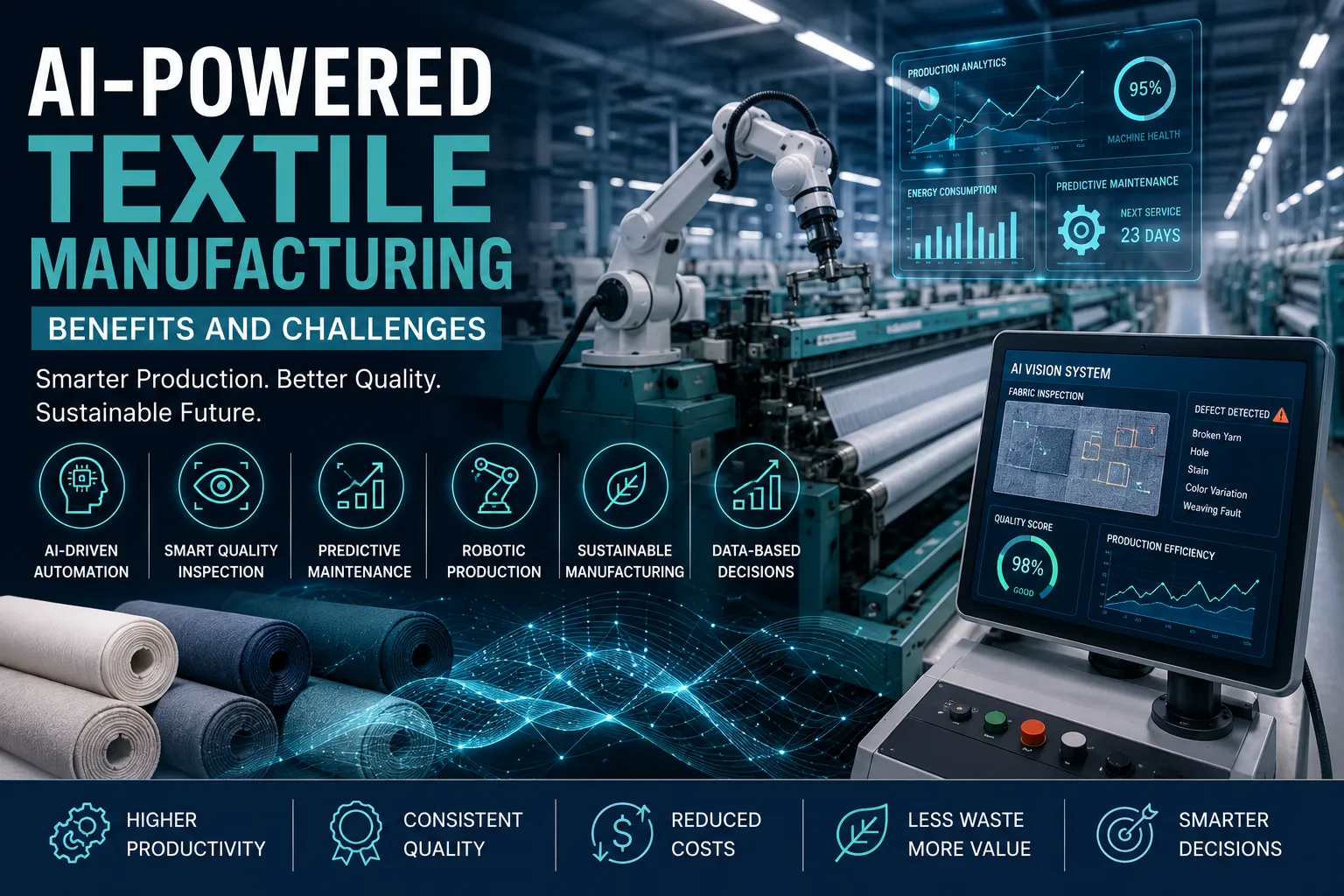
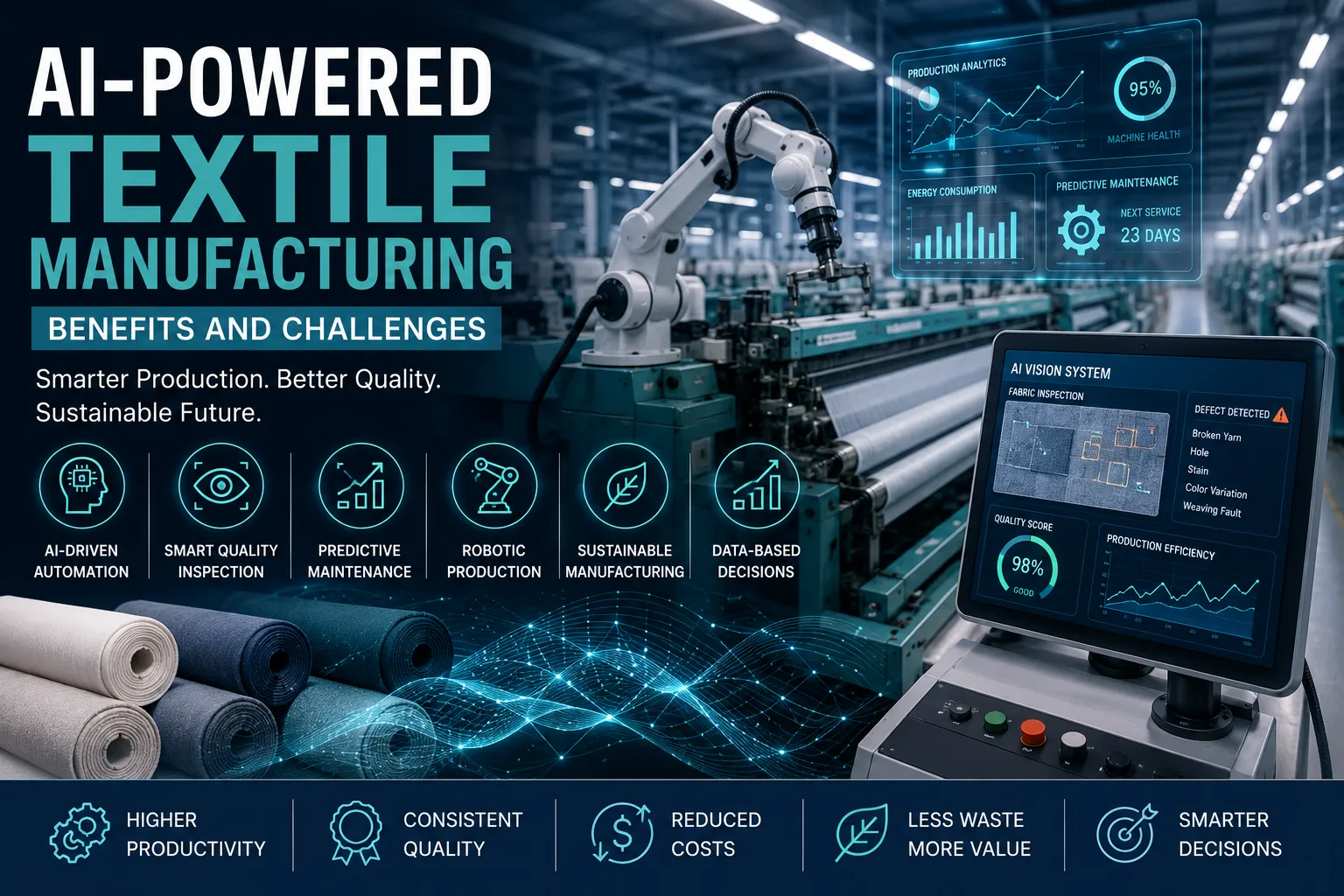
Discover how AI powered textile manufacturing is transforming the textile industry. Learn its benefits, challenges, applications, and the future of artificial intelligence in textile production. Artificial Intelligence (AI) is revolutionizing manufacturing industries around the world, and the textile sector is one of the biggest beneficiaries of this technological transformation. Traditional textile manufacturing has always relied on skilled workers, sophisticated machinery, and continuous quality control. Today, AI is making these processes faster, smarter, and more efficient by enabling manufacturers to automate repetitive tasks, analyze massive amounts of production data, and make informed decisions in real time.
Home textile manufacturers producing bed sheets, towels, duvet covers, comforters, curtains, and hotel textiles are increasingly adopting AI-powered systems to improve productivity while maintaining consistent product quality. Rather than replacing human expertise, AI acts as a powerful assistant that helps manufacturers reduce waste, optimize resources, and respond more quickly to changing market demands.
What Is AI Powered Textile Manufacturing?
AI powered textile manufacturing refers to the use of Artificial Intelligence, machine learning, computer vision, robotics, and advanced data analytics to automate and improve textile production. These technologies collect information from machines, production lines, and quality inspection systems, allowing factories to identify problems before they become costly and optimize every stage of manufacturing. Unlike conventional production methods, AI enabled factories continuously learn from production data. This allows them to improve efficiency over time, reduce downtime, and deliver consistent product quality across large production volumes.
How AI Works in Textile Manufacturing
Modern textile factories generate enormous amounts of production data every day. AI systems collect information from sensors, cameras, and connected machines before analyzing it almost instantly.
The technology can monitor machine performance, detect weaving defects, identify color variations, optimize production schedules, forecast maintenance requirements, and even recommend workflow improvements. Instead of waiting for problems to occur, manufacturers can resolve issues before they affect product quality or delivery schedules.
This predictive capability has become one of the biggest advantages of AI driven manufacturing.
AI Improves Fabric Quality Inspection
Quality inspection is one of the most important stages of textile production. Even small defects in weaving, dyeing, or stitching can affect customer satisfaction and increase production costs.
AI powered computer vision systems use high-resolution cameras combined with deep learning algorithms to inspect fabrics as they move through the production line. These systems can identify weaving defects, broken yarns, printing inconsistencies, stitching problems, and color variations much faster than manual inspection.
Because AI performs inspections consistently without fatigue, manufacturers achieve higher quality standards while reducing human error.
Predictive Maintenance Reduces Machine Downtime
Unexpected machine failures can interrupt production and increase operating costs.
AI continuously monitors machine performance by analyzing vibration levels, temperature, energy consumption, and operating conditions. When unusual patterns appear, the system alerts maintenance teams before equipment breaks down.
This predictive maintenance approach helps manufacturers reduce downtime, extend machine lifespan, improve productivity, and lower repair costs.
Smarter Production Planning
Efficient production planning is essential for meeting customer deadlines and reducing unnecessary costs.
AI analyzes production capacity, available raw materials, workforce availability, historical performance, and customer orders to create optimized manufacturing schedules.
Factories can therefore improve workflow, reduce idle time, balance workloads across departments, and increase overall production efficiency.
AI Enhances Inventory Management
Inventory management becomes increasingly complex as textile manufacturers handle multiple fabrics, colors, accessories, and finished products.
AI helps companies monitor stock levels in real time, predict future demand, identify slow moving inventory, and automate purchase planning.
This reduces overproduction while ensuring sufficient materials remain available to meet customer orders.
Better Demand Forecasting
Accurately predicting market demand has always been difficult in the textile industry because consumer preferences change quickly.
AI analyzes historical sales, online search behavior, seasonal buying patterns, economic indicators, and market trends to estimate future demand more accurately.
Manufacturers can then adjust production volumes before demand changes, reducing excess inventory and improving profitability.
AI Supports Sustainable Textile Manufacturing
Sustainability has become one of the biggest priorities in global textile manufacturing.
AI contributes by optimizing:
-
Fabric utilization
-
Water consumption
-
Energy usage
-
Chemical usage
-
Production planning
-
Waste reduction
By improving operational efficiency, AI helps manufacturers lower their environmental impact while reducing production costs.
Organizations such as Textile Exchange continue encouraging technology that supports responsible and sustainable manufacturing.
AI in Textile Design and Product Development
AI is not limited to factory operations. It also supports textile designers by generating patterns, recommending colors, forecasting trends, and creating digital prototypes.
Manufacturers can develop new home textile collections more quickly while responding to changing consumer preferences.
Products such as bed sheets, duvet covers, towels, curtains, and filled bedding benefit from faster product development cycles.
Benefits of AI-Powered Textile Manufacturing
The adoption of AI offers numerous advantages across textile manufacturing.
Major benefits include:
-
Higher product quality
-
Faster production
-
Reduced manufacturing costs
-
Lower material waste
-
Better inventory management
-
Improved demand forecasting
-
Enhanced customer satisfaction
-
Increased production efficiency
-
Greater sustainability
-
Stronger global competitiveness
These advantages help manufacturers remain competitive in increasingly demanding international markets.
Challenges of AI Adoption
Although AI provides significant benefits, implementing it successfully requires careful planning and investment.
Many manufacturers face challenges such as high implementation costs, integrating AI with existing production systems, training employees, ensuring cybersecurity, maintaining data accuracy, and finding professionals with AI expertise.
Small and medium-sized textile companies may adopt AI gradually, beginning with quality inspection or inventory management before expanding into more advanced applications.
Will AI Replace Textile Workers?
One of the most common concerns is whether AI will replace human workers.
In reality, AI automates repetitive and data intensive tasks, allowing employees to focus on higher value responsibilities such as product development, quality improvement, customer relationships, and creative design.
Experienced textile professionals remain essential because manufacturing still requires technical knowledge, decision-making, and problem solving skills that AI cannot fully replicate.
The Future of AI in Textile Manufacturing
The future of textile manufacturing will combine intelligent automation with human expertise.
Over the coming years, manufacturers are expected to adopt technologies such as autonomous production systems, digital twins, collaborative robots, AI-assisted sustainability monitoring, smart factories, and real time supply chain optimization.
Companies that embrace these innovations early will be better positioned to meet customer expectations while maintaining efficiency, quality, and sustainability.
Conclusion
AI-powered textile manufacturing is transforming the industry by improving productivity, enhancing quality, reducing waste, and supporting sustainable production. From predictive maintenance and automated inspection to demand forecasting and inventory optimization, AI helps manufacturers make smarter decisions throughout the production process.
Rather than replacing human expertise, AI empowers textile professionals with intelligent tools that improve efficiency and encourage innovation. As technology continues to evolve, the partnership between AI and skilled workers will define the future of modern textile manufacturing.
Frequently Asked Questions
1. What is AI powered textile manufacturing?
AI-powered textile manufacturing uses artificial intelligence to automate production, quality control, inventory management, and production planning.
2. How does AI improve textile quality?
AI detects fabric defects, color variations, and stitching issues more accurately than traditional manual inspection.
3. Does AI reduce production costs?
Yes. AI optimizes resources, reduces waste, minimizes downtime, and improves operational efficiency.
4. Can AI predict customer demand?
Yes. AI analyzes historical sales and market trends to improve demand forecasting.
5. Is AI suitable for home textile manufacturing?
Yes. Home textile manufacturers use AI to improve the production of bed linen, towels, curtains, and filled bedding.
6. What are the biggest benefits of AI in textiles?
Improved quality, faster production, lower costs, sustainability, and better decision-making.
7. What challenges do manufacturers face when adopting AI?
Common challenges include implementation costs, employee training, system integration, and data security.
8. Will AI replace textile workers?
No. AI supports workers by automating repetitive tasks while humans continue leading creativity, supervision, and strategic decisions.
9. Is AI helping sustainable textile production?
Yes. AI reduces water use, energy consumption, material waste, and unnecessary production.
10. What is the future of AI in textile manufacturing?
Future developments include smart factories, predictive maintenance, digital twins, autonomous production, and AI-driven supply chains.
Recent Posts
Categories
- Home Textiles (11)
- AI & Textile Innovation (10)
- AI + Textile Manufacturing (10)
- AI + Sustainability (5)
- AI + Home Textiles (4)
- AI + Supply Chain (5)
- AI + Future Technology (7)