Admin July 2, 2026
AI Powered Fabric Inspection Systems for Modern Textile Manufacturing
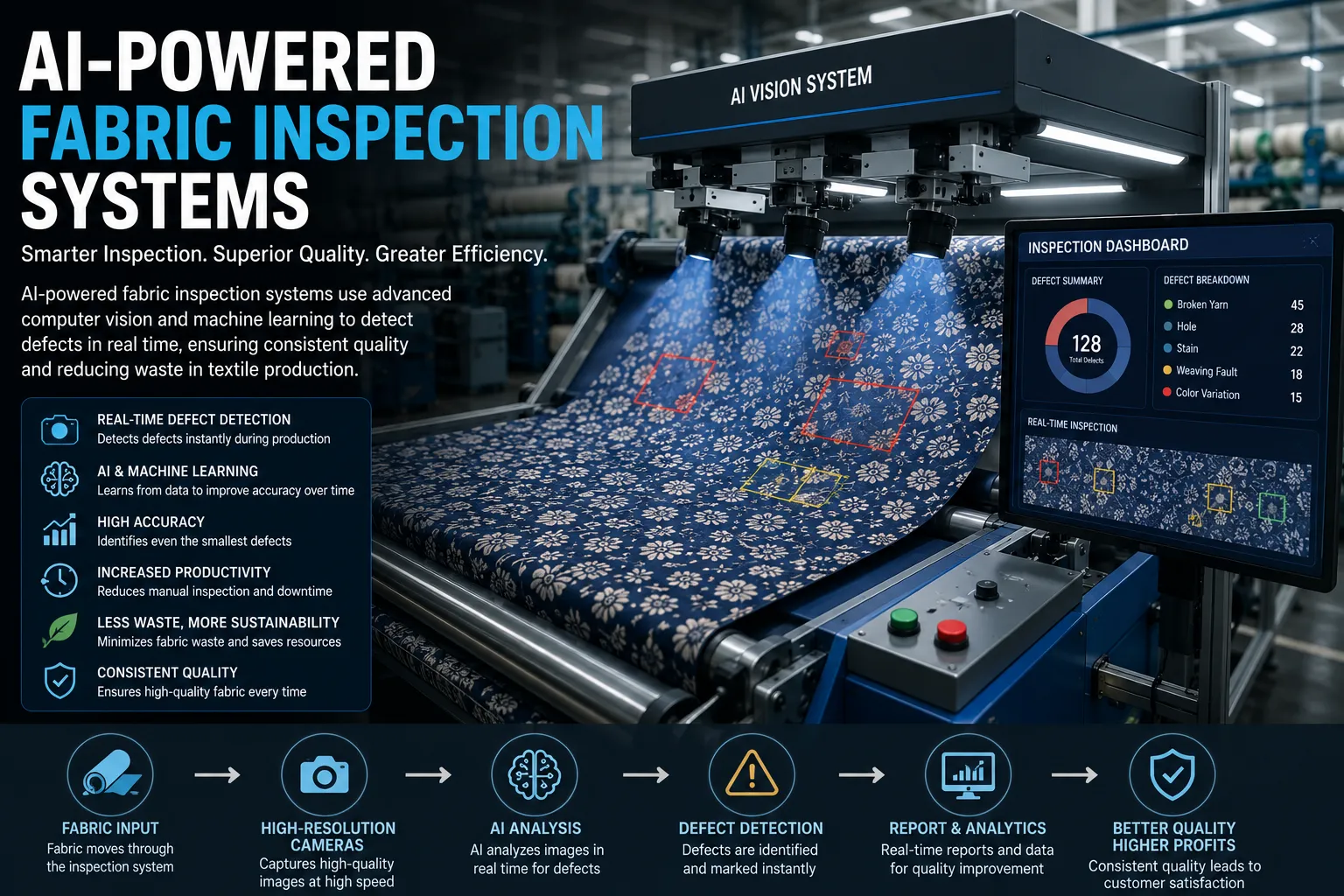
Artificial Intelligence is transforming textile quality control through advanced fabric inspection systems that deliver faster, more accurate, and more reliable results than traditional manual inspection methods. In textile manufacturing, maintaining consistent fabric quality is one of the most important factors for customer satisfaction and business success. Even small defects such as broken yarns, stains, color variations, weaving faults, printing errors, or holes can reduce product value and damage a company's reputation. Manual inspection depends on human attention, which can vary during long production shifts and may result in missed defects. AI powered fabric inspection systems solve these challenges by combining computer vision, machine learning, and high resolution cameras to inspect every meter of fabric with exceptional accuracy. These intelligent systems analyze thousands of images every second, identify defects instantly, and provide manufacturers with real time quality information. As the textile industry continues its digital transformation, AI powered inspection is becoming an essential technology for improving quality, reducing waste, increasing productivity, and supporting sustainable manufacturing.
What Are AI Powered Fabric Inspection Systems
AI powered fabric inspection systems are intelligent quality control solutions that use Artificial Intelligence, computer vision, machine learning, and advanced cameras to inspect fabrics automatically during production. Instead of relying on manual visual checks, these systems continuously scan moving fabric and compare it with quality standards stored in their learning models.
When the system detects an irregularity, it immediately identifies the location, type, and severity of the defect. Production teams receive instant notifications, allowing corrective action before defective fabric continues through the manufacturing process.
This automated inspection process improves both speed and accuracy while reducing human error.
Why Fabric Inspection Is Important
Fabric quality directly affects the performance and appearance of finished textile products. A small defect in fabric can become a major issue once it reaches the customer, leading to product returns, financial losses, and reduced brand trust.
Manufacturers producing home textiles, garments, and industrial fabrics must ensure that every roll of fabric meets strict quality standards before cutting and sewing begin.
AI powered inspection systems provide continuous monitoring throughout production, helping manufacturers maintain consistent quality while reducing the risk of defective products reaching the market.
How Artificial Intelligence Detects Fabric Defects
Artificial Intelligence analyzes images captured by high resolution cameras installed above the production line. As fabric moves through the inspection area, thousands of images are processed every second.
Machine learning algorithms compare these images with patterns learned from millions of previous fabric samples. When the system detects differences from normal fabric structure, it immediately classifies the defect and records its exact position.
The technology becomes more accurate over time because it continuously learns from new production data and inspection results.
This allows manufacturers to improve quality control without slowing production.
Types of Defects AI Can Detect
Modern AI inspection systems can identify many different types of textile defects with remarkable precision.
These include broken yarns, weaving faults, knitting defects, stains, color inconsistencies, printing errors, holes, wrinkles, fabric distortion, missing threads, loose fibers, oil marks, contamination, and surface imperfections.
Because inspection takes place continuously during production, problems can be corrected before large quantities of defective fabric are produced.
This saves both time and manufacturing costs.
Real Time Quality Monitoring
One of the biggest advantages of AI powered inspection systems is real time monitoring.
Instead of inspecting finished fabric after production is complete, manufacturers receive immediate quality information while fabric is still moving through the production line.
Production supervisors can identify trends, adjust machine settings, replace damaged components, or correct process parameters before additional defects occur.
Real time monitoring reduces waste while improving production efficiency and product consistency.
Improving Production Efficiency
Quality problems often create production delays because defective fabric must be repaired, reprocessed, or discarded.
AI powered inspection systems reduce these delays by detecting issues immediately and allowing quick corrective action.
Manufacturers spend less time performing manual inspections and more time focusing on efficient production.
The result is faster manufacturing, lower operating costs, improved productivity, and more reliable delivery schedules.
Supporting Home Textile Manufacturing
Home textile manufacturers depend on consistent fabric quality for products used every day by consumers.
AI powered inspection systems help maintain quality during the production of:
-
Bed Sheets
-
Pillowcases
-
Duvet Covers
-
Comforters
-
Towels
-
Curtains
-
Cushion Covers
-
Table Linen
Accurate inspection ensures these products meet customer expectations while reducing the number of rejected items.
Reducing Waste Through Intelligent Inspection
Textile waste is a significant challenge for manufacturers around the world.
When defects remain undetected until production is complete, large quantities of fabric may need to be discarded or reprocessed.
Artificial Intelligence helps reduce this waste by identifying defects at the earliest possible stage.
Early detection allows manufacturers to correct production problems immediately, reducing material loss, saving energy, and lowering production costs.
This also supports environmentally responsible manufacturing practices.
Organizations such as Textile Exchange encourage manufacturers to adopt technologies that improve efficiency while reducing environmental impact.
External Source
AI Supports Data Driven Quality Control
Every inspection performed by an AI system generates valuable production data.
Manufacturers can analyze defect frequency, machine performance, production efficiency, operator activity, and quality trends over time.
These insights help engineers identify recurring production problems and improve manufacturing processes continuously.
Instead of making quality decisions based only on visual observations, companies can rely on accurate production data for long term improvements.
Challenges of Implementing AI Inspection Systems
Although AI powered inspection provides many benefits, successful implementation requires investment in modern cameras, computing systems, software integration, and employee training.
Manufacturers must also ensure high quality image capture, reliable production data, and regular system updates.
Despite these initial requirements, many companies recover their investment through lower waste, higher productivity, and improved product quality.
The Future of AI Powered Fabric Inspection
AI inspection technology continues to improve every year.
Future systems will detect even smaller defects, classify problems more accurately, predict machine failures before defects occur, and integrate directly with smart factory management systems.
Combined with robotics, cloud computing, Internet of Things technology, and digital manufacturing platforms, AI powered inspection will become a central part of intelligent textile production.
Manufacturers adopting these technologies early will improve quality while strengthening their position in the global textile market.
Why Textile Manufacturers Should Invest in AI Inspection
AI powered fabric inspection offers numerous long term business advantages.
Manufacturers benefit from better quality control, faster inspection, reduced production waste, lower operating costs, improved customer satisfaction, higher productivity, stronger brand reputation, better production data, improved sustainability, and greater competitiveness.
These advantages make AI inspection one of the most valuable investments for modern textile manufacturing.
Conclusion
AI powered fabric inspection systems are transforming textile quality control by combining Artificial Intelligence, computer vision, and machine learning with high speed production monitoring. These intelligent systems detect defects in real time, reduce waste, improve efficiency, and provide manufacturers with valuable production insights.
As textile manufacturing becomes increasingly digital, AI inspection will play an essential role in producing higher quality fabrics while supporting sustainable and cost effective production. Companies that invest in intelligent inspection technology today will be better prepared to compete in the future global textile industry.
Frequently Asked Questions
1. What is an AI powered fabric inspection system?
It is an intelligent quality control system that uses Artificial Intelligence and computer vision to detect fabric defects automatically.
2. How does AI inspect fabric?
AI analyzes images captured by high resolution cameras and compares them with learned quality patterns to identify defects.
3. What defects can AI detect?
Broken yarns, stains, holes, weaving faults, knitting defects, printing errors, color variations, and many other fabric imperfections.
4. Why is AI better than manual inspection?
AI works continuously with consistent accuracy and can inspect fabric much faster than human inspectors.
5. Does AI reduce textile waste?
Yes. Early defect detection prevents large quantities of defective fabric from being produced.
6. Can AI improve textile quality?
Yes. AI provides real time inspection that helps manufacturers maintain consistent quality standards.
7. Which textile products benefit from AI inspection?
Bed sheets, towels, curtains, pillowcases, duvet covers, comforters, upholstery fabrics, and table linen.
8. Is AI inspection suitable for small manufacturers?
Yes. Many scalable AI inspection solutions are available for businesses of different sizes.
9. What technologies are used in AI fabric inspection?
Artificial Intelligence, computer vision, machine learning, high resolution cameras, and image processing software.
10. What is the future of AI fabric inspection?
Future systems will become faster, more accurate, more automated, and fully integrated with smart textile factories.
Recent Posts
Categories
- Home Textiles (11)
- AI & Textile Innovation (10)
- AI + Textile Manufacturing (10)
- AI + Sustainability (5)
- AI + Home Textiles (4)
- AI + Supply Chain (5)
- AI + Future Technology (7)