Admin July 1, 2026
AI Inventory Management for Textile Manufacturers
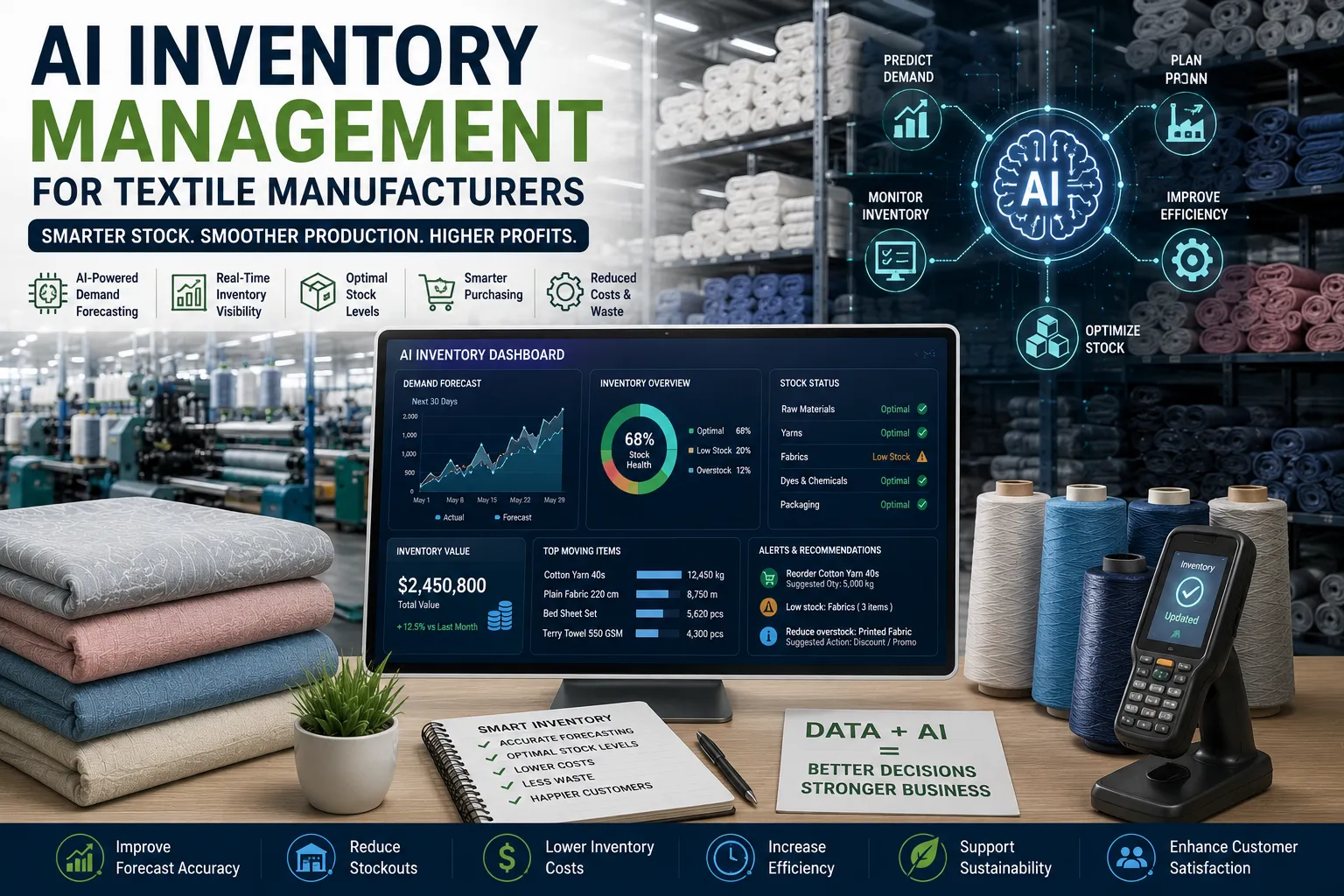
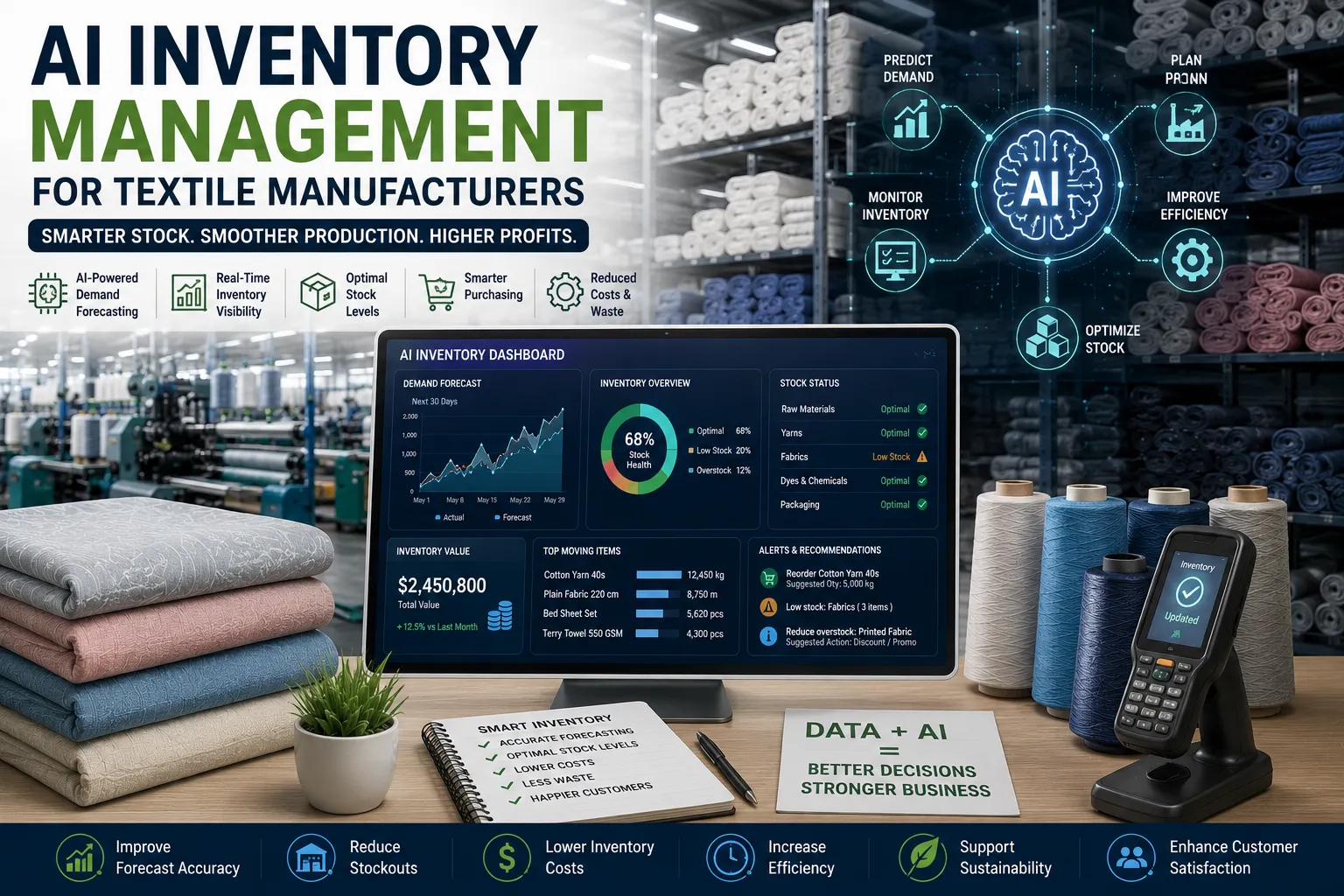
Artificial Intelligence is transforming inventory management across the textile industry by replacing manual stock tracking with intelligent, data driven decision making. Textile manufacturers work with thousands of raw materials, fabric rolls, yarns, dyes, accessories, packaging materials, and finished home textile products every day. Managing this inventory manually can be difficult, especially when customer demand changes quickly or supply chain disruptions occur. Overstocking increases storage costs and ties up valuable business capital, while understocking can delay production and reduce customer satisfaction. AI inventory management solves these challenges by analyzing production data, sales trends, supplier performance, and inventory movement in real time. Instead of relying only on historical records or manual estimates, Artificial Intelligence predicts future inventory requirements with greater accuracy and helps manufacturers maintain the right stock levels at the right time. This intelligent approach improves operational efficiency, reduces waste, supports sustainable manufacturing, and enables textile companies to respond more quickly to changing market conditions.
What Is AI Inventory Management
AI inventory management is the use of Artificial Intelligence, machine learning, and predictive analytics to monitor, analyze, and optimize inventory throughout the textile manufacturing process. Intelligent software collects information from production systems, warehouses, suppliers, customer orders, and sales records before generating recommendations that improve inventory decisions.
Unlike traditional inventory systems that simply record stock quantities, AI continuously learns from business operations and predicts future inventory needs based on changing demand patterns. The more information the system receives, the more accurate its recommendations become.
This allows manufacturers to make faster and smarter purchasing and production decisions while reducing unnecessary inventory costs.
Why Inventory Management Is Important in Textile Manufacturing
Inventory is one of the largest investments for any textile manufacturer. Every roll of fabric, cone of yarn, dye chemical, sewing accessory, packaging material, and finished product represents valuable business capital.
Poor inventory management can create serious operational problems. Excess inventory increases storage costs and may become obsolete if customer preferences change. Insufficient inventory can interrupt production, delay shipments, and damage relationships with customers.
AI helps manufacturers maintain the ideal inventory balance by predicting future demand and recommending the most efficient stock levels.
This improves cash flow while ensuring production continues without unnecessary interruptions.
How Artificial Intelligence Collects Inventory Data
Artificial Intelligence gathers information from multiple business systems and combines it into one intelligent inventory platform.
The system analyzes production schedules, warehouse stock, supplier deliveries, customer orders, historical sales, seasonal demand, transportation schedules, and purchasing activity.
Machine learning algorithms identify hidden relationships between these data sources and generate accurate inventory forecasts that help manufacturers prepare for future demand.
Because inventory conditions change continuously, AI updates its recommendations automatically in real time.
Predicting Future Inventory Requirements
One of the greatest advantages of AI inventory management is its ability to forecast future stock requirements.
Machine learning studies historical sales patterns, seasonal demand, customer buying behavior, promotional campaigns, and market trends before predicting how much inventory will be required in the coming weeks or months.
Instead of making purchasing decisions based on assumptions, manufacturers receive intelligent recommendations that reduce unnecessary stock while preventing shortages.
Accurate forecasting improves business planning and strengthens customer service.
Smarter Purchasing Decisions
Purchasing raw materials at the correct time is essential for efficient textile manufacturing.
AI analyzes supplier performance, delivery times, production schedules, inventory levels, and demand forecasts before recommending when additional materials should be ordered.
This prevents emergency purchasing, reduces unnecessary storage costs, and helps manufacturers negotiate better purchasing agreements with suppliers.
Improved purchasing decisions contribute directly to higher profitability and stronger supply chain performance.
Better Warehouse Management
Modern textile warehouses often contain thousands of different inventory items that must be organized efficiently.
Artificial Intelligence continuously monitors stock movement, identifies slow moving inventory, recommends better storage arrangements, and improves warehouse operations.
Warehouse staff spend less time searching for materials while production teams receive supplies more quickly.
This increases productivity across the entire manufacturing operation.
Reducing Waste Through Intelligent Inventory
Waste reduction is one of the biggest benefits of AI inventory management.
When manufacturers purchase excessive raw materials, unused inventory may remain in storage for long periods before becoming outdated or unusable.
AI minimizes this problem by recommending inventory quantities based on actual production requirements and predicted customer demand.
Better inventory planning reduces fabric waste, unnecessary chemical purchases, excess packaging materials, and obsolete finished products.
This supports both business profitability and environmental sustainability.
Supporting Home Textile Manufacturing
Home textile manufacturers produce many different product categories throughout the year, each with changing customer demand.
Artificial Intelligence helps manage inventory for products including:
-
Bed Sheets
-
Pillowcases
-
Duvet Covers
-
Comforters
-
Towels
-
Curtains
-
Cushion Covers
-
Table Linen
By accurately forecasting inventory requirements for these products, manufacturers improve production planning while reducing storage costs.
Strengthening the Textile Supply Chain
Inventory management plays an important role in the overall textile supply chain.
Artificial Intelligence connects purchasing departments, suppliers, production teams, warehouses, logistics providers, and retailers through one intelligent information system.
Managers gain complete visibility into inventory movement across the entire business, allowing faster decisions and stronger coordination between departments.
This improves delivery performance while reducing unnecessary transportation and storage expenses.
Sustainable Inventory Management
Sustainability has become an important goal for textile manufacturers around the world.
AI supports environmentally responsible inventory management by reducing overproduction, minimizing waste, improving raw material utilization, and optimizing warehouse operations.
Better inventory planning means fewer unused materials, lower energy consumption, and reduced environmental impact.
Organizations such as Textile Exchange encourage manufacturers to adopt digital technologies that improve operational efficiency while supporting sustainable production practices.
Challenges of Implementing AI Inventory Systems
Although AI inventory management offers significant advantages, successful implementation requires planning and investment.
Manufacturers may need modern inventory software, connected production systems, reliable business data, employee training, and cybersecurity protection.
Companies with older manufacturing systems may also need additional integration work before AI can operate effectively.
However, the long term savings often justify the initial investment.
The Future of AI Inventory Management
Inventory management will become even more intelligent as Artificial Intelligence continues to evolve.
Future inventory systems are expected to combine real time sales information, supplier performance, transportation updates, weather conditions, and global market trends into one predictive platform.
Manufacturers may eventually receive automatic purchasing recommendations while AI continuously adjusts inventory based on changing customer demand.
These intelligent systems will improve productivity while reducing operational risk across the textile industry.
Why Textile Manufacturers Should Invest in AI Inventory Management
Companies that adopt AI inventory management gain significant competitive advantages.
Major benefits include improved inventory accuracy, lower warehouse costs, faster purchasing decisions, stronger supply chain coordination, reduced production waste, improved customer satisfaction, better cash flow, more efficient production planning, increased profitability, and greater business flexibility.
These advantages allow textile manufacturers to respond more effectively to changing market conditions while supporting long term business growth.
Conclusion
AI inventory management is transforming textile manufacturing by helping businesses manage stock more accurately, reduce waste, improve purchasing decisions, strengthen supply chain operations, and increase overall efficiency. Instead of relying on manual inventory records and fixed planning methods, manufacturers can use Artificial Intelligence to make smarter decisions based on real time business data.
As customer expectations continue to evolve and global competition increases, intelligent inventory management will become an essential part of every successful textile manufacturing operation. Companies that invest in AI today will be better prepared to improve profitability, operate sustainably, and remain competitive in the future.
Frequently Asked Questions
1. What is AI inventory management?
AI inventory management uses Artificial Intelligence and machine learning to monitor stock, predict demand, and optimize inventory levels.
2. Why is inventory management important for textile manufacturers?
It ensures the right materials are available at the right time while reducing storage costs and preventing production delays.
3. How does AI predict inventory needs?
AI analyzes sales history, production schedules, customer demand, supplier performance, and market trends.
4. Can AI reduce inventory costs?
Yes. AI minimizes overstocking, prevents shortages, and improves purchasing decisions.
5. How does AI improve warehouse operations?
It tracks inventory movement, identifies slow moving stock, and optimizes warehouse organization.
6. Does AI support sustainable manufacturing?
Yes. AI reduces waste, improves raw material utilization, and minimizes unnecessary inventory.
7. Which textile products benefit from AI inventory management?
Bed sheets, towels, duvet covers, pillowcases, curtains, cushion covers, comforters, and table linen.
8. Is AI suitable for small textile manufacturers?
Yes. Many cloud based AI inventory solutions are designed for businesses of every size.
9. What challenges exist when implementing AI inventory systems?
Initial investment, employee training, system integration, and data quality are the most common challenges.
10. What is the future of AI inventory management?
Future systems will provide automated purchasing recommendations, predictive inventory planning, and real time supply chain optimization powered by Artificial Intelligence.
Recent Posts
Categories
- Home Textiles (11)
- AI & Textile Innovation (10)
- AI + Textile Manufacturing (10)
- AI + Sustainability (5)
- AI + Home Textiles (4)
- AI + Supply Chain (5)
- AI + Future Technology (7)