Admin July 2, 2026
AI for Reducing Textile Waste
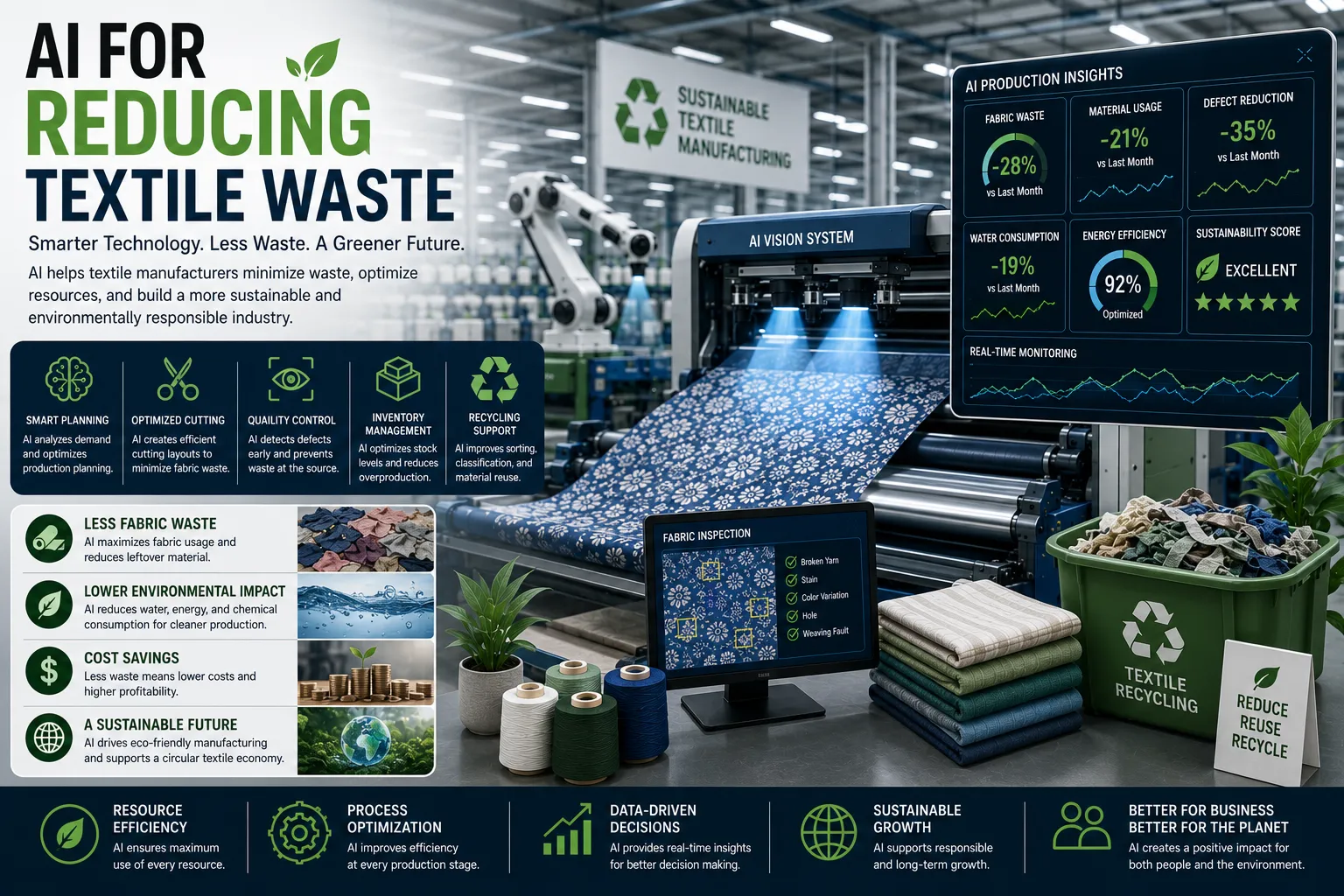
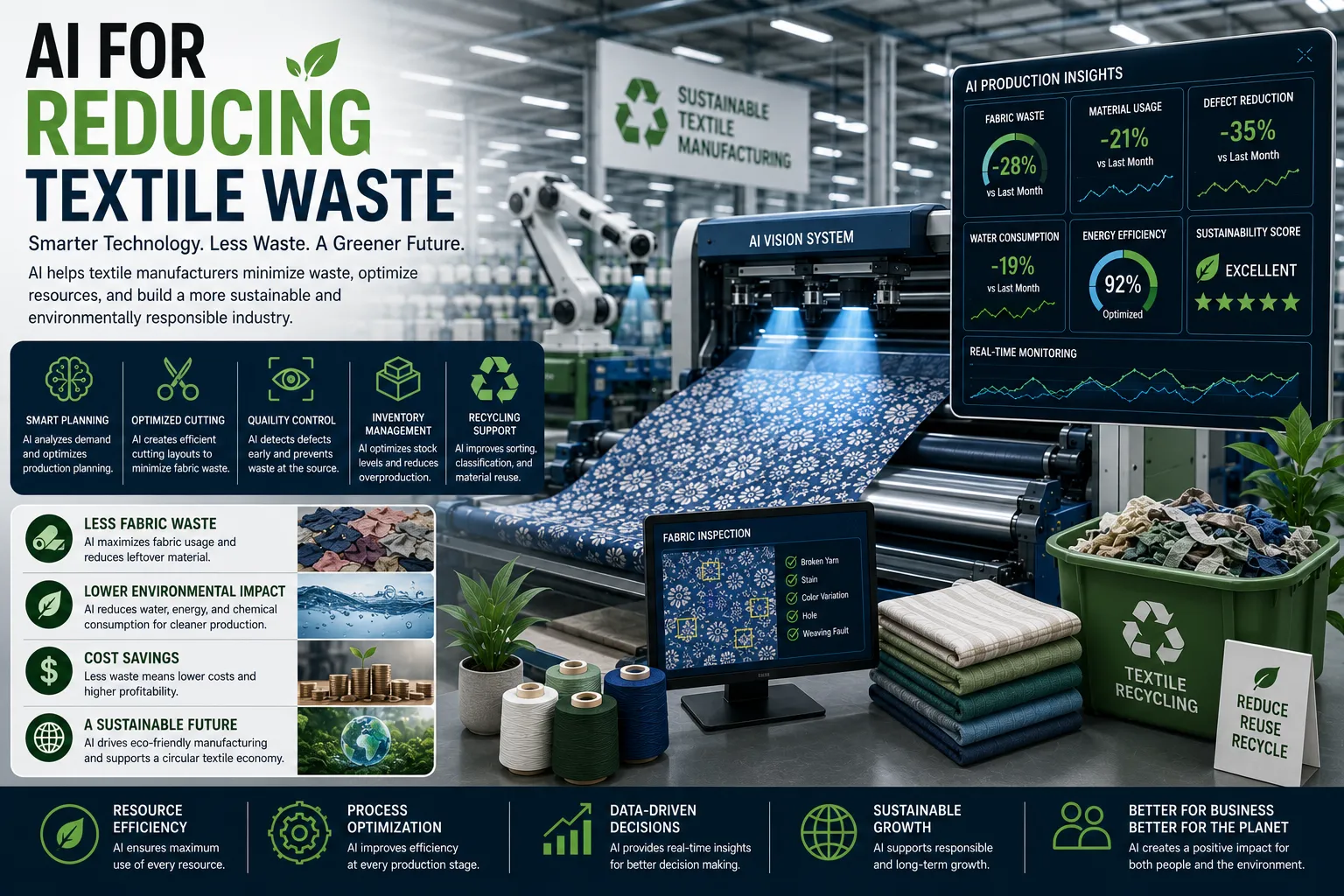
Artificial Intelligence is playing a major role in reducing textile waste by helping manufacturers use resources more efficiently and make smarter production decisions. Textile waste has become one of the biggest environmental challenges facing the global textile industry. Every year, millions of tons of fabric scraps, defective products, excess inventory, and unused raw materials are discarded during manufacturing and after consumer use. This waste not only increases production costs but also places significant pressure on natural resources, energy supplies, and the environment. Artificial Intelligence offers a practical solution by analyzing production data, predicting material requirements, improving quality control, and optimizing manufacturing processes. Instead of relying on manual planning and traditional production methods, textile manufacturers can use AI to minimize waste at every stage of production. From raw material purchasing and fabric cutting to quality inspection, inventory management, and recycling, Artificial Intelligence helps companies produce high quality textile products while supporting sustainability and long term business growth.
What Is Textile Waste
Textile waste includes every type of material that is lost, discarded, or left unused during the production and consumption of textile products. This includes fabric scraps, damaged yarn, defective garments, excess inventory, unsold products, packaging materials, and post consumer textiles.
Many of these materials still have value but are often thrown away because manufacturers lack efficient systems for tracking, recovering, or recycling them. Artificial Intelligence helps solve this problem by improving visibility across the entire manufacturing process and identifying opportunities to reduce unnecessary waste.
Reducing textile waste benefits manufacturers financially while protecting the environment.
How Artificial Intelligence Reduces Textile Waste
Artificial Intelligence analyzes large amounts of production information collected from machines, quality inspection systems, warehouses, customer orders, and supply chains.
Machine learning algorithms identify production patterns, predict future demand, recommend optimized cutting layouts, improve inventory planning, and detect quality problems before they create additional waste.
Instead of reacting after waste has already occurred, manufacturers can prevent waste before it happens.
This proactive approach improves production efficiency while reducing unnecessary material consumption.
Smarter Fabric Cutting
Fabric cutting is one of the largest sources of material waste in textile manufacturing.
Artificial Intelligence creates optimized cutting layouts that maximize fabric utilization while minimizing leftover material. Advanced software analyzes pattern shapes, fabric width, product dimensions, and production requirements before calculating the most efficient cutting arrangement.
Using more fabric from every roll reduces raw material costs while decreasing environmental impact.
Even small improvements in cutting efficiency can save thousands of meters of fabric each year.
Improving Production Planning
Overproduction creates significant textile waste because unsold inventory often remains unused or must be discounted heavily.
Artificial Intelligence improves production planning by analyzing customer demand, seasonal trends, sales history, inventory levels, and market conditions.
Manufacturers receive accurate forecasts that help produce the right quantity of products at the right time.
Better production planning reduces excess inventory while improving cash flow and warehouse efficiency.
Early Defect Detection
Defective products are another major source of textile waste.
AI powered computer vision systems inspect fabrics during production using high resolution cameras and intelligent image recognition software.
The system detects weaving faults, stains, broken yarns, color inconsistencies, printing defects, holes, and stitching problems immediately.
Early detection allows manufacturers to correct machine settings before additional defective materials are produced.
Reducing defective production lowers waste while improving product quality.
Smarter Inventory Management
Maintaining excessive inventory often results in outdated materials, unused fabrics, and obsolete finished products.
Artificial Intelligence continuously analyzes stock levels, supplier performance, customer demand, and production schedules before recommending optimal inventory levels.
Manufacturers purchase only the materials required for planned production while maintaining sufficient stock to avoid shortages.
Efficient inventory management reduces storage costs and prevents unnecessary waste.
Supporting Textile Recycling
Artificial Intelligence is also improving textile recycling by helping manufacturers identify reusable materials more accurately.
AI systems classify different fabric types, fiber compositions, colors, and material conditions, making recycling processes faster and more efficient.
Better material sorting improves recycling quality and increases the amount of textile waste that can be reused instead of being sent to landfills.
These improvements support the development of a circular textile economy.
Supporting Home Textile Manufacturing
Artificial Intelligence helps reduce waste across many home textile product categories.
These include:
-
Bed Sheets
-
Pillowcases
-
Duvet Covers
-
Comforters
-
Towels
-
Curtains
-
Cushion Covers
-
Table Linen
By improving planning, quality control, and production efficiency, AI enables manufacturers to produce these products with less waste and greater sustainability.
Improving Supply Chain Efficiency
Waste does not occur only inside factories. Transportation delays, inaccurate purchasing decisions, and poor inventory coordination also contribute to unnecessary waste.
Artificial Intelligence analyzes supplier performance, warehouse inventory, logistics schedules, production capacity, and customer demand to improve supply chain management.
Better coordination reduces excess inventory, prevents material shortages, and improves resource utilization throughout the supply chain.
Efficient logistics also reduce transportation related emissions.
Supporting Sustainable Manufacturing
Reducing textile waste is one of the most important goals of sustainable manufacturing.
Artificial Intelligence helps manufacturers reduce water consumption, optimize chemical usage, lower energy requirements, improve raw material utilization, and minimize environmental impact through intelligent production planning.
Organizations such as Textile Exchange encourage manufacturers to adopt advanced technologies that improve sustainability while supporting responsible textile production.
Challenges of Using AI for Waste Reduction
Although Artificial Intelligence provides significant benefits, successful implementation requires investment in digital infrastructure, connected production systems, employee training, and reliable manufacturing data.
Companies must also integrate AI solutions with existing production equipment and continuously update machine learning models to maintain high accuracy.
Despite these challenges, the long term savings achieved through lower waste and improved efficiency often outweigh the initial investment.
The Future of AI in Waste Reduction
Artificial Intelligence will continue becoming more advanced as textile manufacturing evolves.
Future AI systems will automatically optimize production schedules, monitor raw material usage, predict waste before it occurs, improve recycling operations, and coordinate sustainable supply chains through intelligent digital platforms.
Combined with robotics, computer vision, Internet of Things technology, and smart factories, AI will play a central role in creating a zero waste textile manufacturing environment.
Manufacturers adopting these technologies today will gain important competitive advantages in the future.
Why Textile Manufacturers Should Invest in AI
Artificial Intelligence offers many long term business benefits beyond waste reduction.
Manufacturers can improve production efficiency, lower operating costs, strengthen quality control, reduce material consumption, optimize inventory, improve customer satisfaction, increase profitability, support sustainability goals, and enhance global competitiveness.
Consumers increasingly value environmentally responsible brands, making sustainable manufacturing an important business opportunity.
Conclusion
Artificial Intelligence is transforming textile manufacturing by helping companies reduce waste through smarter planning, intelligent quality control, optimized fabric utilization, efficient inventory management, and improved recycling processes. Rather than simply automating production, AI enables manufacturers to make better decisions that conserve resources while maintaining high product quality.
As environmental responsibility becomes more important across the textile industry, Artificial Intelligence will continue supporting sustainable manufacturing practices that benefit businesses, consumers, and the planet. Companies that embrace AI driven waste reduction today will be better prepared for the future of responsible textile production.
Frequently Asked Questions
1. How does AI reduce textile waste?
AI improves production planning, quality control, inventory management, fabric cutting, and recycling processes.
2. Can AI reduce fabric waste during cutting?
Yes. AI creates optimized cutting layouts that maximize fabric utilization and reduce leftover material.
3. How does AI improve quality control?
AI powered inspection systems detect defects early before large amounts of defective fabric are produced.
4. Does AI help textile recycling?
Yes. AI identifies, sorts, and classifies textile materials to improve recycling efficiency.
5. Can AI reduce overproduction?
Yes. AI predicts customer demand accurately and helps manufacturers produce only what is needed.
6. Which textile products benefit from AI waste reduction?
Bed sheets, towels, pillowcases, duvet covers, curtains, comforters, cushion covers, and table linen.
7. How does AI improve inventory management?
AI analyzes demand, stock levels, and supplier performance to recommend optimal inventory quantities.
8. Is AI suitable for small textile manufacturers?
Yes. Many AI solutions are scalable and suitable for businesses of different sizes.
9. What challenges exist when implementing AI?
Technology investment, employee training, system integration, and high quality production data are the most common challenges.
10. Why is AI important for sustainable textile manufacturing?
AI reduces waste, conserves resources, improves production efficiency, lowers environmental impact, and supports long term sustainable business growth.
Recent Posts
Categories
- Home Textiles (11)
- AI & Textile Innovation (10)
- AI + Textile Manufacturing (10)
- AI + Sustainability (5)
- AI + Home Textiles (4)
- AI + Supply Chain (5)
- AI + Future Technology (7)