Admin July 1, 2026
AI Demand Forecasting in Home Textiles: How Artificial Intelligence Predicts Customer Demand
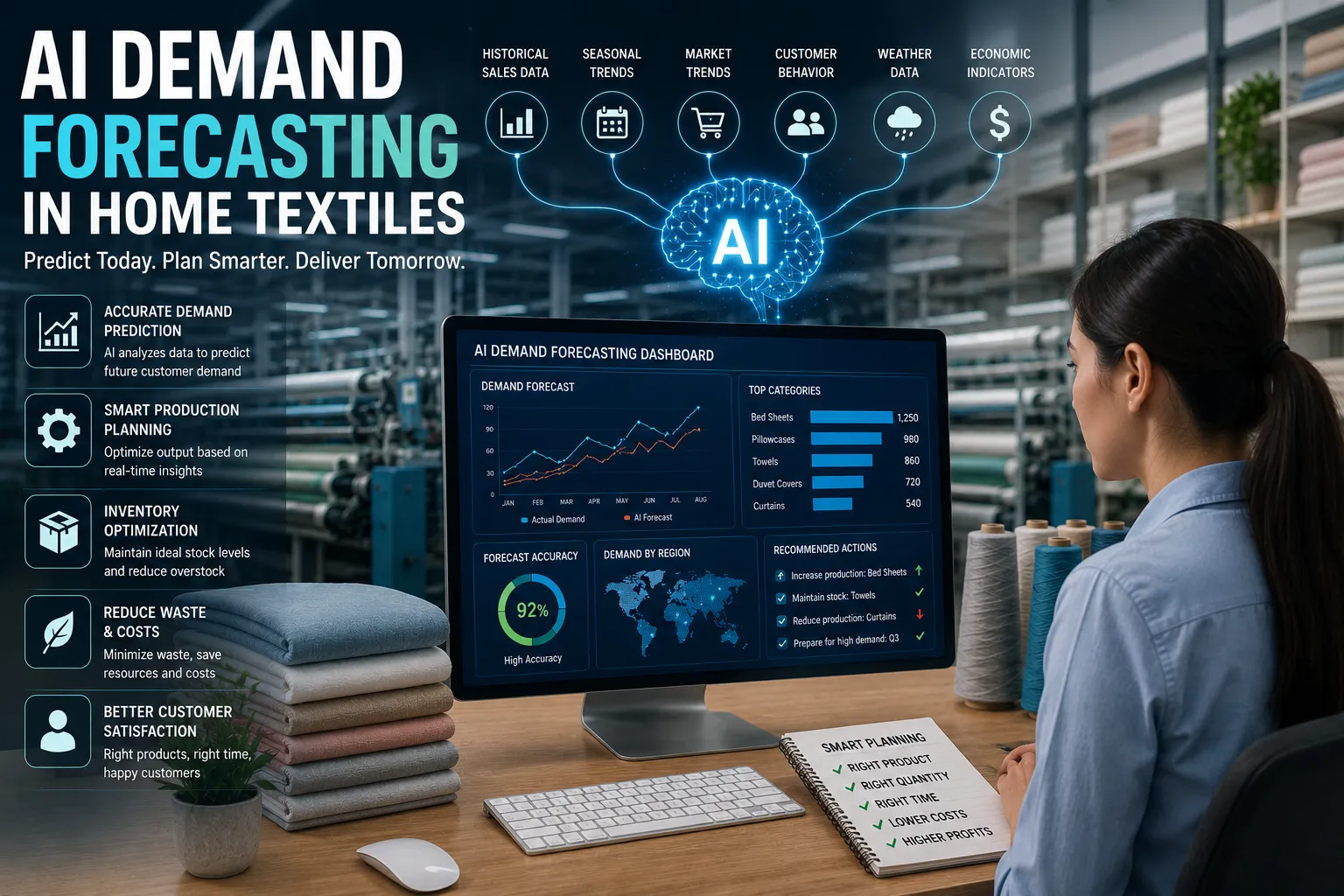
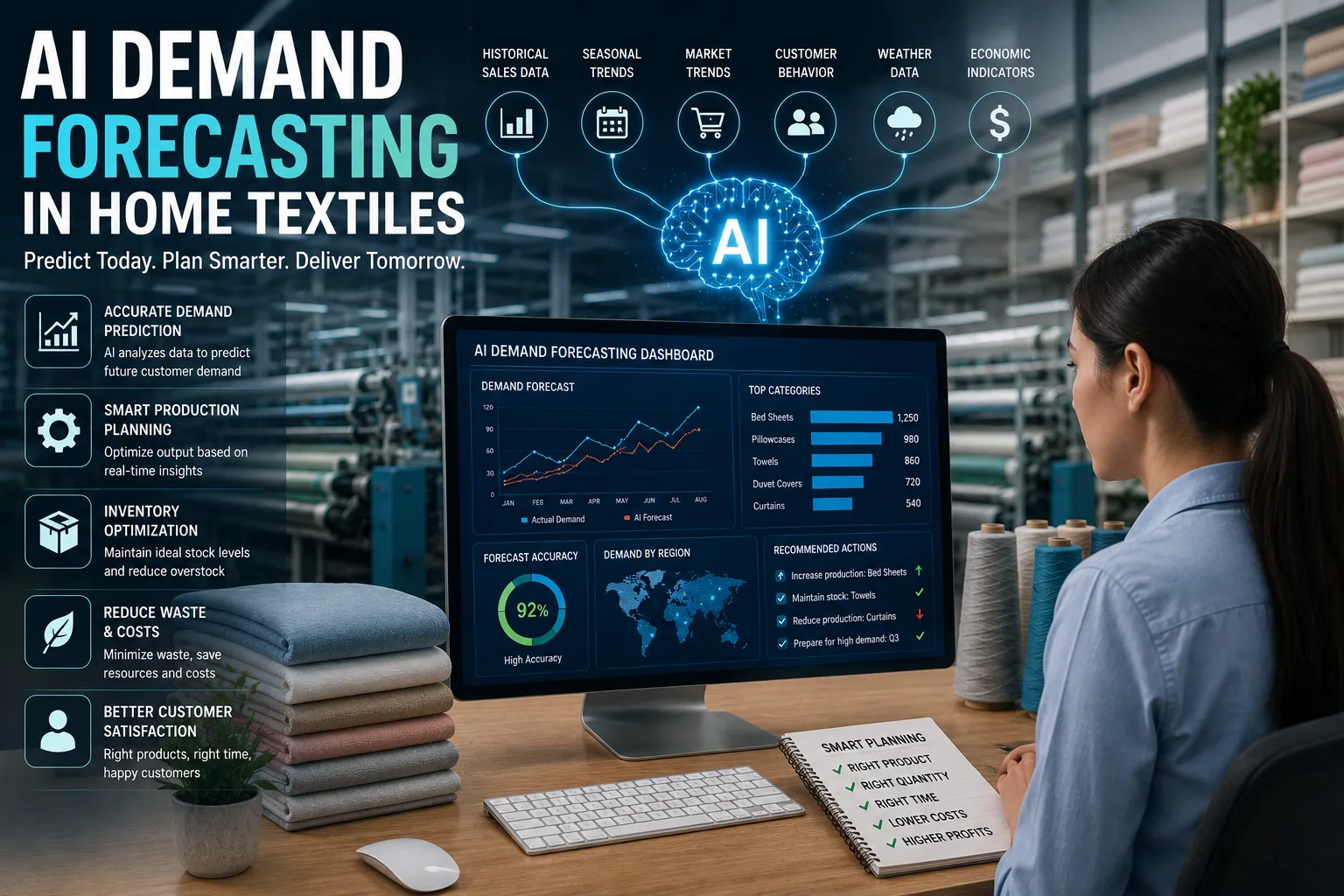
Artificial Intelligence (AI) is changing the way home textile businesses understand customer demand. In today's competitive global market, manufacturers and retailers can no longer rely only on historical sales data or manual forecasting methods. Consumer preferences change quickly due to seasonal trends, online shopping behavior, interior design styles, economic conditions, and social media influence. Producing too many products can increase storage costs and waste valuable resources, while producing too few can result in missed sales opportunities and dissatisfied customers. AI demand forecasting solves these challenges by analyzing enormous amounts of data in real time and predicting future demand with remarkable accuracy. By combining machine learning, predictive analytics, and big data, AI helps home textile manufacturers make informed decisions about production, inventory, purchasing, and supply chain management. Instead of reacting to market changes after they happen, businesses can prepare in advance, improving efficiency, profitability, and customer satisfaction.
What Is AI Demand Forecasting?
AI demand forecasting is the process of using Artificial Intelligence and machine learning algorithms to predict future customer demand based on historical sales, current market trends, seasonal behavior, online search activity, retailer orders, and consumer purchasing patterns. Unlike traditional forecasting methods that often depend on spreadsheets and manual analysis, AI continuously learns from new information and updates its predictions automatically.
The more data the system receives, the more accurate its forecasts become. This enables manufacturers to make faster and more confident business decisions while reducing uncertainty throughout the production process.
Why Demand Forecasting Is Important in Home Textiles
Home textile manufacturers invest heavily in raw materials, production planning, labor, packaging, warehousing, and international shipping. Incorrect demand forecasts can lead to significant financial losses.
If manufacturers produce too many bed sheets, towels, duvet covers, curtains, or pillowcases, excess inventory occupies valuable warehouse space and increases storage costs. On the other hand, underestimating demand can lead to stock shortages, delayed deliveries, and lost customers.
AI demand forecasting helps businesses find the right balance by estimating future customer demand with greater accuracy. This allows manufacturers to optimize production while minimizing unnecessary costs.
How AI Collects and Analyzes Data
AI demand forecasting works by collecting data from multiple sources and transforming it into useful business insights.
These data sources include:
-
Historical sales records
-
Online shopping trends
-
Customer purchasing behavior
-
Search engine activity
-
Retail partner orders
-
Seasonal buying patterns
-
Interior design trends
-
Social media engagement
-
Economic indicators
-
Regional market preferences
Machine learning algorithms analyze millions of data points simultaneously, identifying patterns that would be nearly impossible for humans to detect manually.
As market conditions change, AI continuously updates its forecasts, ensuring businesses always have access to the latest predictions.
Predicting Seasonal Demand
Seasonal changes have a significant impact on home textile sales. Lightweight bedding may experience higher demand during warmer months, while comforters, blankets, and heavier fabrics become more popular during colder seasons.
AI studies previous seasonal performance together with current consumer behavior to predict future purchasing patterns.
Manufacturers can adjust production schedules months in advance, ensuring products are available when customers need them most.
This reduces last-minute production pressure while improving customer satisfaction.
AI Improves Inventory Management
Efficient inventory management is essential for profitable textile manufacturing.
AI helps businesses maintain the right inventory levels by forecasting future sales and monitoring stock in real time. When demand is expected to increase, manufacturers can prepare additional inventory. When demand slows, production can be adjusted to avoid unnecessary stock accumulation.
Better inventory planning reduces warehouse costs, minimizes obsolete inventory, improves cash flow, and ensures products remain available for customers.
Better Production Planning
Production planning becomes much more efficient when manufacturers understand future demand.
AI forecasting enables factories to schedule production more effectively by considering machine capacity, workforce availability, raw material supplies, and customer orders.
Instead of making production decisions based on assumptions, managers rely on accurate data generated by intelligent forecasting systems.
This improves factory utilization while reducing overtime, production delays, and unnecessary operational costs.
Supporting Home Textile Manufacturers
Home textile manufacturers produce a wide range of products that experience changing demand throughout the year.
AI demand forecasting supports the production of:
-
Bed Sheets
-
Pillowcases
-
Duvet Covers
-
Comforters
-
Towels
-
Curtains
-
Cushion Covers
-
Table Linen
By accurately forecasting demand for these products, manufacturers can improve customer service while reducing excess inventory and production waste.
AI Helps Reduce Textile Waste
Overproduction is one of the largest causes of waste in the textile industry.
When products remain unsold, manufacturers lose valuable raw materials, labor, packaging, storage space, and transportation costs.
AI forecasting minimizes overproduction by recommending production quantities based on actual market demand rather than assumptions.
This contributes to more sustainable manufacturing while lowering environmental impact.
Organizations such as Textile Exchange encourage technology that improves efficiency and supports responsible textile production.
AI Strengthens Supply Chain Management
Demand forecasting also improves supply chain performance.
AI predicts future raw material requirements, helping purchasing teams order fabrics, yarns, dyes, and packaging materials at the right time.
Better forecasting reduces supply shortages while preventing excessive inventory purchases.
Suppliers, manufacturers, logistics providers, and retailers all benefit from improved planning and stronger collaboration.
Benefits of AI Demand Forecasting
Implementing AI demand forecasting provides long-term advantages across every stage of textile manufacturing.
Major benefits include:
-
More accurate sales forecasts
-
Better inventory management
-
Lower warehousing costs
-
Reduced production waste
-
Improved customer satisfaction
-
Smarter production planning
-
Faster business decisions
-
Stronger supply chain performance
-
Increased profitability
-
More sustainable manufacturing
These benefits help businesses remain competitive in both domestic and international markets.
Challenges of AI Forecasting
Although AI forecasting offers exceptional accuracy, implementation requires high quality data and ongoing monitoring.
Manufacturers may experience challenges such as incomplete historical data, changing consumer behavior, software integration, employee training, and initial investment costs.
However, as AI systems continue learning from new information, forecasting accuracy improves over time.
Human expertise also remains important for interpreting AI recommendations and responding to unexpected market changes.
The Future of AI Demand Forecasting
Artificial Intelligence will continue becoming more advanced as technology evolves.
Future forecasting systems are expected to combine real time retail sales, smart home purchasing behavior, weather forecasts, economic conditions, and global market trends into highly accurate predictive models.
Manufacturers may eventually receive automated production recommendations generated entirely by AI, allowing them to respond instantly to changing customer demand.
This intelligent decision making will become a key competitive advantage for modern home textile companies.
Conclusion
AI demand forecasting is transforming the home textile industry by replacing guesswork with intelligent, data-driven decision making. Through machine learning, predictive analytics, and real time market analysis, AI enables manufacturers to forecast customer demand more accurately, optimize inventory, improve production planning, reduce waste, and strengthen supply chain performance.
Rather than replacing business professionals, AI provides powerful insights that support better decisions and long-term growth. As technology continues to evolve, companies that adopt AI powered forecasting will be better prepared to meet changing customer expectations while operating more efficiently and sustainably.
Frequently Asked Questions
1. What is AI demand forecasting?
AI demand forecasting uses machine learning and data analysis to predict future customer demand.
2. Why is demand forecasting important for home textiles?
It helps manufacturers produce the right quantity of products, reducing waste and improving customer satisfaction.
3. How does AI predict demand?
AI analyzes historical sales, online searches, seasonal trends, customer behavior, and market data.
4. Which home textile products benefit from AI forecasting?
Bed sheets, towels, duvet covers, curtains, pillowcases, comforters, and table linen.
5. Can AI reduce overproduction?
Yes. AI predicts actual market demand, helping manufacturers avoid unnecessary inventory.
6. Does AI improve inventory management?
Yes. AI helps maintain optimal stock levels and reduces warehousing costs.
7. How does AI support sustainable manufacturing?
It minimizes waste by improving production planning and reducing excess inventory.
8. Is AI demand forecasting accurate?
When supported by quality data, AI provides highly accurate forecasts that improve over time.
9. Can small textile businesses use AI forecasting?
Yes. Many cloud-based AI forecasting solutions are suitable for businesses of all sizes.
10. What is the future of AI demand forecasting?
Future systems will integrate real-time market data, smart analytics, and automated production planning for even greater forecasting accuracy.
Recent Posts
Categories
- Home Textiles (11)
- AI & Textile Innovation (10)
- AI + Textile Manufacturing (10)
- AI + Sustainability (5)
- AI + Home Textiles (4)
- AI + Supply Chain (5)
- AI + Future Technology (7)