Admin July 2, 2026
AI and Robotics in Textile Production
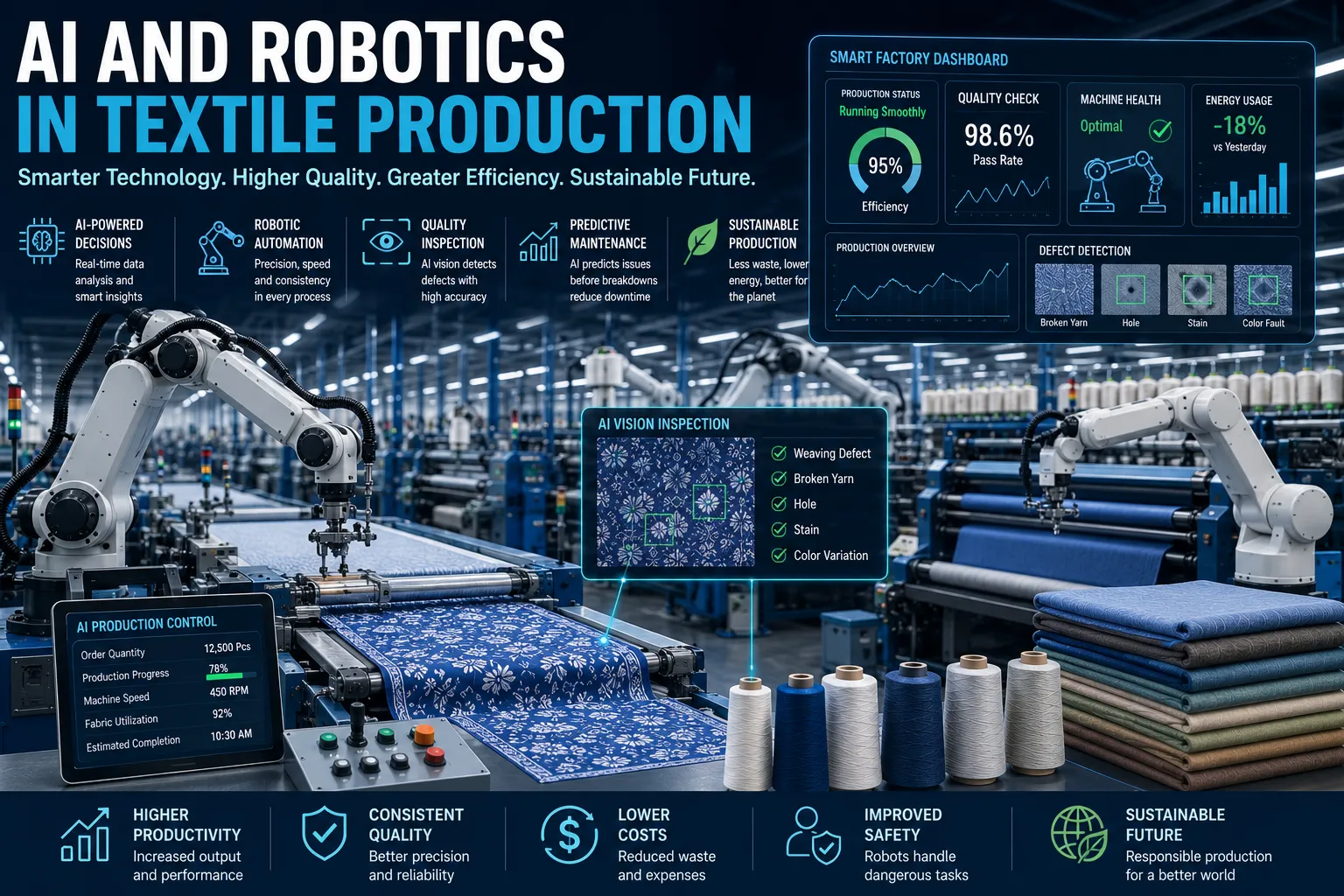
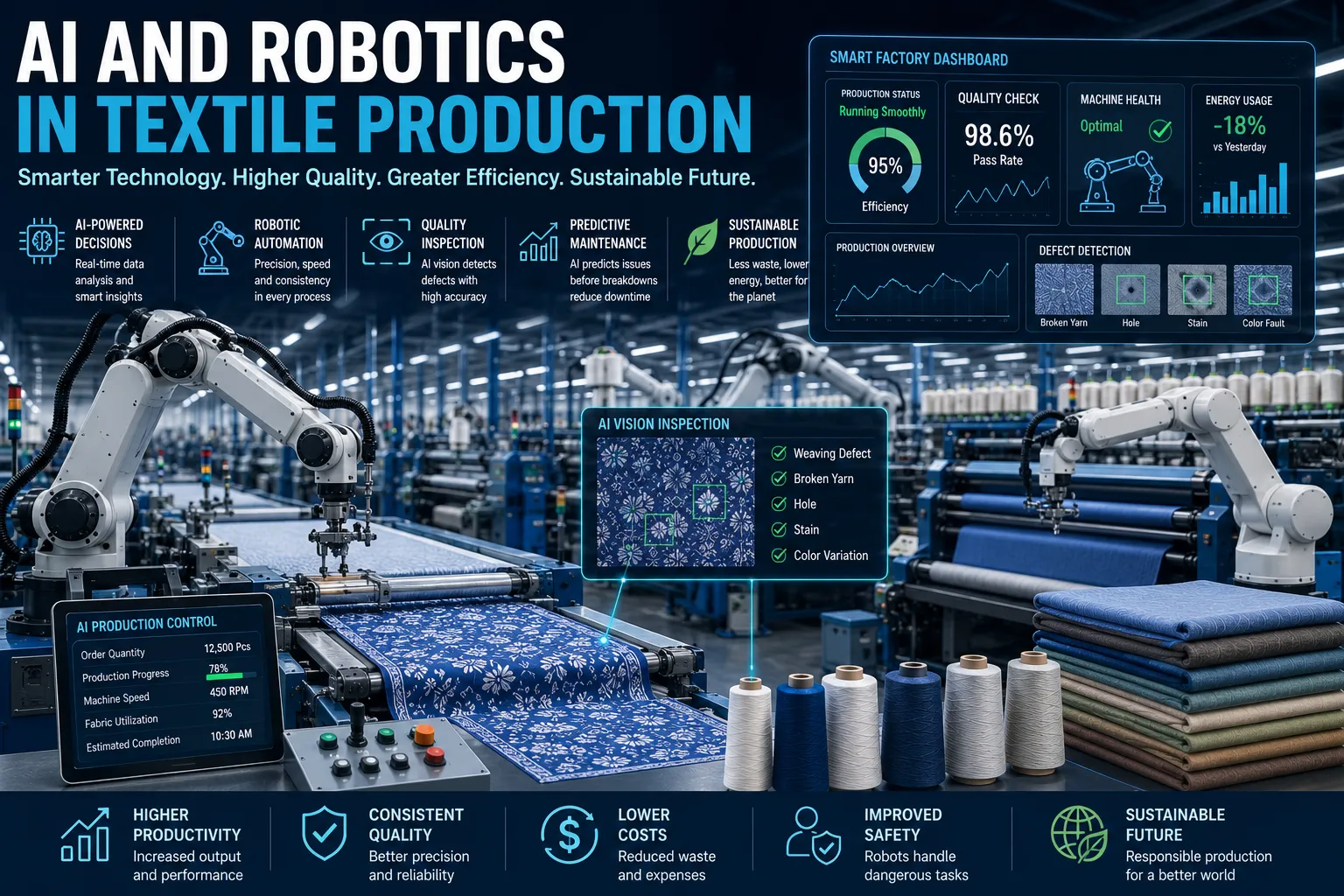
Artificial Intelligence and robotics are transforming the textile industry by creating smarter, faster, and more efficient manufacturing systems. Textile production has traditionally depended on skilled workers and mechanical equipment to perform spinning, weaving, knitting, dyeing, cutting, sewing, finishing, and packaging. While these methods continue to play an important role, modern manufacturers are adopting AI and robotic technology to improve productivity, reduce operational costs, maintain consistent product quality, and respond more quickly to changing customer demands. AI analyzes large amounts of production data and provides intelligent recommendations, while robots perform repetitive and highly accurate manufacturing tasks with speed and precision. Together, these technologies help manufacturers reduce waste, improve workplace safety, optimize resource utilization, and build highly connected production environments. As digital transformation continues across the global textile industry, AI and robotics are becoming essential technologies for manufacturers seeking long term growth, greater efficiency, and sustainable production.
What Are AI and Robotics in Textile Production
Artificial Intelligence is the technology that enables computer systems to learn from production data, recognize patterns, predict future outcomes, and support intelligent decision making. Robotics refers to programmable machines that perform physical manufacturing tasks automatically with high precision and consistency.
When AI and robotics work together, manufacturers can automate both decision making and production activities. AI monitors production conditions, analyzes machine performance, predicts maintenance requirements, and improves planning, while robotic systems perform material handling, fabric inspection, cutting, sewing, packaging, and other repetitive operations.
This combination creates a smarter production environment that continuously improves efficiency and product quality.
Why Textile Manufacturers Are Investing in AI and Robotics
The textile industry operates in a highly competitive market where manufacturers must deliver premium quality products while controlling production costs and meeting strict delivery schedules. Manual operations alone often struggle to meet these increasing expectations.
AI and robotics help manufacturers improve operational efficiency by reducing human error, increasing production speed, maintaining consistent quality, and optimizing manufacturing resources. Intelligent automation also allows companies to respond more quickly to customer demand while improving overall profitability.
As technology becomes more affordable, manufacturers of every size are exploring AI powered production solutions.
Intelligent Automation Improves Manufacturing Efficiency
One of the greatest advantages of combining AI with robotics is intelligent automation.
Unlike traditional automated machines that simply repeat fixed instructions, AI powered robotic systems analyze production conditions and adjust their operations when necessary. If production speed changes, material quality varies, or customer requirements are updated, the system can recommend or implement adjustments automatically.
This flexibility improves production efficiency while reducing unnecessary downtime and material waste.
Manufacturers can produce more products in less time while maintaining consistent quality.
AI Powered Fabric Inspection
Maintaining fabric quality is one of the most important responsibilities in textile production.
AI powered computer vision systems inspect fabrics using high resolution cameras and machine learning algorithms. These systems detect weaving defects, broken yarns, stains, printing errors, color inconsistencies, holes, and surface imperfections with remarkable accuracy.
When defects are identified, robotic handling systems can separate defective materials automatically, allowing corrective action before production continues.
This intelligent quality control process improves customer satisfaction while reducing production waste.
Robotic Cutting and Sewing
Cutting and sewing are among the most labor intensive stages of textile manufacturing.
Modern robotic systems perform these operations with exceptional precision by following digital production instructions generated by AI software. Robots accurately cut fabric according to optimized layouts that reduce material waste while maintaining consistent dimensions.
Advanced sewing robots also perform repetitive stitching operations with excellent accuracy, improving productivity and ensuring consistent product quality across large production volumes.
These technologies are especially valuable for manufacturers producing bed sheets, pillowcases, duvet covers, towels, curtains, and other home textile products.
Predictive Maintenance for Textile Machinery
Unexpected equipment failures can interrupt production and increase operating costs.
Artificial Intelligence continuously monitors machine temperature, vibration, operating speed, power consumption, and production performance. Machine learning algorithms identify unusual operating patterns that may indicate future equipment failures.
Maintenance teams receive early notifications before breakdowns occur, allowing repairs to be completed during planned maintenance periods.
This predictive maintenance approach reduces downtime, extends machine life, lowers repair expenses, and improves production reliability.
Supporting Home Textile Manufacturing
AI and robotics are helping manufacturers produce high quality home textile products more efficiently than ever before.
These technologies support the production of:
-
Bed Sheets
-
Pillowcases
-
Duvet Covers
-
Comforters
-
Towels
-
Curtains
-
Cushion Covers
-
Table Linen
Intelligent production systems improve consistency while helping manufacturers respond quickly to changing market demand.
Smarter Inventory and Supply Chain Management
Artificial Intelligence also improves inventory management and supply chain coordination.
AI analyzes production schedules, warehouse inventory, supplier performance, transportation data, and customer demand before recommending purchasing and manufacturing decisions.
Robotic warehouse systems organize inventory efficiently while reducing manual handling and improving order accuracy.
Together, these technologies create faster and more reliable supply chain operations.
Sustainable Textile Manufacturing
Sustainability has become an important priority for textile manufacturers around the world.
AI and robotics help reduce environmental impact by optimizing material utilization, lowering energy consumption, minimizing water usage, reducing chemical waste, and improving production planning.
Intelligent inspection systems also reduce rejected products, saving valuable raw materials and manufacturing resources.
Organizations such as Textile Exchange encourage manufacturers to adopt advanced digital technologies that support environmentally responsible textile production.
Challenges of Implementing AI and Robotics
Although AI and robotics offer significant advantages, successful implementation requires planning, investment, and employee training.
Manufacturers may face challenges related to equipment costs, software integration, cybersecurity, data management, and workforce development.
However, as technology continues to advance and implementation costs decrease, more textile businesses are expected to adopt intelligent manufacturing systems.
The long term operational benefits often outweigh the initial investment.
The Future of AI and Robotics in Textile Production
The future of textile manufacturing will become increasingly intelligent as Artificial Intelligence, robotics, machine learning, computer vision, cloud computing, and Internet of Things technologies continue to evolve.
Future factories may feature autonomous production planning, self learning robotic systems, digital twins, intelligent supply chains, and fully connected manufacturing environments where machines communicate continuously and optimize production automatically.
These innovations will help manufacturers improve efficiency while producing higher quality textile products with fewer resources.
Why Textile Manufacturers Should Adopt AI and Robotics
Companies investing in AI and robotics gain important competitive advantages that extend far beyond automation.
Major benefits include improved productivity, lower production costs, better product quality, reduced waste, stronger workplace safety, faster manufacturing, more accurate planning, better inventory management, greater sustainability, and increased customer satisfaction.
Manufacturers adopting these technologies today will be better prepared to compete in the future global textile market.
Conclusion
AI and robotics are reshaping textile production by combining intelligent decision making with advanced automation. Together, these technologies improve manufacturing efficiency, reduce waste, strengthen quality control, optimize supply chain operations, and support sustainable production.
Rather than replacing skilled textile professionals, AI and robotics provide powerful tools that help manufacturers make better decisions and operate more efficiently. As digital transformation continues across the industry, businesses that embrace intelligent manufacturing will be well positioned for long term success, innovation, and global competitiveness.
Frequently Asked Questions
1. What is AI in textile production?
AI uses machine learning and data analysis to improve production planning, quality control, maintenance, and manufacturing efficiency.
2. How are robots used in textile manufacturing?
Robots perform cutting, sewing, fabric handling, packaging, inspection, and other repetitive production tasks with high precision.
3. Can AI improve textile quality?
Yes. AI powered inspection systems detect fabric defects early and help maintain consistent product quality.
4. Does robotics reduce production costs?
Yes. Robotics increases efficiency, reduces waste, improves accuracy, and lowers labor related operational costs.
5. How does AI support predictive maintenance?
AI analyzes machine performance data and predicts maintenance needs before equipment failures occur.
6. Is AI suitable for home textile manufacturing?
Yes. AI supports the production of bed sheets, towels, curtains, duvet covers, pillowcases, and many other home textile products.
7. Can AI and robotics improve sustainability?
Yes. These technologies reduce waste, improve energy efficiency, optimize material usage, and support environmentally responsible manufacturing.
8. Will robots replace textile workers?
No. Robots automate repetitive tasks while skilled workers continue supervising production, maintenance, quality management, and innovation.
9. What technologies work together with AI and robotics?
Machine learning, computer vision, Internet of Things, cloud computing, predictive analytics, and smart manufacturing systems.
10. What is the future of AI and robotics in textiles?
Future textile factories will become more connected, autonomous, efficient, sustainable, and capable of intelligent decision making through advanced AI technologies.
Recent Posts
Categories
- Home Textiles (11)
- AI & Textile Innovation (10)
- AI + Textile Manufacturing (10)
- AI + Sustainability (5)
- AI + Home Textiles (4)
- AI + Supply Chain (5)
- AI + Future Technology (7)